De la Espriella wins Colombia presidential election 2026 | allfacts360
De la Espriella wins Colombia's presidential runoff by narrow margin; Cepeda challenges results
Bogotá, 21 June 2026
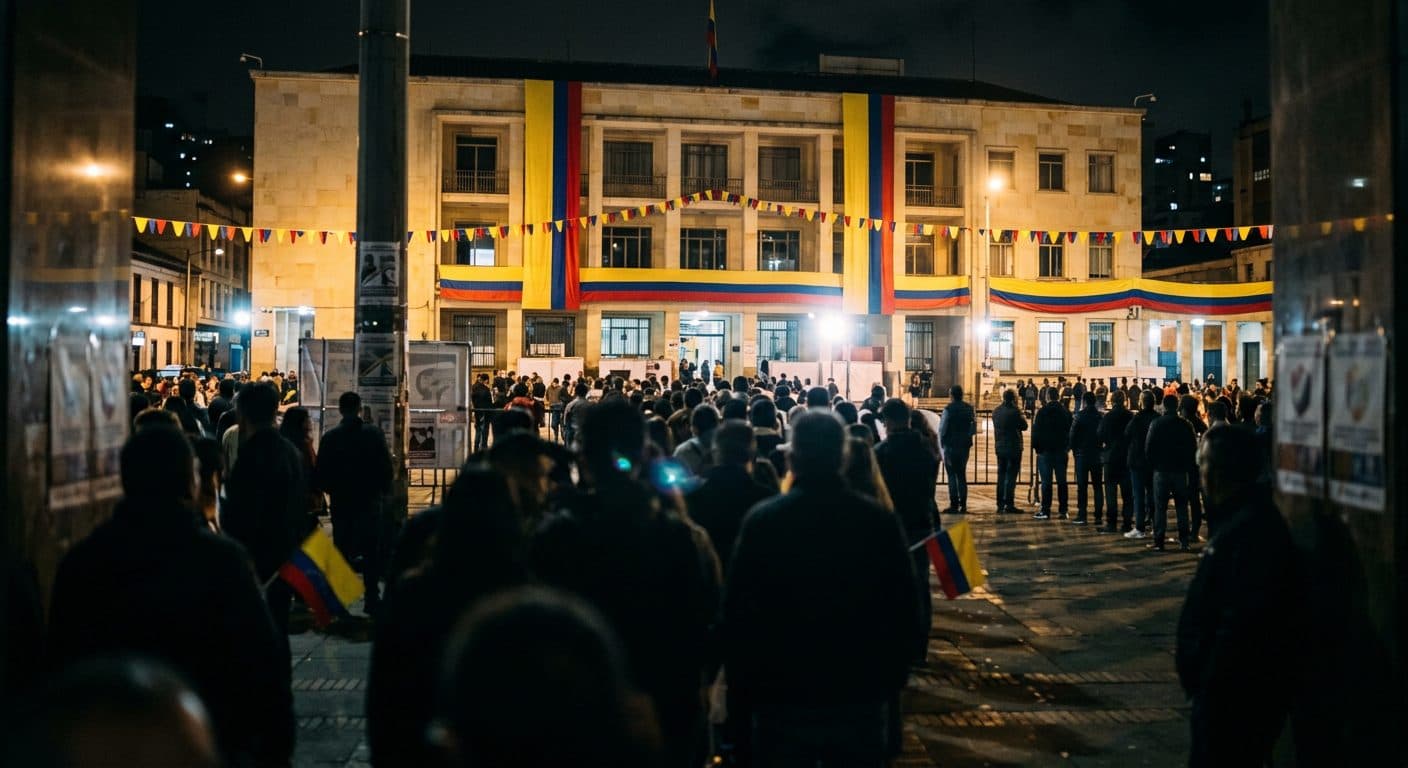
AI-generated image (google/gemini-3.1-flash-image-preview via OpenRouter)
Summary
Right-wing newcomer Abelardo de la Espriella has won Colombia's presidential runoff with roughly 50 percent of the vote, narrowly defeating left-wing senator Iván Cepeda. Cepeda's team said it would challenge results from more than 30,000 polling stations.
Bogotá, 21 June 2026
Right-wing political newcomer Abelardo de la Espriella has won Colombia's presidential runoff election, defeating left-wing senator Iván Cepeda by a margin of roughly 370,000 votes after nearly all ballots were counted, the national electoral authority said.
The national electoral authority reported that de la Espriella, a 47-year-old lawyer and businessman, secured around 49.7 to 50.1 percent of valid votes once nearly 95 percent of polling stations had reported, while Cepeda trailed with 48.4 to 48.7 percent. Approximately 400,000 voters cast blank ballots in what analysts typically interpret as a protest vote, underscoring the polarised mood in the country of around 41 million eligible voters.
Polls closed at 16:00 local time on Sunday (23:00 CEST), capping a runoff that had been preceded by an inconclusive first round three weeks earlier in which de la Espriella had unexpectedly placed first with about 43.7 percent, against Cepeda's 4.9 percent. The lopsided first-round figure reflected a fragmented field, but the runoff reduced the choice to a binary contest between continuity of the leftist project and a sharp rightward turn.
Background: From fragmented first round to runoff
De la Espriella styled himself as a political outsider with no prior elected office and the backing of U.S. President Donald Trump. He campaigned on tax cuts, deregulation, expanded oil and gas development, a reduction of the state apparatus by up to 40 percent, and the construction of large new prisons. On security, he pledged a hardline military response to armed groups, including aerial bombardment of guerrilla positions linked to drug trafficking.
Speaking to supporters after partial results emerged, de la Espriella declared: "Heute findet die wichtigste Wahl in der Geschichte" des Landes statt. He added: "Wenn wir den Sieg errungen haben, werden wir für das ganze Land regieren und nicht nur für einen bestimmten Sektor," as supporters chanted "Das Volk steht hinter dir."
De la Espriella's platform
Cepeda, a 63-year-old senator and longtime ally of outgoing President Gustavo Petro, had campaigned on continuing Petro's social agenda and his policy of dialogue with armed groups known as "total peace." Cepeda had pledged to maintain the 23 percent minimum-wage increase introduced under Petro and other popular social programmes, and framed his candidacy as a defence of those gains.
Trump had publicly endorsed de la Espriella during the campaign, offering his "vollständige und totale Unterstützung" and warning of consequences for U.S.-Colombian relations should "radikal-linken Marxisten" Cepeda win. De la Espriella holds dual Colombian and U.S. citizenship.
U.S. backing and dual citizenship
Speaking to AFP, de la Espriella said he would order the military to launch a 90-day offensive involving bombardments and the fumigation of coca plantations. He also said he would pursue insurgent groups with military force, distinguishing his security platform sharply from Cepeda's conciliatory stance.
After results were公布, Cepeda stated that his team would challenge the outcome in more than 30,000 polling stations, signalling a protracted post-electoral dispute. The narrow margin of roughly 1.3 percentage points, combined with the challenge, leaves the final certification of the result uncertain in the short term.
Voters interviewed by international media described a climate of fear and polarisation. "Es gibt viel Spaltung, es gibt viel Aggressivität," said one 30-year-old voter leaving a polling station. Angie Muñoz, a voter in Bogotá, said citizens currently feel "große Unsicherheit," while Jesús Alberto, a 58-year-old merchant voting in the violence-affected southwestern province of Cauca, attributed the anxiety to armed groups that have "deutlich an Stärke gewonnen haben."
Voter mood and political violence
The campaign was shadowed by political violence. In June 2025, right-wing presidential candidate Miguel Uribe was assassinated, an event that intensified fears over security and reshaped the contours of the race. The killing remained a reference point for voters and candidates alike, with both contenders invoking public safety as a central concern.
Economically, the runoff framed a stark choice. Petro's four-year tenure coincided with falling unemployment and a 75 percent cumulative increase in the minimum wage. De la Espriella nonetheless attacked the left's economic record and pledged to shrink government, lower taxes, and lift regulatory burdens on the oil and gas sector, which he described as central to Colombia's prosperity.
Cepeda, a human-rights lawyer and philosopher, had been one of the architects of Petro's "total peace" policy, which sought dialogue with all armed groups. His campaign argued that de la Espriella's militarised approach risked escalation without resolving the underlying drivers of rural violence and coca cultivation.
Cepeda's challenge to the results
De la Espriella, who calls himself "Der Tiger," framed his candidacy as a rupture with the political establishment. His first-round lead had surprised pollsters, who had predicted a tighter contest, and his coalition drew support from voters seeking a tougher line on crime, corruption, and the country's powerful insurgent and paramilitary factions.
The official certification process now moves to electoral authorities and, if Cepeda's challenge proceeds, to tribunals that will examine alleged irregularities in tens of thousands of polling stations. The dispute will test the resilience of Colombia's institutions following a polarised and violence-marked campaign.
What happens next
Internationally, the result carries implications for the bilateral relationship with Washington. Trump's endorsement aligned the U.S. administration with de la Espriella, while Cepeda had signalled continuity with Petro's more diversified foreign partnerships and his emphasis on climate and social policy. Observers will watch whether the incoming government maintains, modifies, or reverses Petro's diplomatic posture.
For ordinary Colombians, the immediate question is whether the narrow margin and the challenge can be resolved without deepening the polarisation that voters themselves described on polling day. The runoff produced not only a victor but also a sizeable protest vote and an opposition preparing a legal fight, all ingredients for a contentious transition of power.
Questions & Answers
Who is Abelardo de la Espriella?
De la Espriella is a 47-year-old Colombian lawyer and businessman who has never held elected office, who holds dual Colombian and U.S. citizenship, and who styled himself as a right-wing political outsider ahead of the 2026 runoff.
Why is Iván Cepeda challenging the results?
Cepeda's team announced it would contest results from more than 30,000 polling stations after the national electoral authority reported he trailed by roughly 370,000 votes with nearly all ballots counted.
What does de la Espriella plan to do on security and the economy?
He has pledged tax cuts, deregulation, expanded oil and gas production, and a reduction of the state apparatus by up to 40 percent, and told AFP he would order a 90-day military offensive with bombardments and coca fumigation against guerrilla groups.