Diver suffers panic attack during night dive in Lake Attersee and is rescued
Steinbach am Attersee, July 5, 2026
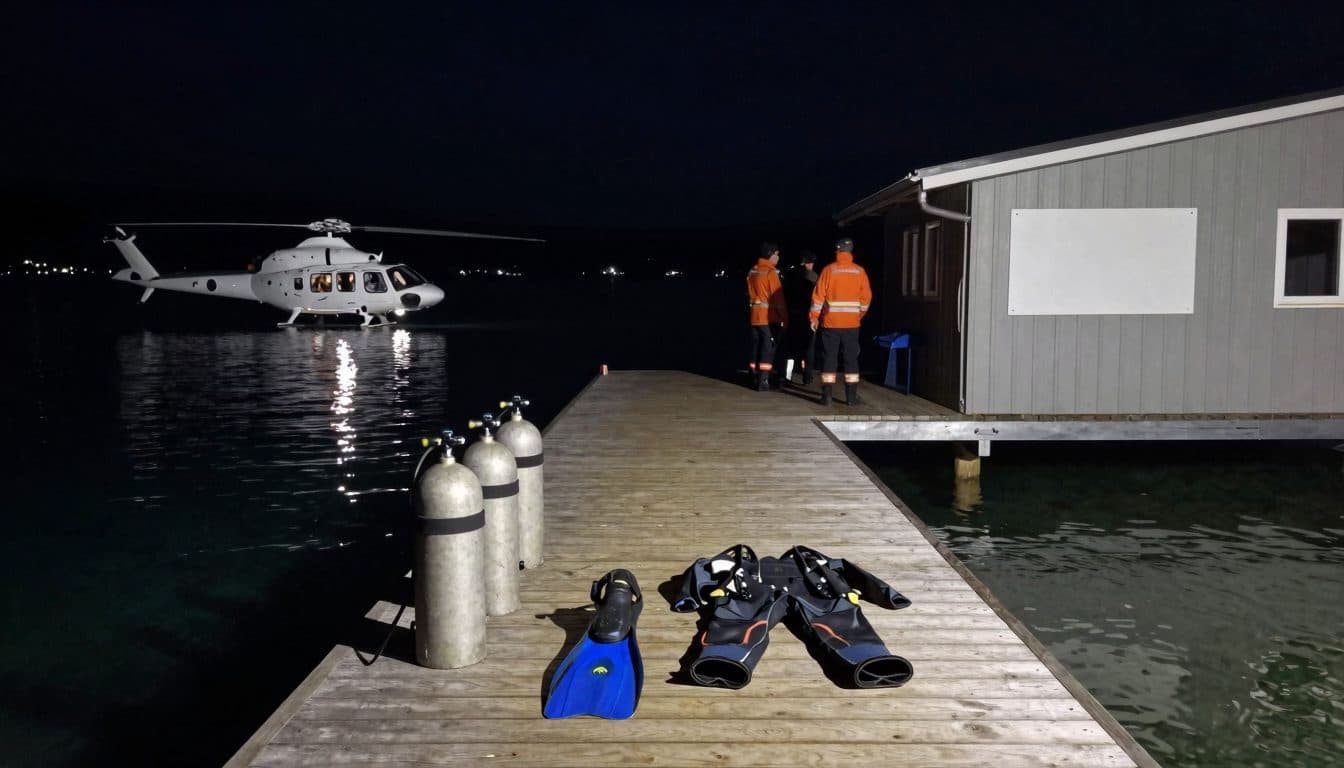
AI-generated image (z-image via Kie.ai)
Summary
A 66-year-old German diver suffered a panic attack during a night dive in Lake Attersee on Saturday and was pulled to the surface from a depth of five meters by her diving instructor and a dive buddy. A Czech doctor who happened to be present provided first aid, after which the woman was transported by rescue helicopter to the hospital in Vöcklabruck.
Steinbach am Attersee, July 5, 2026
A 66-year-old German diver suffered a panic attack during a night dive in Lake Attersee on Saturday evening and was pulled to the surface from a depth of five meters by her diving instructor and a dive buddy.
Underwater at night: Initial situation
As police reported on Sunday morning, the incident occurred in Steinbach am Attersee in the district of Vöcklabruck in Upper Austria. „Eine 66-jährige Taucherin ist am Samstag bei einem Nachttauchgang im Attersee in Panik geraten“, the investigators stated. The trio had at that point already been on their way back from a dive to a depth of 15 meters.
The woman, who according to police is German, signaled to her diving instructor that she wanted to ascend: „Die Deutsche signalisierte ihrem Tauchlehrer noch, dass sie aufsteigen möchte.“ As she increasingly lost control as the panic set in, the diving instructor and another dive buddy intervened. „Der Mann und eine Tauchpartnerin zogen die Frau darum an den beiden Armen an die Wasseroberfläche."
According to the available information, the 66-year-old was properly equipped. „Sie war entsprechend ausgerüstet und trug beim Tauchgang einen Trockenanzug sowie einen Tauchcomputer", the officers explained. According to the assessment of the emergency responders, her regulator is believed to have remained in her mouth throughout the incident: „Sie dürfte ihren Atemregler zwar die ganze Zeit über im Mund gehabt, aber dennoch Wasser in die Lunge bekommen haben."
Help at the pier: Initial measures
After reaching the surface, she „schwamm noch selbstständig zum Steg", as stated in the police report. Upon arriving at the pier, her condition visibly deteriorated: „wo sie sich mehrfach übergab und nach Luft rang." The woman was „die ganze Zeit über bei Bewusstsein", according to the report.
In this critical phase, chance came to the rescue: A Czech doctor who happened to be present noticed the emergency, immediately provided first aid and triggered the subsequent rescue chain. „Eine zufällig anwesende Ärztin aus Tschechien leistete Erste Hilfe und setzte die Rettungskette in Gang", police explained. Before the emergency doctor arrived, the diver received oxygen: „Die 66-Jährige erhielt noch vor Eintreffen des Notarztes Sauerstoff."
After receiving initial medical care, the woman was flown by rescue helicopter to a hospital. „Die Taucherin wurde vom Rettungshubschrauber ins Krankenhaus nach Vöcklabruck gebracht", the emergency services reported. Further details about her health condition and the length of any potential hospital stay were not initially made public.
Transport to the hospital
How exactly the panic attack could have occurred has not yet been conclusively clarified. Even though, according to police, the diver was wearing all safety-relevant equipment and was diving with experienced companions, diving medical experts repeatedly point out that stress reactions can occur suddenly even in experienced recreational divers. The incident highlights the importance of continuous buddy monitoring and immediate medical first aid.
The case is part of a series of diving accidents documented in Austrian waters in recent years. Similar incidents had come to light only recently, in which proper equipment alone was not sufficient to prevent a life-threatening situation. Observers see such events as an indication that even experienced divers carry a residual risk.
Police announced that the incident would be further evaluated as part of their routine inquiries. There were, accordingly, no indications of third-party fault or technical failure of the equipment. Findings on the exact cause of the panic are expected once the investigations have been completed.
Background: Risks of night diving
Lake Attersee is one of the best-known diving areas in the Salzkammergut and is regularly visited by recreational divers from Austria and abroad. Night dives are also a common offering from certified diving schools there. Water temperature and visibility are considered comparatively stable, but can change rapidly in deeper layers and thus create stress situations.
The responsible water rescue service subsequently pointed out that a safety margin from one's own performance limits should always be maintained when diving. In an emergency, adapted ascent protocols and the rapid intervention of dive buddies can save lives – as was also the case in the current incident.
On the day after the incident, the diver's condition stabilized according to information from Vöcklabruck hospital. The treating doctors initially did not release more detailed information out of consideration for the patient's privacy.
The incident has meanwhile sparked debate about safety standards in night diving. Professional associations point out that in darkness, orientation, stress management and communication are required even more than during day dives. The current case is an example of how decisive the presence of a calm, competent dive buddy can become.
Investigations and consequences
Overall, the incident had a fortunate outcome for the 66-year-old. Had the doctor who happened to be present not been on the scene so quickly, the consequences could, in the assessment of rescue workers, have been significantly more severe.
The responsible authorities concluded by emphasizing the good cooperation of all the emergency services involved – from the police to the water rescue service to the rescue helicopter crew – and announced that the incident would be included in their accident statistics in order to draw conclusions for future safety work.
According to the current state of the investigations, the authorities assume that the diver will survive the incident without lasting health damage. A final statement from the treating hospital is expected in the coming days.
Police expressly thanked the doctor who happened to be present for her courageous actions. The diving instructor and the second dive buddy also prevented worse from happening through their prudent behavior.
The incident casts a spotlight on the question of how diving schools will handle high-risk patients in the future. While some schools are calling for stricter medical pre-examinations, others point to the principle of personal responsibility of adult athletes.
Questions & Answers
What exactly happened at Lake Attersee?
A 66-year-old German diver suffered a panic attack on Saturday during a night dive in Lake Attersee and had to be pulled to the surface from a depth of about five meters by her diving instructor and a dive buddy.
Who helped the diver at the pier?
A Czech doctor who happened to be present provided first aid and triggered the rescue chain before the emergency doctor arrived and the woman was given oxygen.
How was the diver treated afterward?
The 66-year-old was taken by rescue helicopter to Vöcklabruck hospital, where, according to police, she remained conscious the entire time.
Panic attack while diving: 66-year-old rescued in Lake | allfacts360