Ebola in DR Congo: over 670 confirmed cases and 136 deaths, outbreak spreads to new health zones
Berlin, 15 June 2026
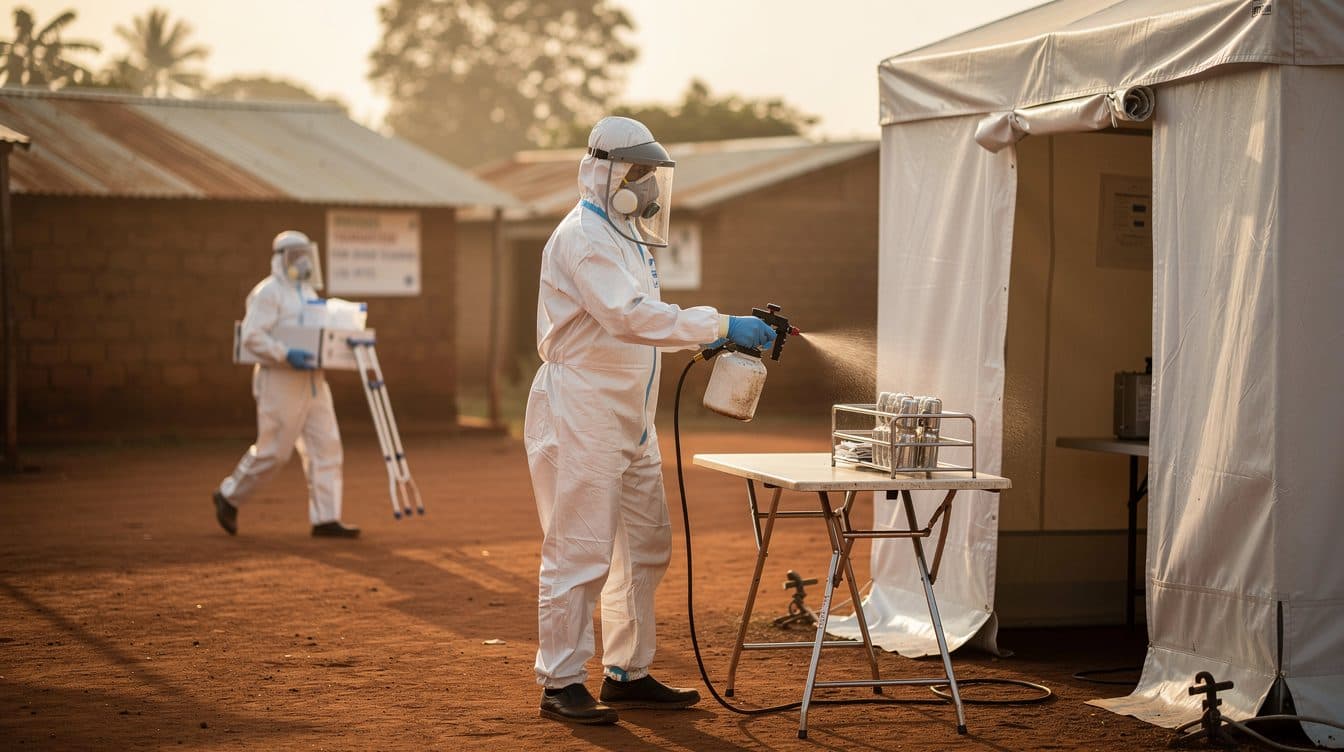
AI-generated image (flux-2/pro-text-to-image via Kie.ai)
Summary
The Ebola outbreak in the Democratic Republic of the Congo has surpassed 670 confirmed cases, with 136 deaths recorded. Health authorities and the WHO report the expansion to new health zones in the provinces of North Kivu, South Kivu, and Ituri, with severe logistical and humanitarian obstacles.
Berlin, 15 June 2026
An Ebola outbreak in the Democratic Republic of the Congo has surpassed 670 confirmed cases, with 136 deaths, and has spread to new health zones in the provinces of Ituri, North Kivu, and South Kivu, according to the Congolese health minister on the platform X and representatives of the World Health Organization (WHO).
What has changed since 12 June
Update of 15 June 2026: since the last summary of 12 June, the official toll of the Ebola outbreak in DR Congo has risen to 676 confirmed cases, including 136 deaths, and the virus has reached three additional health zones in the provinces of North Kivu and Ituri.
The jump in numbers, communicated on Thursday by the World Health Organization, confirms the trend toward geographic expansion that health authorities had feared. "Fast jeden Tag sind neue Gesundheitszonen betroffen", said Olivier le Polain, who works for the WHO in Beni, in the province of North Kivu, to support local authorities. According to le Polain, "Das ganze Ausmaß des Ausbruchs ist noch nicht klar": the full extent of the outbreak is not yet clear.
The figures of the outbreak and the role of health zones
The Congolese health system is organized into over 500 health zones nationwide. A health zone, in the country's system, comprises a network of clinics and a reference hospital serving approximately 100,000-150,000 people. The current outbreak was officially declared about a month ago and is affecting the provinces of Ituri, North Kivu, and South Kivu.
The majority of cases are still concentrated in the province of Ituri, the epicenter of the outbreak. However, according to a government report, the new health zones affected are located in the provinces of North Kivu and Ituri. Although most of the infections recorded in North Kivu and South Kivu involve people coming from Ituri, cases of local transmission in these provinces are now also documented.
Bundibugyo: a virus with no vaccine or specific therapy
One element complicating the health response is the current absence of a vaccine or specific therapy for the Bundibugyo virus, a relative of the Ebola virus. This scientific gap makes containing the chain of transmission even more urgent, but the activities of armed groups and militias in the territory, along with ongoing fighting and the large number of displaced people, are hampering interventions, le Polain explained.
The United Nations Children's Fund (Unicef) has raised an alarm about the indirect consequences of the outbreak. The organization has warned that numerous families, for fear of contagion in clinics, are giving up routine visits or taking their sick children to the doctor. "Die Gefahr sei, dass mehr Kinder sterben" — the concrete risk, according to Unicef, is that a greater number of children will die due to the avoidance of health facilities.
Unicef's alarm: children at risk due to fear of clinics
The nutritional situation in the province of Ituri further worsens the picture. According to data reported in the article, more than half of children under five in the province of Ituri are undernourished, a factor that increases vulnerability to infections and complicates the care of young patients.
The DR Congo has a history of devastating Ebola outbreaks. The country has already faced several waves, including the second largest in the world between 2018 and 2020, which caused more than 2,200 deaths. The memory of that outbreak, the second largest globally, weighs on current response strategies, even though the virus responsible — Bundibugyo — presents significant differences.
A health system already weakened and hampered by conflicts
The Congolese health system, already weakened before the outbreak, is now under additional pressure due to the current flare-up. Local health facilities, lacking adequate resources, are struggling to cope with both Ebola cases and the usual demand for basic care. The combination of fragile infrastructure, insecurity, and mass displacement makes it extremely difficult to reach affected communities, le Polain stressed.
The case and death data were released by the health minister on the platform X and subsequently taken up by the WHO and international media. The real-time transmission of information by the ministry represents an element of transparency, but does not solve the operational problems on the ground.
Humanitarian organizations and the WHO are attempting to strengthen epidemiological surveillance and identify contacts of confirmed cases. However, in areas affected by fighting, access for health workers is severely limited, and the displaced population moves frequently, making contact tracing more difficult.
The weight of memory: the 2018-2020 outbreak
The news of 12 June 2026, disseminated by the Deutschlandfunk program, picked up the figures and testimonies of le Polain, helping to draw international attention to an outbreak that, outside Central Africa, risks going unnoticed despite its severity.
Experts stress that the current flare-up, while not yet comparable in size to that of 2018-2020, presents worrying signs: the rapid succession of new health zones involved, the absence of a targeted vaccine, and the logistical difficulties linked to the conflict context. Every day that passes without effective containment, le Polain warned, increases the risk of further spread.
Congolese authorities and international partners — including WHO, Unicef, and non-governmental organizations in the field — are assessing how to strengthen the response, but the lack of a specific vaccine for the Bundibugyo virus requires a return to classic measures of isolation, contact tracing, and community awareness-raising, in a context where trust in health facilities is being severely tested by the fear of contagion.
The ongoing crisis in the DR Congo fits into a regional picture already marked by other outbreaks of infectious diseases and a prolonged humanitarian crisis. The international community is called upon to support containment efforts, also to prevent the outbreak from spreading beyond national borders, as has happened in the past for other Ebola outbreaks in the Great Lakes region.
Questions & Answers
How many Ebola cases have been confirmed in DR Congo according to the latest update?
According to reports from the WHO and the Congolese health minister on Thursday 11 June 2026, confirmed cases stand at 676, of which 136 have died.
Why does the Bundibugyo virus represent a particular challenge for health authorities?
For Bundibugyo, a relative of the Ebola virus, there is currently neither a vaccine nor a specific therapy, which complicates the containment of the ongoing outbreak.
What are the main obstacles to the health response in DR Congo according to the WHO?
Olivier le Polain, of the WHO in Beni, identifies the main obstacles as ongoing fighting, the high number of displaced people, the activities of armed groups and militias, and the pre-existing weakness of the Congolese health system.
Ebola DR Congo 2026: 676 cases and 136 deaths, what to know | allfacts360