EU Emissions Trading: 2026 Reform – Goals, Criticism | allfacts360
EU Commission Plans to Relax Emissions Trading and Extend Free Allowances Until 2037
Brussels, 17 July 2026
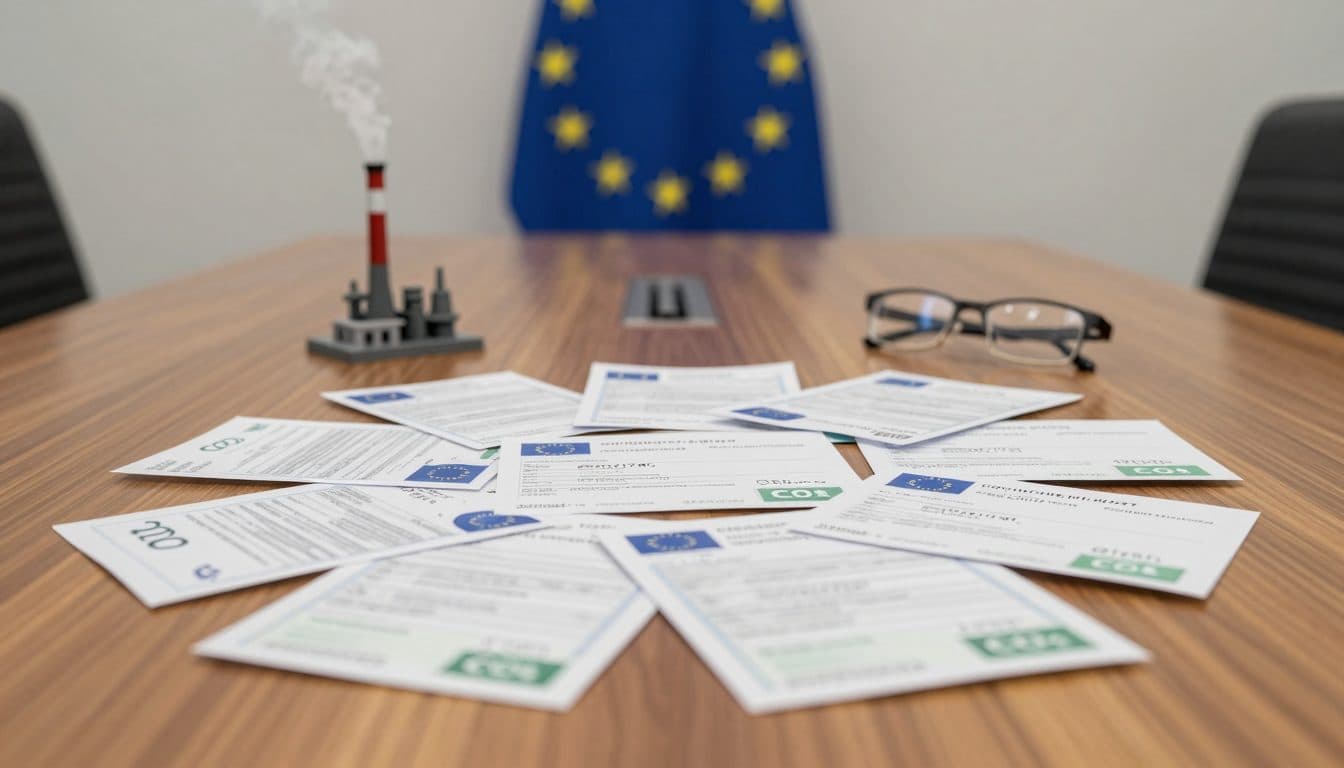
AI-generated image (z-image via Kie.ai)
Summary
The EU Commission proposes to continue the European Emissions Trading System beyond 2039 and to extend free allowances for industry until 2037. In return, companies are to receive more financial support if they make binding investments in climate-friendly processes.
Brussels, 17 July 2026
The EU Commission presented a proposal on 17 July 2026 to relax the European Emissions Trading System (ETS), extend the deadline for free CO2 allowances for industry until 2037, and, in return, more strongly promote investments in climate-friendly processes.
How the EU Emissions Trading System Works
The European Emissions Trading System (ETS) is the EU's most important instrument for reducing greenhouse gas emissions. Since 2005, industrial plants and power stations have had to hold a certificate for every tonne of CO2 they emit. The EU limits the number of allowances placed on the market each year to ensure that carbon dioxide emissions in Europe gradually decline.
The certificates, also known as pollution rights, are traded on energy exchanges. Companies must present enough CO2 allowances each year to cover their emissions. Companies that emit less CO2 can sell their surplus allowances there, while large emitters must purchase additional ones as needed. The CO2 price fluctuates and currently stands at around 80 euros per tonne.
The European Emissions Trading System was previously designed to achieve the EU's climate target for 2040. Accordingly, the number of allowances was to drop to zero by the end of 2039. Since many industrial sectors will not yet have achieved zero emissions by then, emissions trading is now set to continue into the 2040s. It could take until 2046 or 2048 before the affected industries fully offset their CO2 emissions, an EU spokesperson said in Brussels.
Free Allowances for Energy-Intensive Industries
Particularly energy-intensive industries, where international competition is especially intense, receive part of their allowances free of charge. This applies, for example, to the steel and chemical industries. These free allowances have so far been continuously reduced. Originally, the last free allowances were to be issued in 2034.
Regarding free allowances, the EU Commission wants to extend the deadline until 2037 so that the companies concerned do not suffer competitive disadvantages internationally due to costs. In return, companies are to receive more financial support if they make binding investments in climate-friendly processes. In future, however, the allocation is to be tied to investments in moving away from oil and gas.
Planned Use of Revenues
The Commission wants at least half of the money to be earmarked for investments in industry and no longer flow into the general budgets of the member states. According to the Commission, EU emissions trading has generated revenues of over 270 billion euros since 2013, of which roughly three quarters were distributed to the member states. According to the Commission, only around five percent of these funds currently go toward decarbonising the ETS sectors.
Critics such as Italy and Poland argue that this undermines the global competitiveness of industry and are calling for relaxations. The German industry association BDI sees Europe as disadvantaged on the global market due to high energy prices and fears the risk of plant closures and the relocation of production abroad without "course corrections."
Criticism from Politics and Industry
The Greens criticised the Commission's proposals as a setback for climate protection. The climate policy spokesperson of the Greens parliamentary group in the Bundestag, Badum, told the news agency Reuters that softening emissions trading now would punish the front-runners and reward the stragglers.
Others, such as the Swedish steel manufacturer SSAB, continue to want a high ETS price because they have invested heavily in CO2-reducing technologies. Over the past 20 years, CO2 emissions from ETS companies have fallen by roughly half – the system is therefore considered exemplary.
Next Steps in the Legislative Process
The Commission's proposals will now be negotiated in the Council of the 27 EU countries and in the European Parliament. Switzerland's emissions trading system has been linked to that of the EU since 2020. Austrian Chancellor Stocker (ÖVP) had strongly advocated for a continuation beyond 2034.
The EU Commission wants to increase the free allocation to industry through the benchmarks for heat and fuels by 6 billion euros over the period from 2026 to 2030. In future, companies will receive 80 percent of these free allocations if they submit plans for decarbonisation investments, and a further 20 percent after the implementation of these projects.
Adjustment of the Reduction Pathway to 2040
The ETS will be aligned with the EU's emission reduction target of minus 90 percent by 2040 by changing the reduction pathway from 2031 onwards: The annual linear reduction factor for the quantity of CO2 pollution rights is to decrease from 4.4 percent to 3.7 percent from 2031 to 2035, and to 1.7 percent from 2036 onwards. The rate at which it absorbs certificates is to fall from the current 24 percent to twelve percent after 2030.
In addition, the so-called Market Stability Reserve is to be made more dynamic and adapted to the market, which will be shrinking from 2030 onwards. Up to two percent of international emission certificates are to enable the financing of decarbonisation projects abroad and give European companies breathing room in the 2036–2040 period.
In future, the CO2 price is also to apply to flights to countries outside the EU: According to the EU Commission's wishes, the scope is to be extended from 2029 to a radius of 5,000 kilometres from Frankfurt. This news was broadcast on 18.07.2026 on the Deutschlandfunk programme.
Questions & Answers
What does the EU Commission want to change about emissions trading?
The Commission proposes to continue the ETS beyond 2039, extend the deadline for free allowances for industry until 2037, and, in return, more closely tie investments in climate-friendly processes to financial support.
Why are the proposals meeting with criticism?
The Greens in the Bundestag see them as a step backwards for climate protection, while industry associations such as the BDI are calling for further relaxations to safeguard the competitiveness of European companies.
What happens next with the ETS proposals?
The Commission's proposals will now be negotiated in the Council of the 27 EU countries and in the European Parliament; a final decision is still pending.