EU Foreign Ministers Remain Divided on Israel Sanctions – Power Struggle Between Von der Leyen and Kallas Intensifies
Brussels, July 13, 2026
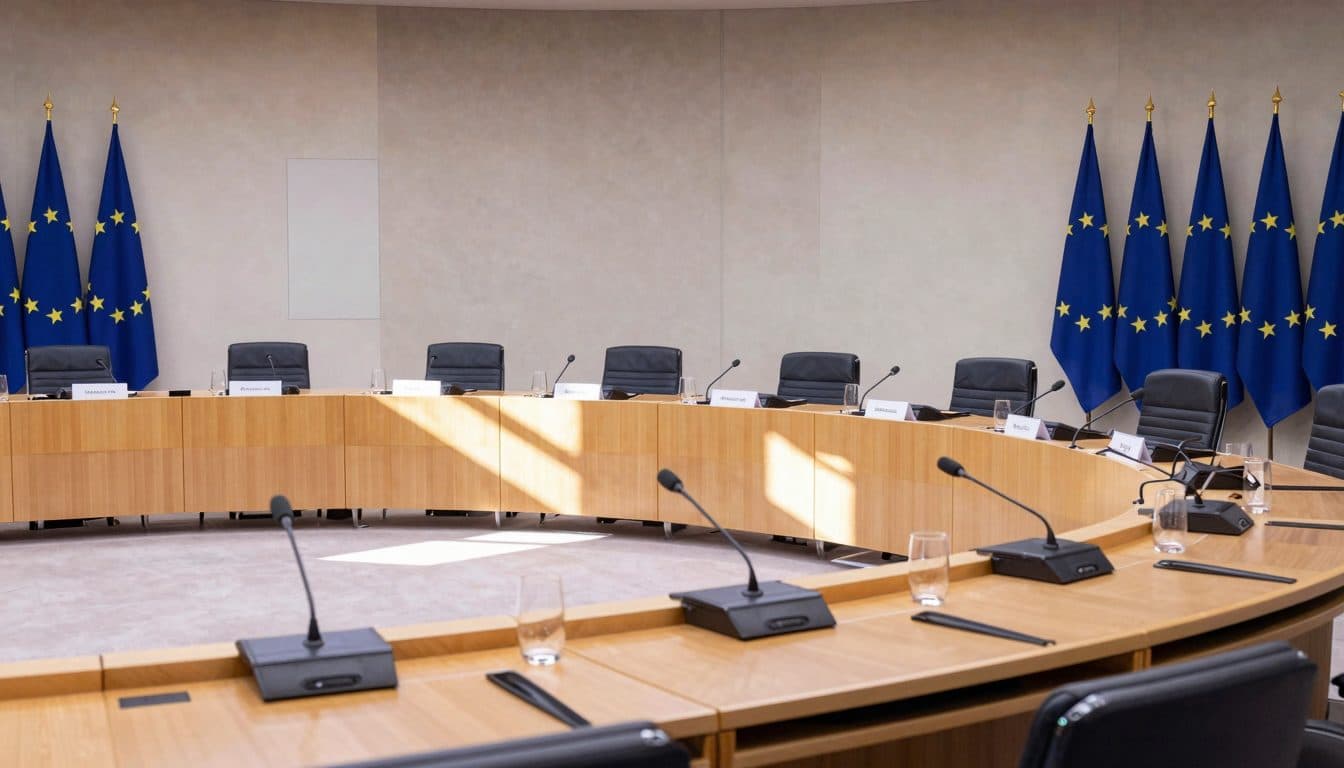
AI-generated image (z-image via Kie.ai)
Summary
At the final foreign ministers' meeting before the summer recess in Brussels, the EU failed to agree on further sanctions against Israel. While a majority of member states favor an import ban on settlement products, Germany and Italy are blocking the move – and the dispute between Ursula von der Leyen and EU foreign policy chief Kaja Kallas is intensifying.
Brussels, July 13, 2026
At the meeting of EU foreign ministers in Brussels on Monday, no agreement was reached on further sanctions against Israel, as the power struggle between Ursula von der Leyen and EU foreign policy chief Kaja Kallas over the right approach toward Benjamin Netanyahu intensifies.
No Agreement in Brussels
The foreign ministers of the 27 EU member states gathered in Brussels on Monday for their last session before the summer recess. On the agenda, alongside the situations in Ukraine and the Middle East, were possible sanctions against Israel over the continued expansion of Jewish settlements in the occupied West Bank. As the German Press Agency reported, member states remained clearly divided on the issue. A majority favors a complete import ban on goods from the settlements, but several states – including Germany – reject such a move.
Back in May, the foreign ministers had tasked the EU Commission with drafting proposals for measures against settlement products. The Commission subsequently presented an options paper with three variants: a licensing system for trade, a complete import ban, and high tariffs that would effectively amount to a ban. The body adopted no concrete decisions. EU foreign policy chief Kaja Kallas had presented only an options paper before the deliberations, not a finished proposal. Ahead of the meeting, she said all parties agreed "dass die Situation im Westjordanland untragbar ist".
After the session, Kallas stated that a majority of EU states preferred the option of completely halting trade with Israeli settlements. She insists on a qualified majority – a position she bases on the legal service of the EU Council. The dispute over the majority requirements forms the core of the conflict: in EU trade policy, a qualified majority of member states suffices; in foreign policy, however, unanimity is required. A qualified majority in the EU Council requires the approval of 15 of the 27 member states, representing at least 65 percent of the EU population.
Dispute Over Majority Requirements
According to sources from Brussels, the EU Commission's position paper indicates that it considers unanimity necessary – thereby effectively siding against Kallas. Commentators interpret this approach as a sign of a renewed power struggle between Commission President von der Leyen and the EU foreign policy chief. The Commission, whose President Ursula von der Leyen has repeatedly drawn attention through her closeness to Israel, had – according to Belgium's account – given the impression "dass die Kommission die Sache in die Länge ziehe wolle", as Belgian Foreign Minister Maxime Prévot criticized.
Johann Wadephul, a CDU politician, made clear in Brussels on Monday that the German federal government stands by the position of addressing criticism of Israel through dialogue and refraining from punitive measures. Wadephul said the settlement policy contradicts international law. At the same time, he counted on "effektive Gespräche" with the Israeli government. During his most recent visit to Tel Aviv, he had made it clear to the Israeli government that Germany expected decisive action by the Israeli government against violent settlers.
Germany and Italy Act as Brakes
Italy's [foreign minister] stated that he was not fundamentally opposed to economic sanctions, but that such steps should only be decided unanimously, given that it was a sensitive foreign policy matter. Germany, together with other states, also makes a trade halt unrealistic in the near future, insofar as unanimity is required. According to delegation circles, some member states also fear that sanctions could strengthen extremist forces such as the party of Itamar Ben Gvir.
France, Spain, Sweden, the Netherlands and Ireland, on the other hand, are pushing for the most far-reaching measures possible. Spain, Ireland and the Netherlands have already imposed their own restrictions on dealings with Israeli settlers. Austria's Beate Meinl-Reisinger explained that Austria advocates going further. The EU has already imposed sanctions. The growing radicalism of Israeli settlers as well as the illegal settlements are "absolut inakzeptabel", said Meinl-Reisinger. The developments were making a two-state solution to the Israeli-Palestinian conflict de facto increasingly impossible.
Background: Settlement Expansion and ICJ Ruling
Luxembourg's Xavier Bettel sharply criticized waiting for a change of government in Israel: "Wollen wir wirklich warten, bis die Regierung wechselt, um endlich eine Entscheidung treffen zu können? Ich finde das ein wenig beschämend." According to Bettel, this was already the 100th time they had discussed how to put pressure on Israel. The Netanyahu government, which is partly far-right and pushes for annexations, is being boycotted by EU foreign policy chief Kallas due to her Israel-critical stance.
The discussion revolves around a concrete economic figure: around 28 percent of all Israeli exports go to the EU annually – making the EU Israel's most important trading partner. Critics point out, however, that the proposed trade measures would affect only a fraction of EU-Israel trade and could be circumvented through re-declaring or mixing Israeli products with settlement goods. In Israel, there is no separate labeling for products from the West Bank or the Golan Heights; for example, the majority of organic eggs sold in Israel come from a single settlement in the West Bank.
The background to the debate is the expansion of settlements under Netanyahu's right-religious government. Israel has occupied the West Bank and East Jerusalem since 1967; today more than 700,000 Israeli settlers live there alongside some three million Palestinians. The largest settlements have meanwhile become cities. The International Court of Justice in The Hague declared settlement construction unlawful two years ago and called on Israel to "sofort jede neue Siedlungsaktivität zu beenden und alle Siedler aus den besetzten palästinensischen Gebieten abzusiedeln". Israeli media are increasingly using the term "jüdischer Terror" for the violence of radical settlers. The violence of radical Israeli settlers against Palestinians and their property in the occupied West Bank has increased significantly since the Hamas massacre of October 7, 2023 and the subsequent Gaza war. In addition, there are ongoing attacks by Jewish extremists on the Palestinian civilian population.
Economic Leverage and Limits
The EU imposed sanctions against violent settlers and their organizations more than two months ago – but these measures are considered largely symbolic. Advocates of further sanctions argue that no unanimous decision is required, but only a qualified majority. They view sanctions as a purely trade measure and not as a foreign policy act. The legal service of the EU Council supports this reading, as Kallas explained citing the opinion.
The next official meeting of EU foreign ministers is not scheduled until early October – right at the peak of the Israeli election campaign. Israel has been called to parliamentary elections in October. Kallas, however, left open the possibility of holding an extraordinary session during the summer recess. She said the ambassadors of the member states had been instructed to advance the issue. German restraint on sanctions against Israel is explained by historical reasons.
Outlook: Summer Recess and Election Campaign
The power struggle between Von der Leyen and Kallas thus enters the next round – again it is about Israel. Observers in Brussels interpret the Commission's position paper as a clear signal that it does not want to deliberately escalate the conflict, while Kallas seeks to increase pressure on Israel. Which side prevails in the coming weeks could also depend on how Berlin positions itself after the summer recess.
(Maria Sterkl from Jerusalem, 13.7.2026)
Questions & Answers
Why was the EU unable to agree on tougher sanctions against Israel?
At the foreign ministers' meeting on July 13, 2026 in Brussels, a majority of member states did speak out in favor of an import ban on products from Israeli settlements, but Germany and Italy, together with other states, blocked the move because they consider unanimity necessary. A trade halt is therefore unrealistic in the near future.
What are Ursula von der Leyen and Kaja Kallas disputing on the Israel issue?
Kaja Kallas demands – supported by the legal service of the EU Council – a qualified majority for trade measures against Israel. The EU Commission under Ursula von der Leyen, by contrast, signals in its position paper that it considers unanimity necessary. The Commission thus stands opposed to the foreign policy chief.
What did the International Court of Justice rule on the settlements?
The International Court of Justice in The Hague declared settlement construction in the occupied Palestinian territories unlawful two years ago and called on Israel to "sofort jede neue Siedlungsaktivität zu beenden und alle Siedler aus den besetzten palästinensischen Gebieten abzusiedeln".
EU Disputes Israel Sanctions: Kallas vs. Von der Leyen | allfacts360