EU introduces flat-rate customs charge on small consignments from third countries
Brussels, 01 July 2026
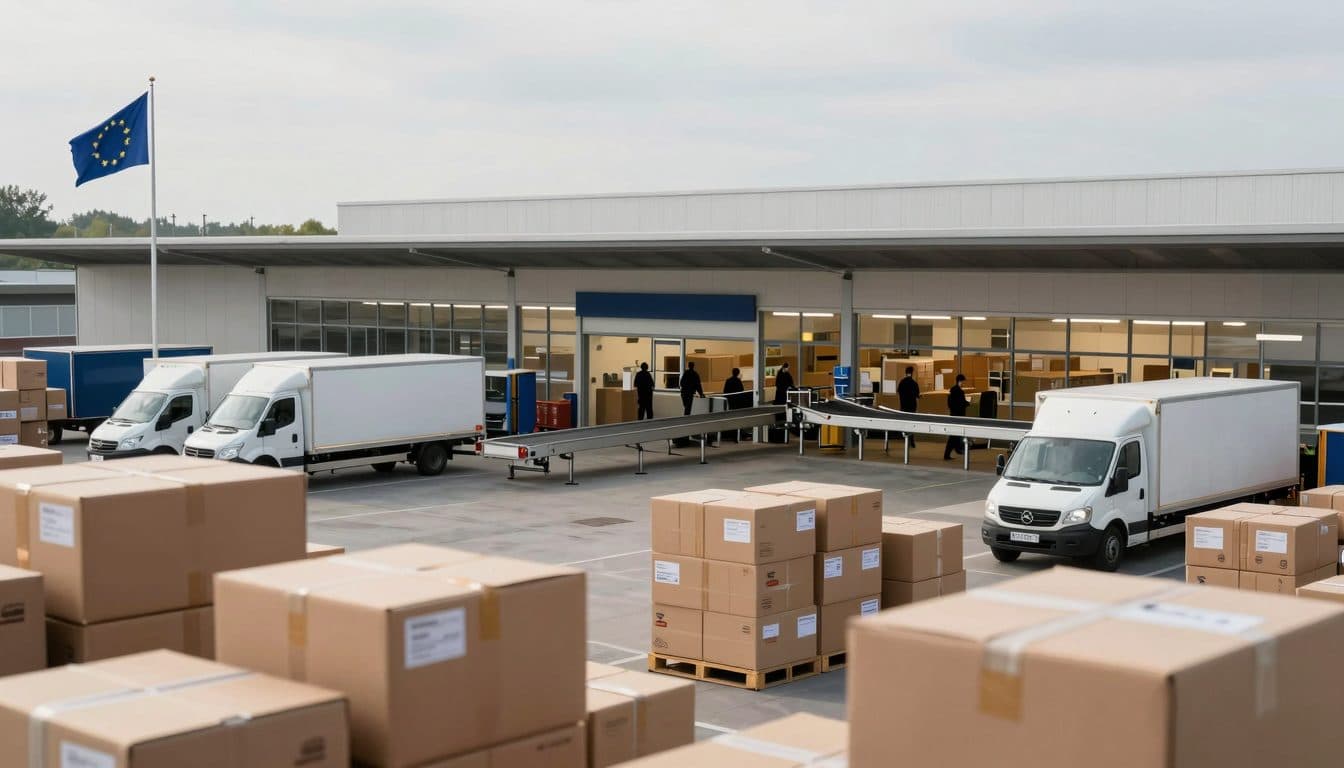
AI-generated image (z-image via Kie.ai)
Summary
The European Union is introducing a new customs duty on parcels from countries outside the EU starting Wednesday: three euros flat per product category in a…
Brussels, 01 July 2026
The European Union is introducing a new customs duty on parcels from countries outside the EU starting Wednesday: three euros flat per product category in a consignment, eliminating the previous duty-free threshold for goods under 150 euros.
Scale of the parcel flood
The EU Commission justifies the move with a flood of parcels that has grown in recent years with the popularity of online retailers such as Shein and Temu, causing problems for customs authorities. "Last year, according to EU Commission figures, 5.9 billion consignments with a value of less than 150 euros each arrived," Brussels said. That amounts to 16 million parcels per day – four times as many as in 2022 (1.39 billion).
In concrete terms, the new regulation means: Until now, an exemption applied to deliveries with a value of less than 150 euros. "This exemption has now been abolished," the Commission announced. "No duty was levied on it" – that changes as of 1 July. For a parcel containing a T-shirt and a hair clip, for example, six euros will be due, "Enthält ein Päckchen ausschließlich mehrere T-Shirts, bleibt die Abgabe bei drei Euro."
Who pays – and how much?
As the EU Commission explains, sellers or importers are responsible for declaring and paying the charge. Retailers can, however, pass the flat-rate customs charge on to consumers. Experts have already noted that prices on online platforms have risen accordingly. "Wir sehen bereits, dass die Preise auf den Plattformen steigen, die Kosten landen also überwiegend bei den Verbraucher:innen," said Karolin Junker de Neui, e-commerce expert at the consultancy Etribes.
The background is the growing popularity in recent years of online retailers such as Shein and Temu. "Billig-Anbieter wie Shein oder Temu boomen: Massenhaft bestellen Kundinnen und Kunden in Europa Produkte aus dem Ausland," describes the German Environmental Aid organisation. Managing director Barbara Metz said the number of parcels being imported into the EU had risen from 1.3 billion to 5.8 billion per year since 2022. "Das ist ein kleiner Schritt in die richtige Richtung, um auch deutlich zu machen, dass wir ein Eindämmen der vielen Pakete brauchen, die hier ankommen."
Logistics industry reaction
At the same time, parcel service providers DHL and Hermes do not expect fewer parcels to be sent to Europe as a result. "Wir haben in den letzen Jahren gesehen, dass diese EU-Zollfreigrenze ausgenutzt wurde," said Ann-Katrin Hamacher of the Federation of German Consumer Organisations. For example, consignments had been split into several small parcels in order to avoid customs duties and inspections. Parcels with a goods value of over 150 euros had also sometimes been mislabelled, so that the companies likewise did not have to pay.
According to the Commission, the flat rate is intended to bridge the period until a new digital platform for processing and control goes live. The flat rate is expected to apply until 1 July 2028. Thereafter, the usual customs rates are to apply depending on goods value, origin and product classification. The whole process is to be supervised by a new EU customs authority based in the French city of Lille. A new central digital platform is planned for 2028, to be used by all 27 national customs authorities in the EU.
Competition and consumer protection
Whether the measure will achieve the desired effect, however, remains uncertain. Katharina Gangl, research director at the Nuremberg Institute for Market Decisions, said in an interview with SWR Aktuell: "Gerade bei kleinen Preisen nehmen wir Preiserhöhungen überproportional wahr." The entire presentation of the discount platforms is designed to sell more than consumers actually want. It remains to be seen how online retailers will respond to the new rules.
Economist Samina Sultan of the German Economic Institute does not believe the flood of parcels can be stopped by customs duties. "Durch den Aufbau von Lagern und Distributionszentren hier in Europa finden natürlich auch Investitionen hierzulande statt," she said. Specifically, large Chinese platforms such as Shein and Temu have already begun building local warehouses and distribution centres in Europe. In doing so, however, they would simultaneously circumvent the new rules – and bring the business onto the European market duty-free.
Transitional arrangement until 2028
Sultan also warned of the consequences for smaller providers: "es wird eben wahrscheinlich so sein, dass man vor allen Dingen kleinere Unternehmen im Ausland trifft, die nicht die Möglichkeit haben, solche Logistikanpassungen vorzunehmen." Sultan is thinking here of companies that offer handicrafts or products in small margins to a limited extent. Alien Mulyk, designated chief executive of the German E-Commerce and Mail Order Association (bevh), also confirmed: "Die Unternehmen haben bereits begonnen, ihre Logistik nach Europa zu holen und fallen durch Einfuhren per Container nicht mehr in den Anwendungsbereich der Abgabe."
For consumers, the change means, above all, paying more attention when ordering. Under the Import One-Stop-Shop (IOSS) procedure, in which most major platforms participate, import sales tax is often already included in the purchase price. "Nichtkommerzielle Geschenksendungen aus Nicht-EU-Staaten mit einem Warenwert von bis zu 45 Euro sind zollfrei," the EU Commission explains. The prerequisite, however, is that the parcel is clearly labelled as a gift shipment – otherwise the recipient may end up paying customs duties and a service fee upon delivery.
Consumers should also prepare for longer waiting times. A spokesperson for Germany's parcel market leader DHL expects 85 to 90 percent of parcels coming from non-EU countries to be pre-cleared via two different systems and delivered normally. For 10 to 15 percent of these parcels, this will not be the case – here DHL will initially assume liability and pay taxes and fees. To do so, the recipient must pay a flat rate of 7.50 euros at the door, plus the taxes and fees paid in advance.
What consumers should watch out for
Deutsche Post, for example, charges a service fee of 7.50 euros for this. In addition, the import sales tax may apply, corresponding to the German value-added tax rate of seven or 19 percent. The EU Commission points out that the German Price Indication Regulation applies to all online marketplaces aimed at German consumers: all prices must be quoted inclusive of tax and fees.
German customs recommends that consumers, before placing an order with a non-EU country, check the seller's terms and conditions to see whether the flat-rate customs charge is already included in the sales price or whether customs clearance is intended to be handled by the buyer. Customs offers a duty calculator for this purpose. Hints about the shipping location can often be found in the shipping information, in the general terms and conditions, or in the ordering process, explains the European Consumer Centre Germany. Unusually long delivery times may also be an indication that the goods are not coming from the EU.
The new customs requirements are intended to level the playing field – European providers are subject to stricter requirements in some areas, including labour law, hazardous-substance protection and technical standards. MEP Anna Cavazzini (Greens), who has observed the work of customs at major European ports such as Antwerp and Rotterdam, said: "Die Beamten sind total überlastet und können einfach nicht mehr gewährleisten, dass gescheit kontrolliert wird." The new platform is intended to make it easier to "die schwarzen Schafe können endlich leichter und gezielter entdeckt werden".
At the end of May, the European Commission had already imposed a 200-million-euro fine on Temu – the reason: the platform is not doing enough to combat illegal products on its site. Temu has until the end of August to respond to the allegations. Shein and Temu did not respond to dpa inquiries. Even when products pass through customs, the risk remains: many products are rated as "toxic" and "dangerous" by Stiftung Warentest, including chargers that can burst into flames or children's clothing containing toxic substances.
In addition to the customs reform, the EU is also planning an additional processing fee for parcels from third countries for November – how high this will be has not yet been decided. How high it will be has not yet been decided. The national customs charge will, however, be paid by the businesses, not by consumers. The FPÖ criticised the regulation as a "massive finanzielle Mehrbelastung", while Austria's Economics and Finance Minister Wolfgang Hattmannsdorfer (ÖVP) and Markus Marterbauer (SPÖ) welcomed the abolition of the duty-free threshold. By November at the latest, however, Marterbauer would have to abolish his national parcel tax, otherwise a lawsuit from Brussels would be looming.
Questions & Answers
What changes as of 1 July 2026 for parcels from non-EU countries?
The previous duty-free threshold for consignments with a value of less than 150 euros is abolished. Instead, a flat-rate customs
EU introduces flat-rate customs charge on small… | allfacts360