EU and China Seek Trade Balance: New Customs Rules and Joint Monitoring
Brussels, 02 July 2026
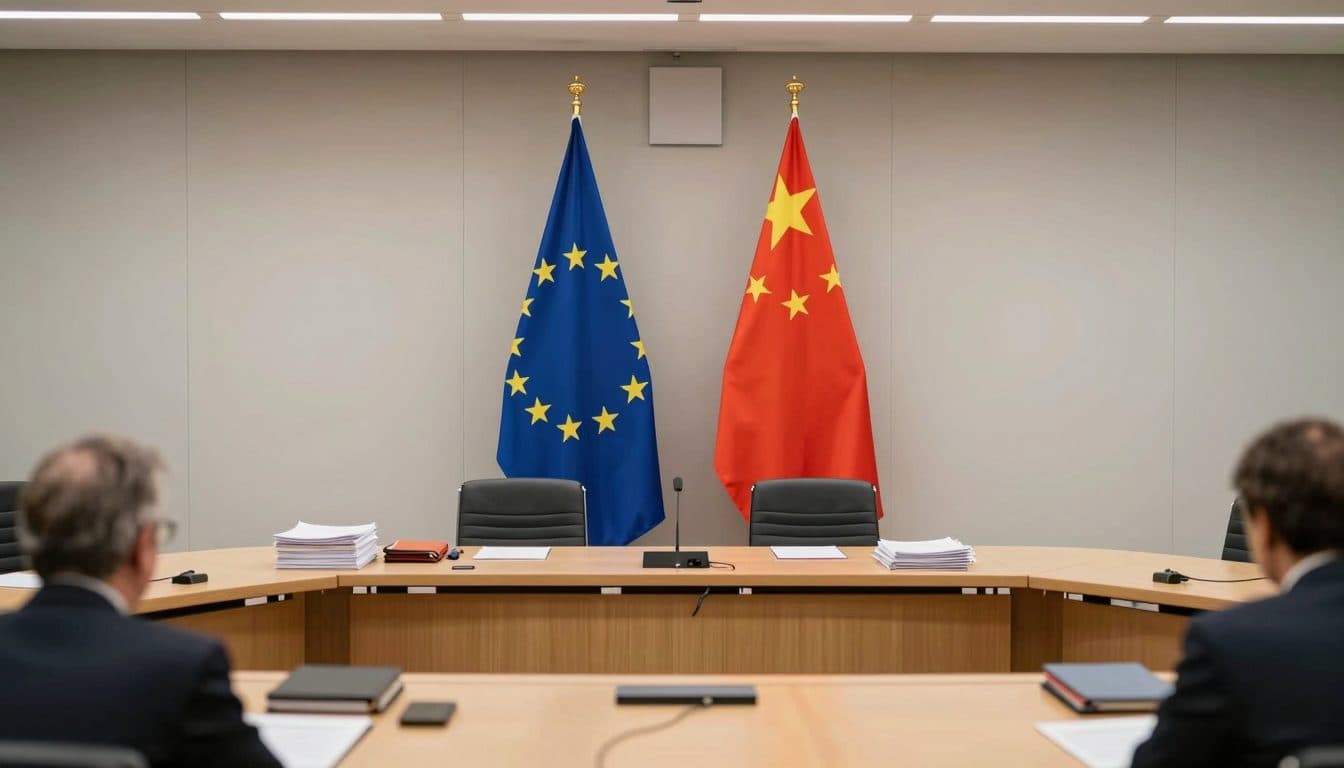
AI-generated image (z-image via Kie.ai)
Summary
The EU is tightening customs rules for cheap Chinese imports and setting up a joint monitoring mechanism for trade flows with Beijing. EU Trade Commissioner Šefčovič and Chinese Trade Minister Wang Wentao also agreed in Brussels on a gradual realignment of economic relations, as the gap between imports and exports continues to widen.
Brussels, 02 July 2026
The EU and China agreed this week in Brussels on a joint monitoring mechanism for their trade flows, while new customs duties on Chinese low-value parcels under 150 euros will take effect from July.
The meeting between EU Trade Commissioner Maroš Šefčovič and Chinese Trade Minister Wang Wentao in Brussels marks a new attempt to stabilize the economic relationship between the two sides, which has been in crisis for years. Šefčovič said after the talks: „Der Status quo ist keine Option... Wir wollen damit beginnen, die Handelsbeziehungen zwischen der EU und China ins Gleichgewicht zu bringen. Die Kluft wird immer größer.“ Both sides agreed to „unverzüglich einen gemeinsamen Mechanismus zur Überwachung der Handelsströme einzurichten, der dazu beitragen soll, das Handelsgleichgewicht herzustellen."
Imbalance in Numbers
The trade balance between the two economic blocs is strongly asymmetric. In 2025, the EU exported goods worth 199.6 billion euros to China and imported goods worth 559.4 billion euros. In the first quarter of 2026 alone, Chinese imports into the EU rose by another four billion compared to the same period the previous year, reaching a total of 145 billion euros. The German trade association HDE estimates the damage caused by the current de minimis regulation — that is, duty-free status for small shipments — at at least 400 million euros per year for the public purse.
The EU is responding, among other measures, with a new flat-rate customs duty: From July, Chinese exporters must pay EU tariffs on private shipments — three euros per product category in a parcel valued at under 150 euros. If a parcel contains three cables and a T-shirt, six euros will be due. The new flat-rate customs charge will initially apply for two years and is intended to bridge the period until a new digital platform for processing and control is launched.
What the New Flat-Rate Customs Duty Means
This flat rate is not the only step. VAT has already been levied on the declared value of goods in such shipments since 2021. Until now, parcels under 150 euros were duty-free because the goods value is low. In 2028, regular customs rates are to apply once the „EU Customs Data Hub" goes live — depending on the value, origin, and classification of the goods. In November 2026, the amount of a processing fee will additionally be set.
Charging cables, clothes, shoes, toys, books: billions of small parcels containing such items are imported from China into the EU. A total of 5.9 billion shipments reached Europe last year, equivalent to 16 million parcels per day — other estimates put the figure at 160 million small parcels from China per day. According to the EU, more than 90 percent of these shipments came from China.
Criticism of Cheap Platforms
HDE President Alexander von Preen criticizes platforms such as Temu and Shein in particular: „Temu und Shein halten sich oft nicht an die rechtlichen und regulatorischen Vorgaben, liefern unsichere Ware in unseren Markt, die mitunter gesundheitsgefährdend ist, und bringen viele heimische Händler an den Rand des Ruins." His association estimates that this unfair competition would eliminate more than 40,000 jobs in Germany, including 28,300 in retail alone.
Switzerland is also affected, even though it is not part of the EU. The new duty also applies to parcels from Switzerland valued at under 150 euros — after all, Switzerland is not part of the EU. Anyone in Switzerland running an online shop whose shipments to the EU fall under the new duty can find out about the procedure from the post office. The shop can either absorb the customs fee itself or pass it on to customers in the EU. There is no change, however, for orders placed from Switzerland at European online shops. After all, the EU does not want to curb exports from the EU, but rather the import of cheap goods into the Union.
Further Protective Instruments: IAA and Cyber Security Act
In addition to the customs rules, the EU is expanding other protective instruments. In early March 2026, the Commission presented the draft of an Industrial Accelerator Act, or IAA for short. In joint ventures in strategic areas such as photovoltaics and electric cars, for example, investors from the Far East may hold a maximum of 49 percent of the shares — this requires official approval. Effectively, Chinese providers classified as high-risk („High Risk Supplier") are excluded from business in areas such as telecommunications and solar energy under the Cyber Security Act 2 from January 2026.
The German Chamber of Industry and Commerce (DIHK) is critical of this and warns: „Eine Buy-Europe-Politik könnte Handelspartner und Investoren aus Drittländern verprellen." Justyna Szczudlik of the Polish Institute of International Affairs (PISM) also points to the risk of Polish companies being displaced by Chinese competitors. Allegro, the online platform popular in Poland, has since been overtaken by Chinese competitors.
Rare Earths as Leverage
Another point of contention is China's export controls on rare earths and permanent magnets, which China introduced in response to the customs decisions by US President Donald Trump. The US had previously cut off exports of high-performance chips to China, which are used, for example, in artificial intelligence. Chen Lingyan, head of department at the Chinese authority for import and export control, said in mid-June at a round-table discussion with German business in Düsseldorf: „Bisher wurden 90 Prozent der deutschen Anträge stattgegeben." Trade Minister Wang is said to have assured Brussels that the existing export controls would not affect EU supply chains.
Beijing-based Professor Zhao Yongsheng of the University of International Business and Economics views the new monitoring mechanism positively: „Die Etablierung eines Mechanismus zur Überwachung des bilateralen Handels zeigt, dass ab sofort Beratungen bei Handelsstreitigkeiten auf einer strukturierten Plattform stattfinden... Die unmissverständliche Botschaft lautet, EU und China wollen durch Gespräche und Verhandlungen nach Einigungen suchen." Observers assess the step as a cautious rapprochement, but say concrete results must first be awaited.
Questions & Answers
Welche neue Zollregel gilt ab Juli 2026 für Pakete aus China?
Ab Juli 2026 müssen chinesische Exporteure EU-Zölle auf private Sendungen zahlen: drei Euro pro Produktkategorie in einem Paket mit einem Wert von unter 150 Euro. Die Pauschale gilt vorerst für zwei Jahre.
Warum führen die EU und China einen gemeinsamen Überwachungsmechanismus ein?
EU-Handelskommissar Maroš Šefčovič und Chinas Handelsminister Wang Wentao einigten sich in Brüssel darauf, „unverzüglich einen gemeinsamen Mechanismus zur Überwachung der Handelsströme einzurichten, der dazu beitragen soll, das Handelsgleichgewicht herzustellen." Hintergrund ist das wachsende Handelsdefizit der EU gegenüber China.
Welche Auswirkungen hat die neue Regel auf die Schweiz?
Der neue Zoll gilt auch für Pakete aus der Schweiz mit einem Wert unter 150 Euro, weil die Schweiz nicht zur EU gehört. Schweizer Onlinehändler können die Gebühr selbst tragen oder an EU-Kunden weitergeben.
EU-China Trade: New Tariffs on Cheap Parcels & Monitoring | allfacts360