European Parliament Adopts Position on Digital Euro, Paving Way for Trilogue Negotiations
Strasbourg, 09 July 2026
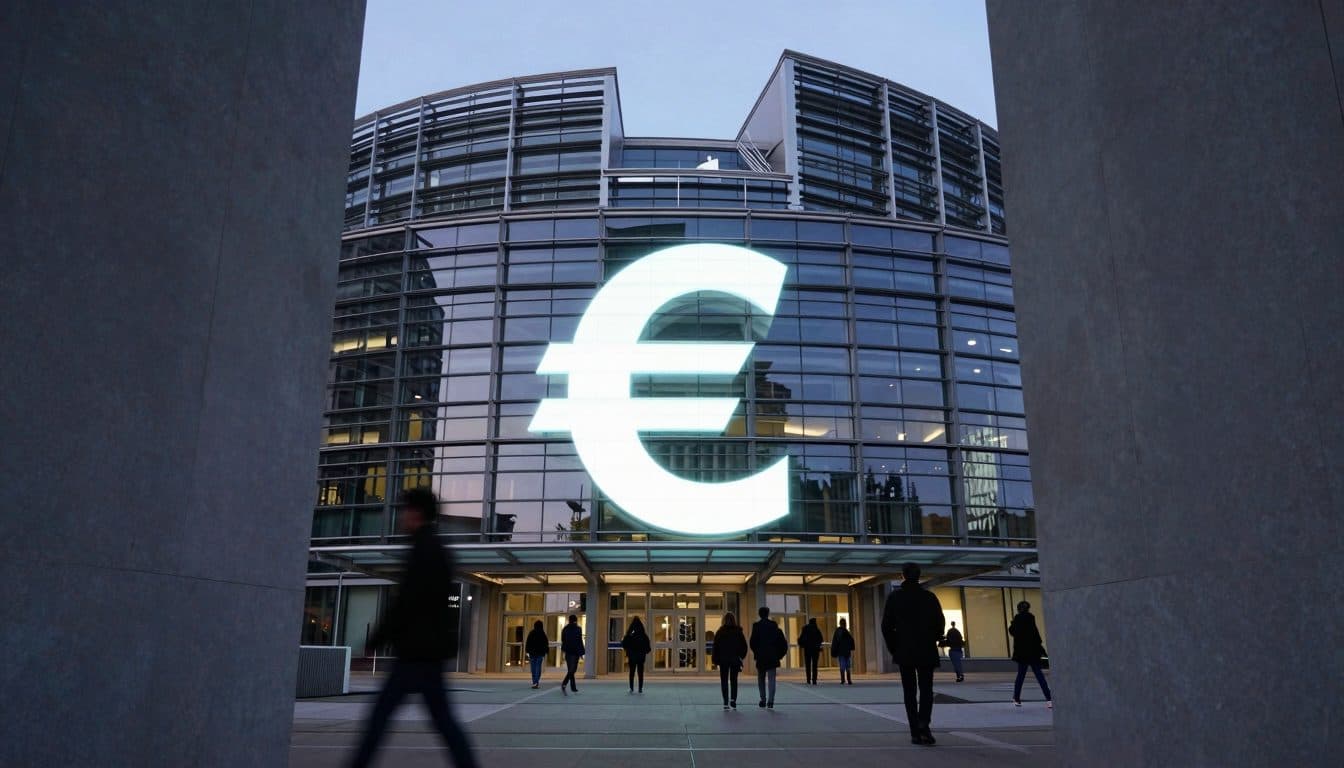
AI-generated image (z-image via Kie.ai)
Summary
The European Parliament in Strasbourg has adopted with a clear majority a parliamentary position on the legal framework for the digital euro. This clears the way for negotiations with the EU member states on the concrete design of the digital cash alternative.
Strasbourg, 09 July 2026
The European Parliament on Tuesday in Strasbourg adopted with 416 votes in favor against 169 votes and 22 abstentions a parliamentary position on the legal framework for the digital euro, on which it must now negotiate with the 27 EU member states.
Background: What It Is About
The vote concludes a years-long preparation in Parliament, during which the rapporteur sought to draw a line between consumer protection, technical feasibility, and the mandate of the European Central Bank (ECB). The draft forms the basis for the so-called trilogue negotiations with the Council of EU member states, in which the final version of the legal framework is to be agreed upon.
The decision is an interim step in a project that the euro-area central banks have been pursuing for years. According to its own information, the ECB is aiming for an introduction of the digital euro in 2029; the launch of a pilot project is planned for 2027, with which the technical infrastructure is to be tested under real conditions.
Data Protection at the Center of the Debate
At the center of the debate was the question of how privacy and the functionality of the new means of payment can be reconciled with each other. The rapporteur championed the concept in plenary: "Niemand wird wissen, wofür wir unser Geld ausgeben", promised Rojas in plenary. This is intended to ensure that transactions with the digital euro cannot be easily traced.
At the same time, she rejected "Gerüchte" that the account-based digital euro would make payment transactions easily monitorable. The chosen technical architecture provides that personal data would not be collected to an extent that would allow conclusions to be drawn about individual purchasing decisions.
Technical Risks and Research
Critics see this as an insufficient guarantee. In a project funded by the Federal Ministry of Research, Technology and Space Affairs titled "Concrete Contracts", scientists favor digital payment systems with double-blind signatures. Such cryptographic procedures are intended to ensure that neither the central bank nor payment service providers can draw conclusions about individual transactions.
Experts see a practical risk in hardware security. "Aber das Problem des Double Spending ist unlösbar." Once cracked via the mobile phone's secure element, digital euros could be copied at will. This reference to a possible vulnerability in storage on end devices ran through the technical debate.
The costs of the project have also long been the subject of criticism. For the alias lookup function alone, with which payment service providers can find the counterparty's bank, up to 55.8 million euros were estimated. This is only one sub-component of the overall architecture.
Costs and Liability Issues
For the development of the offline euro token system being prepared by Giesecke+Devrient, the ECB has budgeted up to 661 million euros. The company is involved in the project as one of the external service providers.
The researchers also note in a study with colleagues from Hamburg, Groningen, and Basel that the costs originally estimated by the central bank at 1.3 billion euros have already been spent on external service providers. This means that funds are committed before the legal and technical basis has even been finalized.
The parliamentary position also contains a determination on the question of liability. For losses arising on the basis of infrastructural weaknesses, according to Recital 60c inserted by Parliament, the central bank would ultimately have to answer. This is intended to ensure that individual private users or small payment service providers are not held liable for systemic failures.
Further Procedure
Despite the open questions, approval in plenary was clear. With 416 votes against 169, Parliament adopted the parliamentary position. 22 members abstained. The result shows broad, if not unified, support for the project.
In the further debate, the rapporteur also pointed to the international dimension. The digital euro is to be a European response to private stablecoins and token-based payment systems, whose spread outside the euro area is increasing rapidly. For this reason as well, a separate legal framework is necessary to underpin the ECB's monetary sovereignty.
Among experts, the assessment remains mixed. The computer scientist Gütschow, for example, said in a conversation with heise online: "Es ist eine schöne Idee". However, he sees significant hurdles in concrete implementation, particularly regarding the tension between data protection and supervisory obligations.
Outlook
The next steps are clearly defined: On Tuesday in Strasbourg, the members adopted a draft for the necessary legal framework, on which they must now negotiate with the 27 EU member states. Only after the conclusion of these trilogue negotiations could the legal framework enter into force.
According to ECB planning, several more years are likely to pass before actual introduction. If the pilot operation in 2027 is successful, the digital euro could be available in 2029 as a complementary means of payment alongside cash and card payments. Until then, technical, legal, and political details still need to be clarified.
One thing is certain: With Tuesday's vote, Parliament has fixed its negotiating position. This marks the beginning of the phase in which the concrete design of the digital euro will be negotiated between Parliament, the Council, and the Commission.
Questions & Answers
What exactly did the European Parliament vote for on 9 July 2026?
The Parliament adopted, with 416 votes against 169 and 22 abstentions, a parliamentary position on the legal framework for the digital euro. This draft forms the basis for negotiations with the 27 EU member states.
What is the digital euro and when is it expected to come?
The digital euro is a digital variant of the common currency, intended to serve as a complementary means of payment alongside cash. According to its own information, the ECB plans a pilot project for 2027 and an introduction for 2029.
What costs have so far been estimated for the project?
The ECB plans up to 661 million euros for the offline euro token system being prepared by Giesecke+Devrient. Already now, 1.3 billion euros are said to have flowed to external service providers.
Digital Euro: European Parliament Votes in Favor of Legal | allfacts360