Federal Cabinet Approves EEG Reform and Grid Package – No More Fixed Feed-in Tariff for Small Rooftop Systems in the Future
Berlin, July 29, 2026
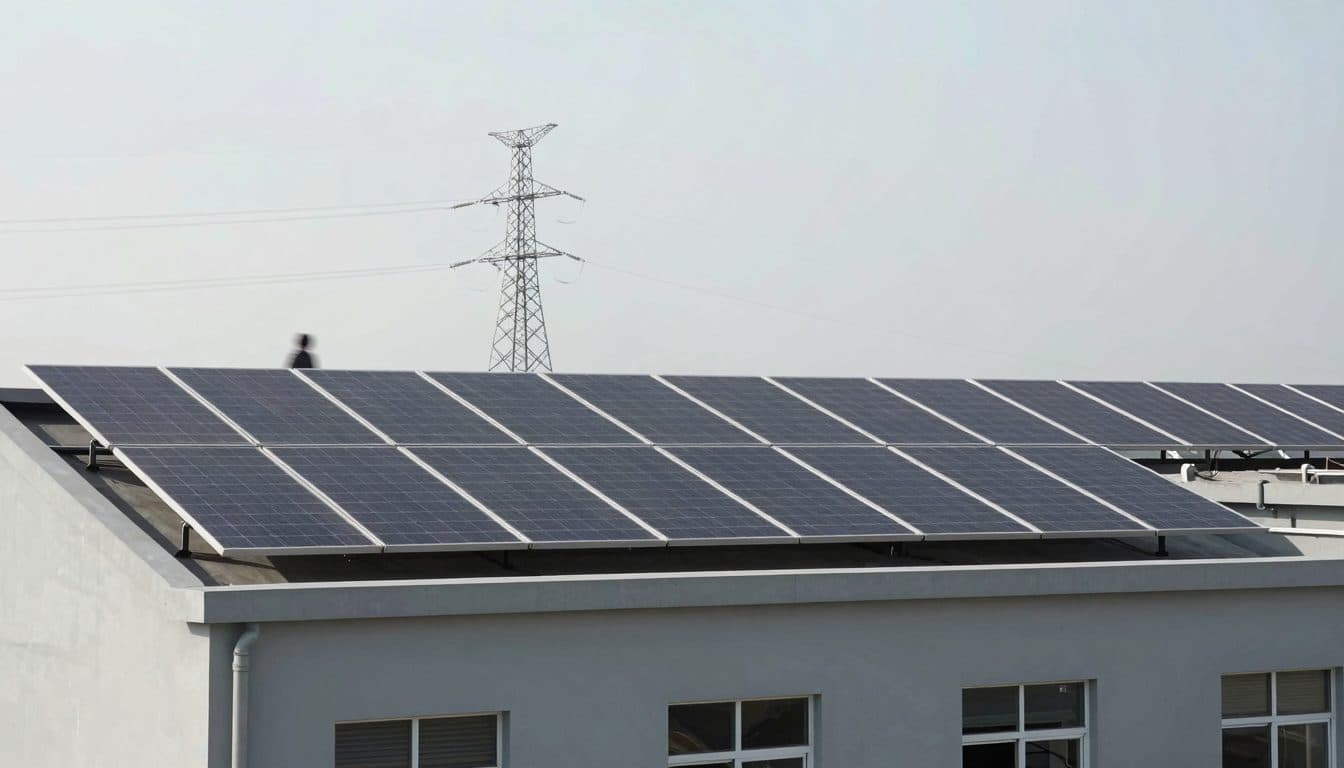
AI-generated image (z-image via Kie.ai)
Summary
The Federal Cabinet has approved the EEG reform and the grid package from Federal Economics Minister Katherina Reiche. Starting in 2027, new small solar systems will no longer receive a fixed feed-in tariff and must market their electricity themselves. The plans are controversial in industry, with associations warning of a collapse in photovoltaic expansion.
Berlin, July 29, 2026
The Federal Cabinet approved on July 29, 2026, the EEG reform and the so-called grid package from Federal Economics Minister Katherina Reiche (CDU), meaning that starting in 2027, among other things, the fixed feed-in tariff for new small solar systems on house roofs will be eliminated.
Agreement After Months of Wrangling
The reform of the Renewable Energy Sources Act (EEG) and the grid package had previously been negotiated for months between the Economics and Environment Ministries. Shortly before the cabinet meeting, Federal Economics Minister Reiche and Federal Environment Minister Carsten Schneider (SPD) agreed on the final details, as Schneider confirmed. With the grid package, the federal government aims to synchronize the expansion of renewable energies with the expansion of the electricity grid.
The core of the EEG reform is the departure from the fixed feed-in tariff for new solar systems under 25 kilowatts of installed capacity. In the future, smaller rooftop systems should no longer receive a guaranteed feed-in tariff and must market their electricity themselves. Until now, the rule has been: anyone who feeds solar electricity into the grid receives a fixed amount per kilowatt-hour for 20 years, which decreases every six months.
End of the Fixed Feed-in Tariff
Reiche justified the step by saying that renewable energies had become "adult" and had to bear more financial responsibility as well as responsibility for the electricity grid. So far, something is being remunerated via EEG support that the taxpayer pays for but cannot actually be used, said the CDU politician. She announced: "We are ending the EEG as an all-round carefree package." Over-subsidization will be abolished; the era of the fixed feed-in tariff at the taxpayer's expense is coming to an end.
For newly commissioned systems, the law provides for a transition period of up to 36 months in which operators will receive a lower transitional payment below the previous feed-in tariff. For typical small rooftop systems, a transitional payment limited to three years is initially planned, which is to be one cent below the then-applicable feed-in tariff of 6.2 cents per kilowatt-hour. From 2030, the transitional payment is to be eliminated entirely. The maximum system size that still receives this payment is to be gradually lowered: in 2027, the limit will be 50 kilowatts; in 2028, 25 kilowatts; and in 2029, below seven kilowatts.
Transition Period and Direct Marketing
After the switch to direct marketing, small systems should be able to claim a "direct marketing bonus" for a further four years; once direct marketing starts, the electricity sold in this way should receive a bonus of 1.5 cents per kilowatt-hour. Reiche also emphasized that small systems combined with a battery and, in the vast majority of cases, also with a connection for an electric car are an investment that pays off after just a few years. This should not be paid for permanently by the general public.
New is also a mandatory direct marketing requirement: households that do not consume the self-generated solar electricity themselves should be obliged to market it on electricity exchanges. In addition, new rooftop systems with less than 100 kilowatts of capacity should in future be allowed to feed at most half of their capacity into the public grid at the same time; the remaining electricity should be consumed or stored in the house as far as possible; otherwise the system will be curtailed. Balcony power plants remain exempt from the new rules; for existing solar systems, the previous rules should fundamentally continue to apply.
The Grid Package: Hot Spots and Redispatch
With the grid package, the federal government is responding to a structural weakness of the German electricity system: in northern Germany there is a lot of wind energy, in the south numerous energy-intensive industrial centers; at the same time, transport over the long distances still overloads the grid. Grid operators can disconnect wind or solar parks from the grid when too much electricity is produced, so that the grid is not overloaded. Until now, they have been financially compensated for this, creating costs that all electricity customers share via grid fees. In the future, new wind and solar systems in regions with overloaded grids should lose part of their compensation when they cannot feed in electricity due to bottlenecks. Grid operators are to designate "hot spots" in which a large portion of generation must be curtailed; in these areas, redispatch compensation is to be eliminated, but a cap on a certain percentage of the system's annual electricity yield is planned.
In the first draft of the new EEG, the Federal Economics Ministry had still planned a so-called redispatch reservation: in designated bottleneck regions, operators of new wind and solar systems would have received no compensation for up to ten years if their systems were curtailed due to overloaded grids. In the revised draft, this rule was weakened: a region should only be able to be declared a bottleneck area in the event of more severe grid bottlenecks; in addition, only a limited portion of annual electricity generation should be allowed to be curtailed without compensation, and in the bottleneck areas a distinction should in future be made specifically between wind and solar systems. The Economics Ministry spoke of an important milestone and a paradigm shift; controversial cutback plans by Reiche were somewhat softened in the process.
EU State Aid Law and Budget
The EU Commission's approval under state aid law for the current support system expires at the end of 2026. The EU Commission must still approve the changes, provided they are adopted. According to the German Association of Energy and Water Industries (BDEW), it is possible that, according to BDEW, legally supported new systems may be commissioned but not yet subsidized if no new regulation is in force by the end of 2026. Reiche had said she did not want to risk an interruption.
In the 2027 federal budget, around 16.5 billion euros are earmarked for the promotion of renewable energies. According to the draft, the expansion targets for wind and solar energy remain in place, but binding annual interim targets are to be eliminated. Instead, it is to be checked each year whether the expansion of wind and solar energy is still on track. Under the current EEG, renewable energies are to cover at least 80 percent of German gross electricity consumption by 2030; the goal is to cover 80 percent of electricity with renewables by 2030. In the first half of 2026, it was already 58 percent; renewable energies covered a record share of 58 percent of German electricity consumption in the first half of the year. More than half of electricity already currently comes from renewable energies.
Industry Welcomes – Associations Warn
Schneider assessed the agreement as a reliable framework for a new phase in the expansion of renewable energies and electricity grids. Especially in light of global crises and trade restrictions, it is important that Germany becomes independent of oil and gas from other countries even faster, said the SPD politician. The draft law states that grid expansion can therefore often not keep pace with the addition of new systems, frequently leading to realization periods of eight to twelve years.
German industry welcomed the plans. "With the EEG amendment and the grid package, the federal government is setting important and long overdue impulses for an efficient and competitive energy system," declared Holger Lösch, Deputy Managing Director of the Federation of German Industries (BDI), on Wednesday. Both projects address key challenges arising from the rapid expansion of renewable energies and rising grid and electricity costs. Wolfgang Große Entrup, Managing Director of the German Chemical Industry Association (VCI), said: "For far too long, it was only about unchecked growth of renewables. The result is high system costs and a significant need for investment in grids and infrastructure. This has saddled Germany as a location with almost the highest electricity costs among industrialized countries."
Research Sees Investment Risks
Criticism came from environmental associations and the opposition. Michael Kellner, energy policy spokesperson for the Greens, told the German Press Agency: "These draft laws are an attack on the successful energy transition in Germany"; wind and solar energy would be slowed rather than accelerated. Ursula Heinen-Esser, President of the German Renewable Energy Federation (BEE), said the plans endangered not only the climate targets of the coalition agreement, but also hundreds of thousands of jobs and regional value creation. The BEE warns that nearly all segments of renewable energies would be burdened and investment decisions in the double-digit billion range would be at stake. The German Solar Industry Association warns of a massive collapse in photovoltaic expansion in Germany if the plans are implemented; the German Wind Energy Association warned of an expansion stop. The German Environmental Aid declared that new hurdles for the expansion of renewable energies were looming. Environmental associations accuse Reiche of slowing down the energy transition.
Scientific voices pointed to the risks of the plans. DIW economist Claudia Kemfert criticized that the consequences of overloaded or too slowly expanded electricity grids are increasingly being shifted onto the operators of wind and solar systems. The electricity system lacks storage, flexible consumers, and intelligent control; existing grid capacities are therefore not optimally utilized in many places. Energy scientist Michael Sterner from OTH Regensburg said the weakening of the redispatch reservation is central because it keeps new wind and solar projects financeable. He called for aligning grid expansion with the pace of renewable energies, and not the other way around: "The turtle must become as fast as the hare – not the hare crawl at a turtle's pace." Without binding monitoring and quantitative pathways,
EEG Reform 2027: Implications for Solar Systems and Grids | allfacts360