Fuel Discount Ends: Price Surcharge Expected at the Pumps
Berlin, June 30, 2026
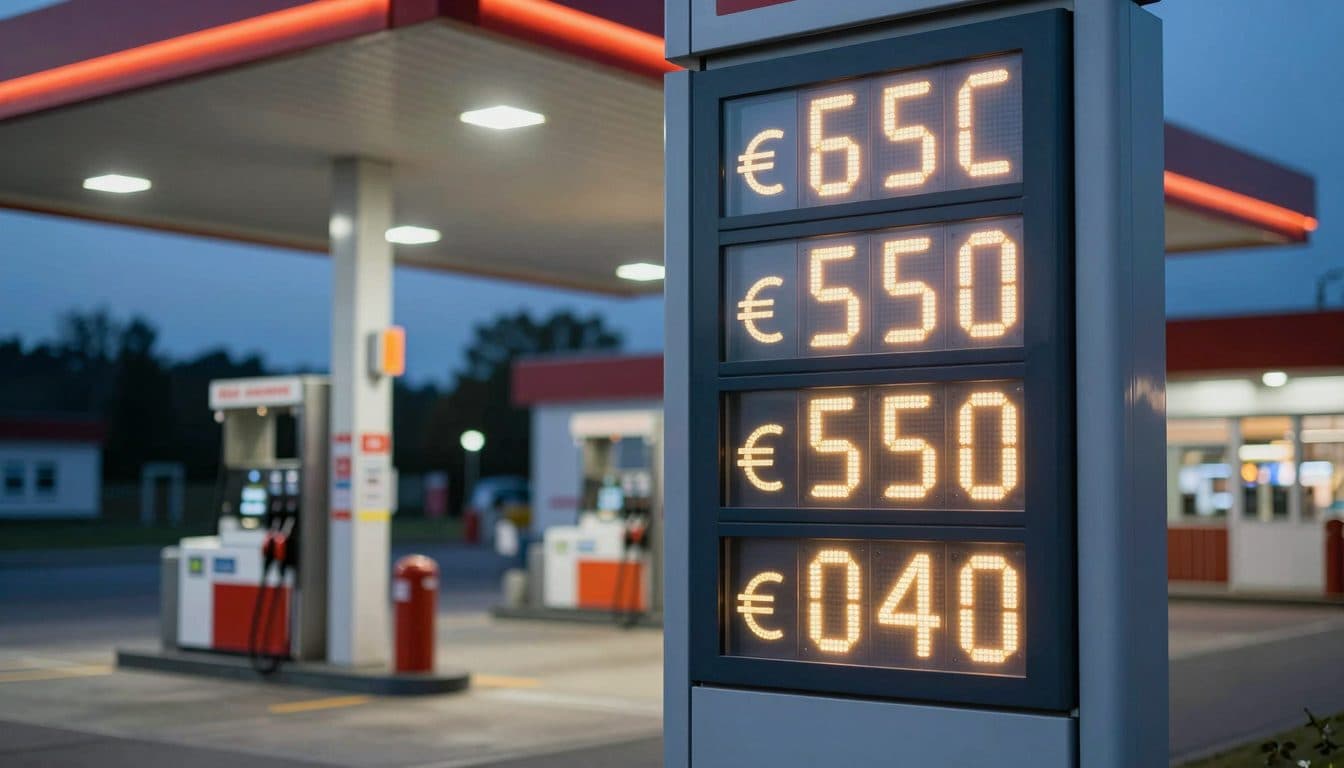
AI-generated image (z-image via Kie.ai)
Summary
The federal government's fuel discount expires at midnight tonight, two months after its launch in early May. Consumer advocates and the Federal Cartel Office are warning the oil companies against excessive price hikes, while the Ifo Institute says only a partial pass-through of the relief occurred for diesel.
Berlin, June 30, 2026
The federal government's fuel discount expires on the night of July 1, 2026, after which fuel at German gas stations will once again be subject to the higher energy tax, and motorists must expect rising prices, according to the Ifo Institute.
Ifo Review: Only Partial Pass-Through
After two months, the temporary reduction of the energy tax on fuels—introduced in early May to cushion the impact of the Iran war on consumers—ends on Wednesday night. For fuel leaving the tank farm or refinery on July 1, the old, higher tax of 16.7 cents per liter including value-added tax will once again apply. The Munich-based Ifo Institute therefore expects rising fuel prices at the pumps at the beginning of July.
In a review, the Ifo Institute calculated that the tax cut of 16.7 cents per liter on diesel was passed on to end customers by an average of only 12 cents. "With that, the fuel discount for premium gasoline was passed on to motorists almost in full," said Florian Neumeier, deputy head of the Ifo Center for Public Finance. For Super E5 and Super E10, the pass-through was nearly complete at 17 and 16 cents per liter respectively, the institute added.
Doctoral researcher Christian Gréus said: "The incomplete pass-through for diesel means that part of it ended up with the oil companies." Ifo based its analysis on a comparison of fuel prices in Germany and France in order to separate the discount effect from normal price movements. How high prices actually rise depends primarily on the development of the oil price, according to the researchers. Since this has recently fallen, fuel prices have also eased, as Ramona Schmid of the Ifo Institute explained.
Warning from Consumer Advocates
Ramona Pop, chair of the Federation of German Consumer Organisations (vzbv), warned the oil industry against excessive price jumps. "The end of the fuel discount must not become the starting signal for extra profits," said Pop. There is no reason for the corporations to raise prices by more than the expired tax relief. The Federal Cartel Office remains obliged to look closely. At the same time, Pop demanded that, given persistently high energy prices, the federal government must finally deliver on its promise and also lower the electricity tax for private households.
Ramona Pop also demanded: "Those who pass on rising crude oil prices immediately must not slam on the brakes when prices fall." That would not only lower costs for consumers, but also make the switch to climate-friendly alternatives more attractive. The consumer centers once again demanded follow-up relief after the fuel discount expires.
Federal Cartel Office Increases Pressure
Andreas Mundt, president of the Federal Cartel Office, warned the gas station industry against unjustified price hikes at the authority's annual press conference in Bonn. Companies must not exploit the situation to implement price increases that cannot be objectively justified. According to Mundt, the Federal Cartel Office has opened proceedings against the owners of all German refineries and issued extensive information requests. It will consistently follow up on relevant indications.
Thanks to a legislative change reversing the burden of proof, the Federal Cartel Office can in future demand that the oil companies disclose their cost structures and justify their prices. "Companies must disclose their cost structures and show that their prices are justified," the authority stated. The deputy chair of the CDU/CSU parliamentary group and chair of the fuel price task force, Sepp Müller, simultaneously announced further tightening of competition law. "At times one must get the impression that there were price-fixing arrangements," said Müller. The Federal Cartel Office as an independent authority is now examining this.
ADAC Demands Further Relief
Müller nevertheless drew a positive balance: "95 percent is not 100 percent. But 95 percent is very good—to stay in school grade terms: that would be an A." However, prices will go up by just under 17 cents because the energy tax is being returned to its normal level. The goal had been an instrument that works quickly—especially for frequent drivers, commuters, outpatient care services, and coach companies. As of now, no further interventions are planned; price developments will continue to be monitored.
The ADAC stated: "Against the backdrop of rather falling crude oil prices, the ADAC sees no reason for sharply rising fuel prices." The automobile club demanded, at the end of the fuel discount, "that price adjustments should not be implemented abruptly on July 1 as long as fuel taxed at the lower rate is still in the tanks." According to the ADAC, the fuel discount saved drivers on net only 20 to 30 euros per motorist. The club called for further relief, such as a reduction of the electricity tax for private households and an increase in the commuting allowance.
ADAC spokesperson Christoph Tietgen explained that, given current oil prices, diesel and gasoline prices should actually be below the two-euro mark. There are sometimes differences of seven cents per liter between neighboring gas stations. E10 is five to six cents cheaper than E5, and almost all cars built from 2010 onward can use E10. On Sunday, the nationwide average daily price for Super E10 stood at 1.845 euros per liter and for diesel at 1.765 euros per liter, according to ADAC data.
Industry Pushes Back Against Criticism
The industry association Fuels und Energie (en2x) rejected the criticism of recent months. Chief executive Christian Küchen stated: "We reject the accusation that the industry charged excessive prices in recent months." The gas station companies in en2x had lowered prices by 17 cents per liter when the fuel discount was introduced; the discount was "consistently passed on to fueling customers in full." "When the energy tax on gasoline and diesel is raised back to its regular level on July 1, we will accordingly see the reverse reaction," en2x said.
The Federal Association of Independent Gas Stations (bft) also questioned the Ifo study. Chief executive Daniel Kaddik said that the Ifo Institute essentially compares the German market with the French one, but the latter is, among other things, "dependent on entirely different raw material markets." bft board chair Carsten Müller announced that prices will rise by the full amount of the expiring fuel discount. Müller sharply criticized the 12 p.m. rule: prices cannot be raised at midnight due to this rule, but raising them at noon on Tuesday is not possible either because the major oil companies fear public criticism.
12 p.m. Rule and Rush on Gas Stations
Because of the 12 p.m. rule, gas stations may only raise prices once per day. Motorists must therefore expect higher prices at the pumps again from Wednesday noon. Kaddik said he expects "today and tomorrow, or rather until 12 noon on the 1st, a run on the gas stations." The gas stations will "not run dry," but stocks at the end of the fuel discount will "already be relatively low." Long queues are expected at gas stations in Schleswig-Holstein especially around midday.
Federal Transport Minister Patrick Schnieder (CDU) told the Rheinische Post: "Studies show that a large part of this relief also reached consumers." He announced: "We will monitor the situation very closely together with the Economics and Finance Ministries and then draw the necessary conclusions and derive targeted steps." Government spokesperson Stefan Kornelius stated: "The tax cuts have largely reached consumers" and had dampened price peaks in a phase of particularly high prices. The Federal Finance Ministry stated: "We are not ruling anything out," should further measures become necessary.
Political Reactions
The black-red coalition factions do not want to extend the 17-cents-per-liter tax relief beyond its planned expiration at the end of June. According to Federal Finance Ministry estimates, the fuel discount cost around 1.6 billion euros. The Ifo Institute considers ending the measure to be the right move. Manuela Schwesig (SPD), Minister President of Mecklenburg-Western Pomerania, called on the Chancellor to speak with the oil companies to ensure gasoline prices do not rise again. She also spoke out in favor of a price cap on the Luxembourg model and a tax reform "that primarily relieves low and middle incomes."
The Monopolies Commission had already determined in mid-June that the fuel discount was passed on to a large extent, but not in full; according to this, the price decline was highest in the northwest and lowest in the south. On June 26, prices in Germany for Super E5 were 17 cents, for Super E10 16 cents, and for diesel 12 cents below comparison values of foreign gas stations without a fuel discount, the Ifo reported on Monday.
The Ifo researchers see the incomplete pass-through for diesel as an indication that the oil companies retained part of the relief. Industry associations such as en2x and bft reject this interpretation and point to their own surveys showing that the discount was passed on in full. How high prices will actually rise on Wednesday depends, in the view of the Ifo Institute, primarily on the oil price.
Consumer advocate Pop announced that she will closely monitor further price developments. Should the corporations raise prices beyond the expired tax relief, the Federation of German Consumer Organisations intends to examine legal steps. The Federal Cartel Office announced it would rigorously follow up on indications of unjustified price increases. As a result, the gas station landscape remains under close scrutiny by competition authorities and consumer advocates even after the end of the fuel discount.
Fuel Discount Ends: Prices Rise from July 1 | allfacts360