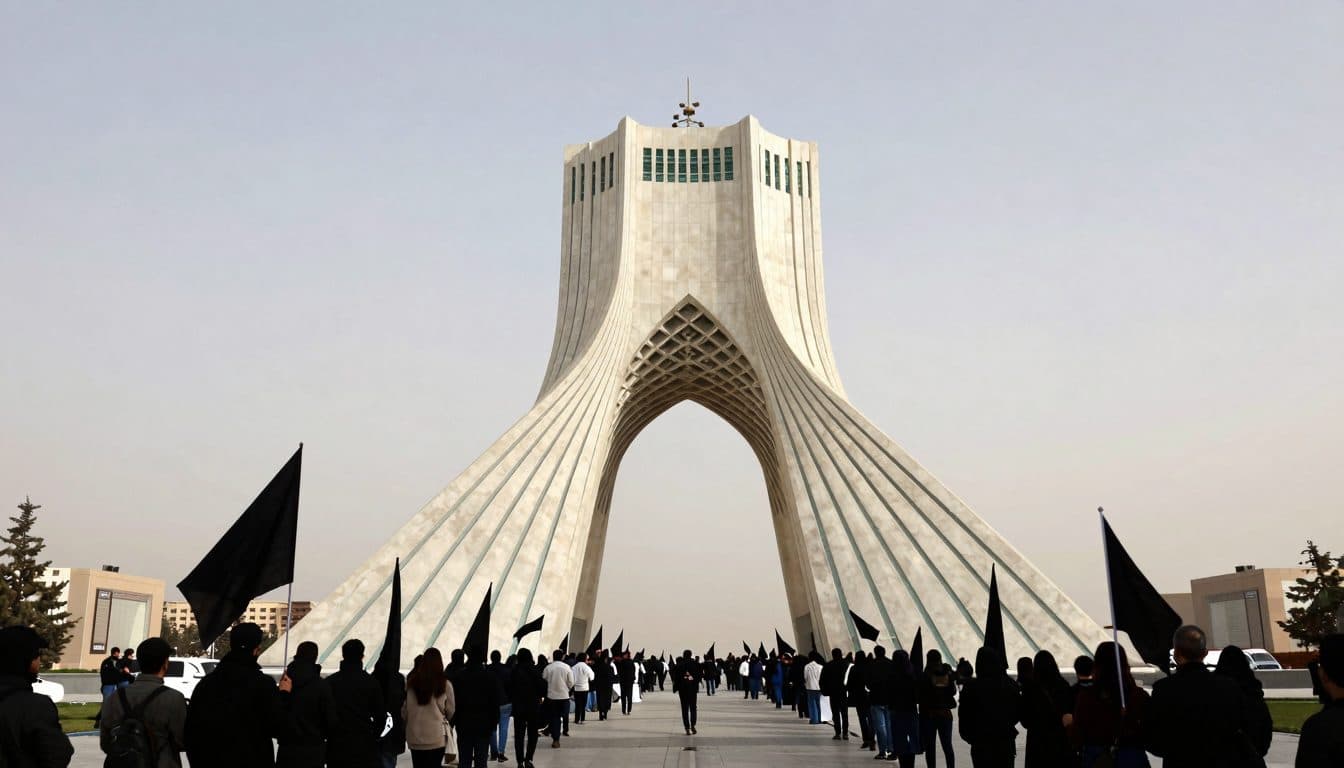
Funeral procession through Tehran: Millions accompany Khamenei on his final journey
Tehran, July 6, 2026
AI-generated image (z-image via Kie.ai)
Summary
Ahead of the burial of the killed Iranian head of state, Ayatollah Ali Khamenei, a funeral procession lasting several hours brought millions of people onto the streets of Tehran. The procession ended at the Azadi Tower in the west of the capital.
Tehran, July 6, 2026
Ahead of the burial of the Iranian head of state Ayatollah Ali Khamenei, who was killed on February 28, a funeral procession lasting several hours and involving millions of participants moved through Tehran on Monday, ending at the Azadi Tower in the west of the capital.
Route and course of the funeral procession
Ahead of the burial of the Iranian head of state Ayatollah Ali Khamenei, who was killed on February 28, a funeral procession lasting several hours and involving millions of participants moved through Tehran on Monday, ending at the Azadi Tower in the west of the capital. According to government information, the procession began far in the east of the capital and led along the central main traffic axis to the Azadi Tower in the west of the city.
Nationwide, large crowds gathered as part of mourning ceremonies. The Iranian leadership had previously announced the route of the funeral procession. In the megacity of Tehran, the coffin was carried through the city.
The general responsible for planning, Hassan Hassanzadeh, had announced on state television that the procession could last up to twelve hours. The funeral procession for the former supreme leader Khamenei, who had been in power since 1989, is considered one of the largest public events in the history of the Islamic Republic.
Airspace closure and logistical preparations
On the day of the procession, Iran closed the airspace over Tehran for security reasons. Temporally and spatially limited flight restrictions also applied on Tuesday and until the mourning ceremony on Thursday, according to government statements. Further ceremonies were planned in the pilgrimage city of Qom and in neighboring Iraq.
In Tehran, according to state information, the 97-year-old Grand Ayatollah Jafar Sobhani assumed the role of prayer leader. In Qom, the influential Ayatollah Makarem Shirazi (99) was to lead the funeral prayer, and in the northeastern hometown of Mashhad, Ayatollah Noori Hamedani (101).
Approximately four months after his killing, Iran's head of state Ayatollah Ali Khamenei was to be buried. Khamenei had been killed on February 28 in an Israeli airstrike on his official residence in the Iranian capital. Subsequently, the United States and Israel waged war against Iran for more than five weeks before representatives of Washington and Tehran agreed to a ceasefire in early April.
Background: Khamenei's death and succession
Khamenei had served as supreme leader since 1989, significantly longer than his predecessor Ruhollah Khomeini, who had founded the Islamic Republic in 1979. His son Mojtaba Khamenei assumed the succession in early March, about a week after his father's death.
Since his appointment, the new supreme leader has not appeared in public, which had triggered speculation about his state of health. According to reports, Mojtaba Khamenei had been at least seriously injured in airstrikes at the end of February. The Iranian regime declared that he was a war invalid, but provided no further details. Khamenei's successor, Mojtaba Khamenei, also continued not to appear publicly.
Speculation surrounding Mojtaba Khamenei
Iranian media reported that the 56-year-old Mojtaba Khamenei would likely not appear as prayer leader at the funeral prayer. It was initially unclear whether he would appear at the mourning ceremony in Mashhad. Mojtaba Khamenei, the son of the killed head of state, had been appointed as the new head of state one week after the death of his father.
At the funeral procession in the capital, significant gaps were also visible across the political spectrum. Leading politicians of the reform-oriented camp, including former presidents Hassan Rouhani and Mohammad Khatami as well as former foreign minister Mohammad Javad Zarif, stayed away from the mourning ceremonies according to reports.
Absence of politicians from the reform camp
Opposition and reform-oriented politicians did not take part, according to reports. Former president Mahmoud Ahmadinejad from the hardliner camp was also absent. Mohammad Ali Abtahi, former vice president, criticized on the platform X that former presidents had not been invited to the mourning ceremonies. He wrote: 'Eine solche Anwesenheit hätte (...) ein Bild der inneren Geschlossenheit und des nationalen Zusammenhalts vor den Augen der Weltöffentlichkeit vermitteln können'.
Khamenei's body was to be buried after the ceremonies in his birthplace Mashhad in northeastern Iran. Before the mourning ceremony in Mashhad, the coffin had already been carried through Tehran. In the megacity of Tehran, the coffin was carried through the city, as the government announced.
The reports about the public image of the mourning ceremonies stand in contrast to the severity of the preceding events. After the killing of Khamenei, the United States and Israel had waged war against Iran for over five weeks before a ceasefire took effect. The scale of the funeral procession on Monday reflected, according to the assessment of state authorities, the mourning of large parts of the Iranian population.
State authorities spoke of a 'Millionenmetropole Teheran' and emphasized the participation of numerous citizens. The news about Khamenei's funeral procession was broadcast on 06.07.2026 on the program Deutschlandfunk; the news agency dpa-AFX was cited as the source of the report.
Planned further ceremonies and burial
Khamenei's burial in Mashhad is to take place approximately four months after his killing, according to the information. Until then, further mourning ceremonies are planned in the pilgrimage city of Qom and in neighboring Iraq. The Iranian leadership described the procession as an expression of national sympathy and unity.
The reporting on the funeral procession took place against the backdrop of ongoing speculation about the state of health of the new head of state Mojtaba Khamenei. Since he had not appeared publicly since his appointment, it remained open to what extent he would participate in the remaining ceremonies. His status as a 'Kriegsversehrter' was also mentioned by state television, without further details being given.
Observers interpreted the reports about the absence of leading politicians from the ranks of the reformists and moderate forces as an indication of internal political tensions within the Iranian leadership. Abtahi's criticism on the platform X further highlighted these tensions, as he explicitly complained about the absence of former presidents at the mourning ceremonies.
Overall, the funeral procession through Tehran shows a country in transition, struggling after weeks of war, the death of its long-time head of state, and the appointment of a successor to find a public form of mourning. The coming days, with mourning ceremonies in Qom, in Iraq, and finally the burial in Mashhad, will show the extent to which the Iranian leadership can also establish societal legitimacy beyond the ranks of the hardliners.
Questions & Answers
Who was Ayatollah Ali Khamenei and how did he die?
Khamenei had been Iran's supreme leader since 1989 and had been in power significantly longer than his predecessor Ruhollah Khomeini. He was killed on February 28 in an Israeli airstrike on his official residence in Tehran.
Who succeeded Khamenei?
His son Mojtaba Khamenei was appointed as the new head of state in early March, about a week after the death of his father. However, he has not appeared publicly since his appointment and, according to Iranian media, is said to have been seriously injured in the airstrikes at the end of February.
Why were reform-oriented politicians absent from the mourning ceremonies?
Former vice president Mohammad Ali Abtahi criticized on X that former presidents had not been invited; former presidents Hassan Rouhani, Mohammad Khatami, as well as former foreign minister Mohammad Javad Zarif also stayed away from the ceremonies, without the exact reasons being publicly stated.
Khamenei funeral procession in Tehran: Millions in the | allfacts360