G7 Summit in Évian: Macron Welcomes Trump for the Final Major Appearance of His Term
Évian-les-Bains, 15 June 2026
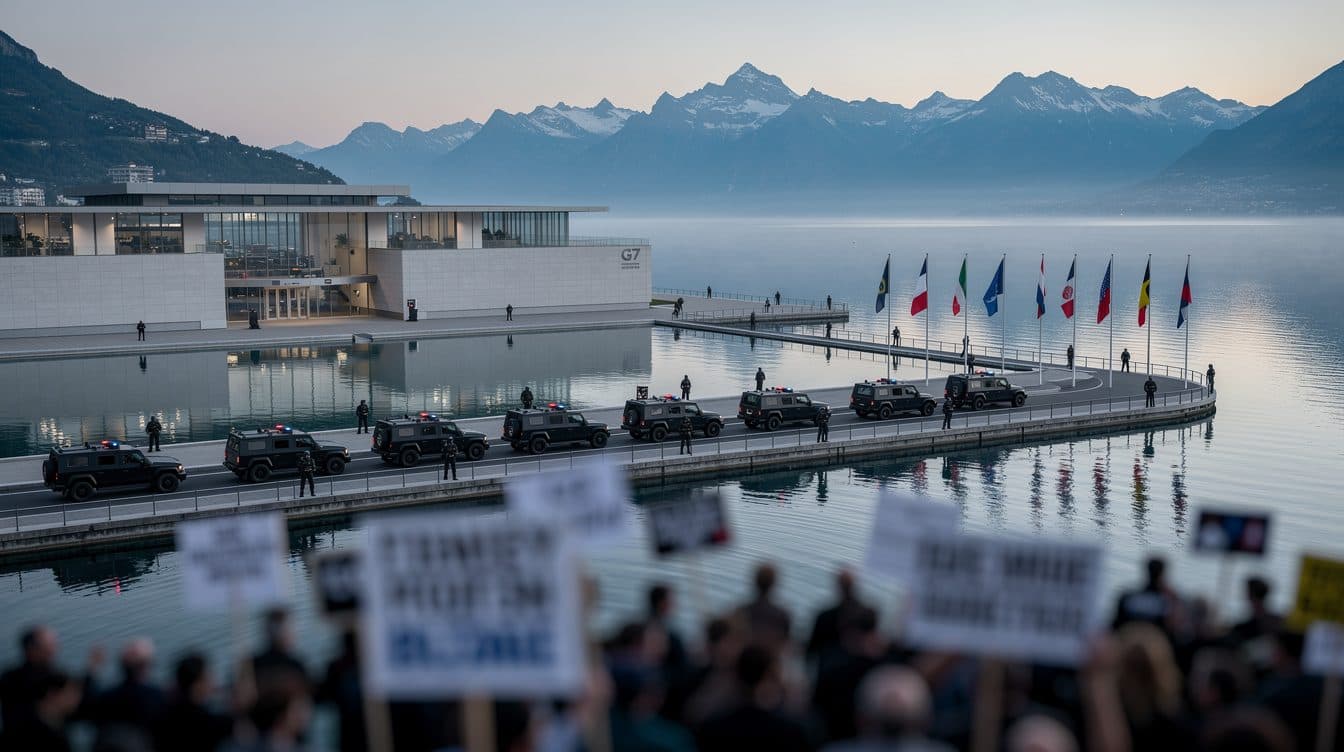
AI-generated image (flux-2/pro-text-to-image via Kie.ai)
Summary
At the G7 summit in the French town of Évian-les-Bains, Emmanuel Macron hosts the heads of state and government of the leading industrial nations for his last major international summit. The focus is on the Ukraine war, the consequences of the Iran conflict, and the dispute over global trade imbalances – with Donald Trump as an unpredictable guest.
Évian-les-Bains, 15 June 2026
At the G7 summit in the French town of Évian-les-Bains, French President Emmanuel Macron hosts the heads of state and government of the leading industrial nations from Monday to Wednesday for his last major international summit.
More than twenty years after the G8 summit of 2003, the heads of state and government of the leading Western industrial nations are returning to Lake Geneva. The spa town of Évian-les-Bains on the French side of Lac Léman is once again the venue for a high-level meeting dealing with wars, crises, and the future of the liberal world order. For Macron, it is already his second G7 summit as host, after welcoming the group in 2019 in the seaside resort of Biarritz.
In addition to the heads of state and government from the G7 countries – the USA, Canada, Japan, Germany, France, Great Britain, and Italy – representatives of five guest states have also been invited this year: Egypt, Brazil, India, Kenya, and South Korea. South Africa, on the other hand, was not invited because Trump had threatened a boycott, according to a government spokesperson. Swiss Federal Councillor Guy Parmelin has been invited to the gala dinner, as Switzerland is making Geneva Airport available for arriving guests.
At the G7 summit under the French presidency, the agenda will focus on reducing global imbalances, protecting minors in the digital space, and supply chains for rare earths. Macron made clear in advance that he intends to denounce global economic imbalances and advocate for shared, sustainable growth. „Das gemeinsame Ziel sei ein „nachhaltiges, geteiltes Wachstum, das allen zugutekommt“, the Élysée Palace emphasized.
The Economy at the Center
The global economy is a bigger issue than ever since the first G7 meeting after the 1973 oil shock. In 1975, the signatories agreed in Rambouillet to „keine zusätzlichen inflationären Kräfte zu entfesseln" – today, the G7's call for shared growth sounds almost cynical in light of the US president's erratic tariff policy. Ahead of the summit, Macron therefore organized a video conference with the G7 countries, China, the International Monetary Fund, and several emerging economies.
„Wir sind gemeinsam zur Überzeugung gekommen, dass diese Ungleichheiten gefährlich sind", it was said on Thursday following a video conference attended by, among others, Chinese Vice Premier Zhang Guoqing and German Chancellor Friedrich Merz. China will not be represented at the summit itself, but the dialogue is to be continued in Évian.
Ukraine and Iran as Main Topics
At the center of the summit, however, are not economic issues alone. It is the first in-person meeting of G7 heads of state and government since the attacks by the USA and Israel on Iran, which resulted in the closure of the Strait of Hormuz. The four European G7 states – France, Great Britain, Germany, and Italy – reaffirmed overnight their willingness to participate in a defensively oriented military mission to secure the strait.
To open the summit, the heads of state and government were to discuss the international crises at a working dinner in the evening – progress with regard to Iran, but a certain concern about the implementation of the framework agreement, as well as Russia's recent attacks on Ukraine, which are likely to further complicate the resumption of negotiations with Moscow. Macron also wants to urge Trump to tighten sanctions against Moscow, after a Russian attack set fire to the thousand-year-old Kyiv Pechersk Lavra, a UNESCO-protected site.
„Es ist sehr wichtig, dass diese Verhandlungen zu konkreten Entscheidungen führen", Ukrainian President Zelensky said on Sunday, even before the Russian attacks on the cathedral in the area of the famous cave monastery. Talks on „Frieden und Sicherheit für die Ukraine und Europa" are planned. French diplomats hope that Zelensky will at least „kreuzen" with Trump, if the two do not even manage to have a conversation.
The greatest challenge for Macron, however, is likely dealing with the US president himself. Donald Trump arrived on Monday and is scheduled to meet his French counterpart for a bilateral discussion late in the afternoon (5:30 p.m.). He left Washington only a few hours after a martial display in front of the White House, which he had organized for himself on his 80th birthday. When asked whether he held Trump's 2025 remark "Emmanuel täuscht sich immer" against him, Macron replied in a television interview that he was being „pragmatisch".
Trump as an Unpredictable Guest
The experiences with Trump at previous G7 meetings are not encouraging. In 2025, Trump left the G7 summit in Canada early, disrupting the plans of the other heads of state and government. Even bigger was the uproar in 2018 in Canada, when, after his likewise premature departure, he withdrew his signature from the painstakingly negotiated final communiqué while still on the plane. At this summit, topics that might provoke him were therefore avoided.
The economic policy conflict between Washington and Paris is particularly acute. Trump had threatened Macron with a drastic tariff increase of 100 percent on champagne and wine if he did not withdraw the French digital tax on US tech corporations. „Sollten sie dies dennoch tun, habe ich keine andere Wahl, als einen Zoll von 100 Prozent auf alle Champagner und Weine aus Frankreich zu erheben", he told the New York Post. He said he had asked Macron not to burden US companies.
France had introduced a tax of three percent in 2019 on revenues generated in the country by digital companies. Under Trump, the USA have proven that they are no longer part of the community of values that the G7 defines itself to be. Since Trump's re-election, the USA have pursued annexation rhetoric and have not even spared G7 partners such as Canada. They use tariffs deliberately as a weapon, for sanctioning and extortion – including against G7 partners.
Despite all the differences, Canadian Prime Minister Mark Carney is optimistic. The style of the French head of state – „direkt, konkret und ehrgeizig" – could enable progress with all G7 partners „inklusive Präsident Trump", Carney praised in advance. „Wir werden respektvolle, aber klare Gespräche darüber führen", Macron announced. Potential for irritating the US president is therefore certainly there, despite the courting.
Macron's Last Stage
For Macron, who has advocated a stronger role for Europe in a world of increasing great power rivalries since his 2017 Sorbonne speech, this is the last major stage. In all other G7 member countries, different politicians are at the helm today than in 2019. Next year, the USA will assume the G7 presidency – fueling concerns about a further weakening of the format.
A D7 alliance of the EU, Great Britain, Japan, South Korea, Australia, New Zealand, and Canada would be a strong signal of resilience, proposes former NATO Secretary General Anders Fogh Rasmussen. They are to maintain contact with the G20 body – and not least with development aid, which is being treated as a stepchild in Évian. The Danish politician proposes an economic assistance mechanism – analogous to Article 5 of the NATO treaty: Whoever seeks to economically blackmail one of the D7 members attacks all of them.
Security Measures and Protests
The security measures are massive. On the French side, around 16,000 police officers, gendarmes, and soldiers are deployed. Switzerland is contributing around 4,000 soldiers to the security operation, as the state guests are landing at Geneva Airport. In the afternoon, according to police, around 20,000 people took part in a largely peaceful demonstration in the Swiss city. The G8 summit of 2003 is unforgotten in the region, when there were severe riots, particularly in Switzerland.
On Wednesday evening, Macron will bring the international meeting to a close with a lavish dinner at the Palace of Versailles – with Trump alone and to celebrate the 250th anniversary of American independence. It was there, in 1783, that the treaty was signed sealing the independence of the United States. Macron and then-German Chancellor Angela Merkel had deliberately signed the treaty for the Versailles project shortly before Trump's inaugural visit to Paris in 2017.
Versailles as a Symbolic Conclusion
On Wednesday at 3 p.m., the summit will end with a press conference by host Macron. Fifty years after the group's birth in Rambouillet – then still the G6 – the liberal world order faces an existential challenge. The oil crisis, the collapse of the Bretton Woods system of fixed exchange rates – the world seemed to be falling apart back then. Today, many observers worry, the division of the Western alliance is perhaps the greater threat.
Macron, the former investment banker, has cleverly invited the American to the gilded Palace of Versailles at the close of the summit. Gone are the days when Macron, shortly after his election in 2017, responded to Trump's battle cry "Make America Great Again" with a video: "Make Our Planet Great Again." Artificial intelligence is present through Macron's slogan "KI für alle". The French president advocates for the „sichere, schnelle und wirkungsvolle" dissemination of this technology around the world.
Questions & Answers
Who is the host of the G7 summit in Évian?
The host is
G7 Summit Évian 2026: Macron, Trump and the Crises | allfacts360