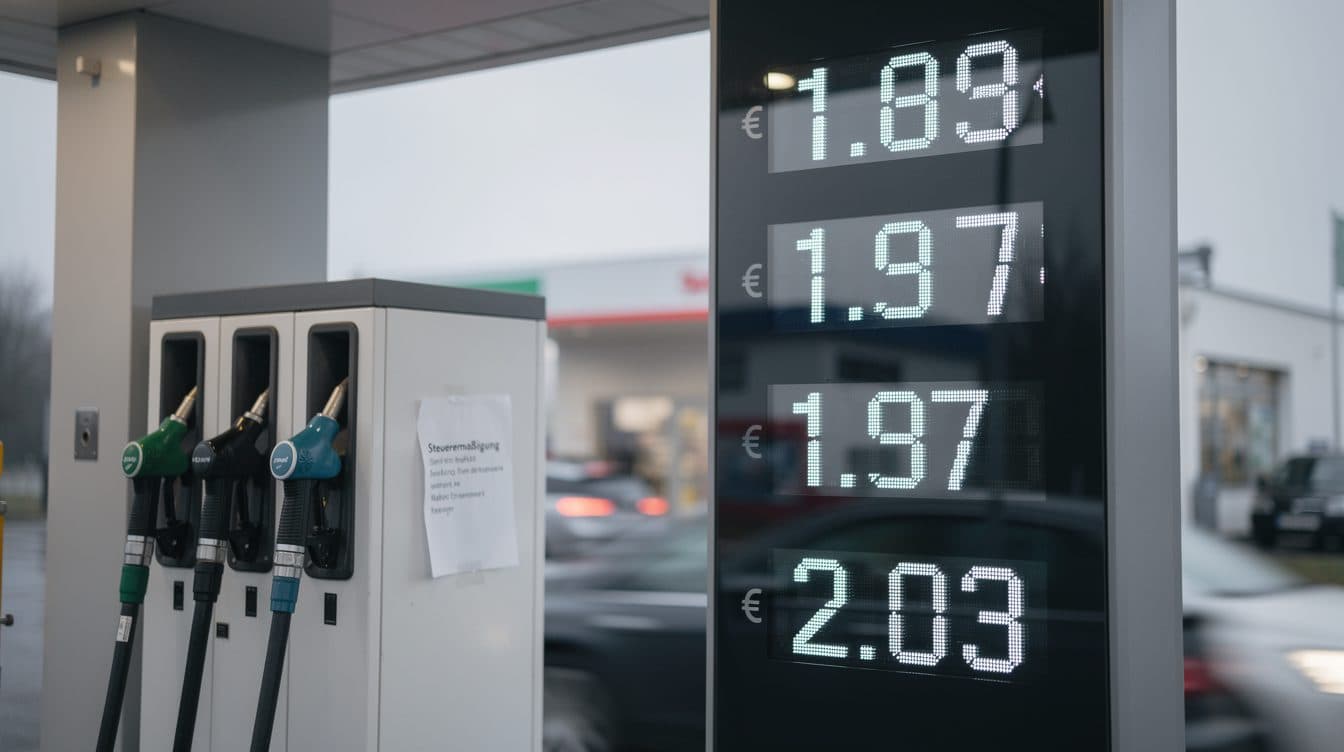
German coalition lets fuel discount expire as planned, with eyes on further relief if prices spike
6/10/2026
AI-generated image (flux-2/pro-text-to-image via Kie.ai)
Summary
Germany's Union and SPD parliamentary groups have confirmed that the temporary fuel discount, known as the Tankrabatt, will expire on June 30 as originally scheduled. Politicians and consumer groups are now debating whether additional measures, such as an electricity tax cut, may be needed to cushion drivers from higher prices at the pump.
Germany's governing Union and SPD parliamentary groups have confirmed that the temporary fuel discount, the so-called Tankrabatt, will expire at the end of June, while politicians and consumer advocates debate whether further relief may be needed if prices at the pump rise sharply after July 1.
A two-month measure ending on schedule
The Tankrabatt, which has been in force since May 1, reduces the fuel tax on petrol and diesel by just under 17 cents per liter. The two-month measure was always designed to end on June 30, and the parliamentary groups of the Union and the SPD have now confirmed, after what they describe as long deliberations, that they will let it lapse on schedule. "Wir haben nach langen Beratungen entschieden, dass wir den Tankrabatt wie geplant am 30. Juni auslaufen lassen werden," said Sepp Müller, deputy parliamentary group leader of the Union.
Sepp Müller justified the decision on fiscal grounds, arguing that an extension would not make financial policy sense. "Wir können es uns in der aktuellen Lage nicht leisten, Schulden dafür aufzunehmen," he said. The federal government spent roughly 1.6 billion euros in tax funds on the discount, according to calculations by the ifo Institute, and Müller said the country could not afford to take on further debt to prolong it. From July 1, fuel prices will once again depend on taxes, levies and the development of international oil markets.
Herbert Rabl, spokesperson for the Tankstellen-Interessenverband (TIV), said the end of the discount came as no surprise. "Wir haben nichts anderes erwartet," he told reporters. Rabl, whose organization represents gas station operators, also argued that politics cannot permanently finance part of the oil companies' profits, noting that these companies "in diesem Jahr 'so viele Gewinne eingefahren wie nie zuvor – gerade auf dem deutschen Markt'" – made more profits this year than ever before, especially on the German market.
Industry and consumer groups diverge on effectiveness
The oil industry's own representatives insisted that the savings were passed on to drivers in full. A spokesperson for the mineral oil association Fuels und Energie said: "Die Tankstellen haben von Anfang an die Steuersenkung auf Benzin und Diesel in voller Höhe an die Tankkundschaft weitergegeben und werden dies bis zum Ende der Laufzeit ebenso tun." The ifo Institute, however, has calculated that while oil companies passed on the relief largely to drivers, around 1.6 billion euros in federal tax funds effectively remained with the companies rather than reaching consumers.
Consumer advocates are skeptical. Ramona Pop, a board member of the Verbraucherzentrale Bundesverband, said the Tankrabatt had not proven itself. "Der Tankrabatt hat sich nicht bewährt, daher ist es gut, dass er nicht verlängert wird. Statt neuer Schnellschüsse braucht es jetzt dauerhaft wirksame Vorschläge," she said, calling instead for lasting measures such as a reduction of the electricity tax for private households to provide direct relief.
The ADAC, Germany's largest automobile club, has been particularly critical of the way oil companies behaved during the discount period. According to the club's data, the daily price difference for a liter of Super E10 between the day's highest and lowest prices averaged 14.6 cents, and for diesel 18.4 cents per liter – figures the ADAC described as the highest ever recorded. The club views these intraday swings as evidence that mineral oil companies responded to the so-called 12 o'clock rule by demanding risk premiums.
The 12 o'clock rule and intraday price swings
The 12 o'clock rule, introduced by the federal government on April 1, restricts petrol stations to only one petrol price increase per day. It was brought in one month before the fuel discount to dampen fuel price increases caused by the Iran war, and the ADAC has argued that the rule itself has been undermined by sharp midday price jumps.
An ADAC spokesperson warned that the end of the discount must not signal the end of relief efforts. "Das Ende des Tankrabatts darf nicht bedeuten, dass Überlegungen für die Entlastung der Menschen eingestellt werden," the spokesperson said, adding that drivers could be expected to see petrol prices above two euros per liter again at gas stations. The club urged the coalition to "kurzfristig Maßnahmen abstimmen, die zielgerichtet besonders Betroffene entlastet" – to quickly coordinate targeted relief measures for those particularly affected.
Bas and Zorn leave the door open to further action
Bärbel Bas indicated that the door to further action is not closed. "Wenn es zu großen Belastungen kommt, werden wir sicherlich darüber auch nochmal reden müssen," she said, while noting that the discount was set for two months. She also pointed out that the situation would continue to be observed beyond the summer and that "natürlich andere Entscheidungen vielleicht noch treffen müssen" – other decisions may still need to be taken.
Bas's SPD colleague Armand Zorn, vice-chair of the SPD parliamentary group, struck a similar note alongside Müller. The two said that if the situation changed dramatically from July 1, the coalition could react quickly, even during the summer holidays. "Ändert sich die Lage ab 1. Juli dramatisch, können wir schnell reagieren," Müller and Zorn said, though they did not commit to specific measures or to a price cap.
Looking ahead, Müller said he plans to push for tighter cartel law. He announced an intention to "Den Markt aufräumen und mehr Transparenz schaffen" – to clean up the market and create more transparency – a signal that structural reform of the fuel market may be on the legislative agenda even as short-term relief options remain under discussion.
Electricity tax and cartel law on the table
Focus magazine had previously reported that there would be no extension of the fuel discount, a finding that the coalition's confirmation has now put beyond doubt. The political debate has, in effect, shifted from whether to extend the Tankrabatt to what, if anything, should replace it if prices at German gas stations rise sharply once the temporary relief ends.
Beyond petrol, the broader question of household energy costs has also entered the debate. Pop's call for a cut in the electricity tax highlights a recurring theme in German consumer policy: whether fiscal relief is best delivered through short-term, visible measures such as fuel discounts or through longer-lasting adjustments to levies and taxes that affect a wider range of households.
The episode has also reignited scrutiny of the oil companies' pricing behavior. With the ADAC's data on intraday price differences providing fresh ammunition, lawmakers from both governing parties now have political cover – and, critics would say, an obligation – to examine whether the 12 o'clock rule needs to be tightened, and whether the roughly 1.6 billion euros in tax funds that did not reach drivers can be better targeted in any future relief package.
Questions & Answers
Why is Germany's fuel discount expiring on June 30?
The Union and SPD parliamentary groups decided, after long deliberations, to let the temporary Tankrabatt – in force since May 1 – lapse as originally scheduled. Sepp Müller of the Union said an extension would not make financial sense and the government could not afford to take on further debt for it.
How much of the tax cut actually reached drivers?
According to ifo Institute calculations, the oil companies passed on the relief largely to drivers, but around 1.6 billion euros in federal tax funds effectively remained with the companies rather than reaching consumers, and the ADAC documented record intraday price swings.
What could replace the Tankrabatt if prices rise after July 1?
SPD chairwoman Bärbel Bas and Armand Zorn said the coalition could react quickly, even during the summer holidays, to a dramatic price change, without committing to specific measures. Ramona Pop has called for a reduction of the electricity tax for private households as more lasting relief.
German fuel discount ends June 30: coalition eyes further | allfacts360