Germany loses bid for UN Security Council seat: Austria and Portugal to join the Council in 2027/2028
New York, June 5, 2026
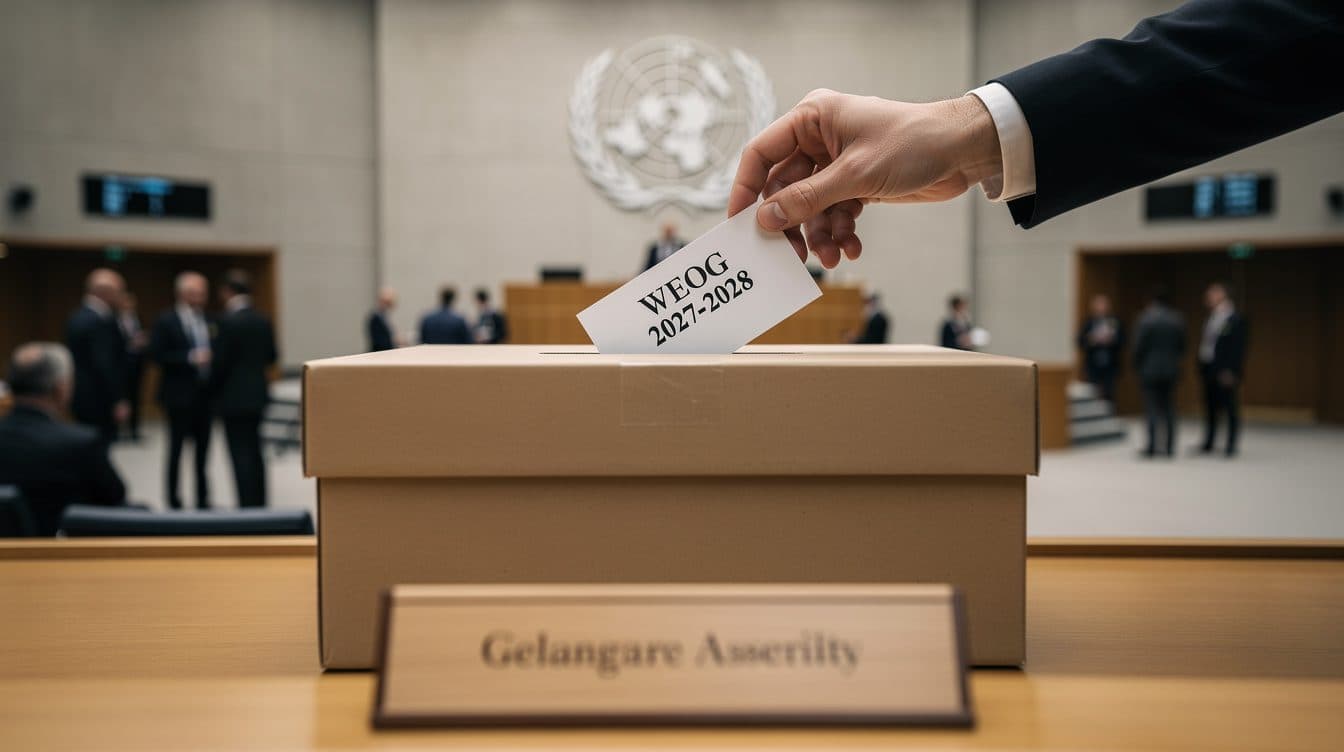
AI-generated image (flux-2/pro-text-to-image via Kie.ai)
Summary
In the election held in the UN General Assembly on June 3, 2026, Germany failed to secure the desired non-permanent seat on the UN Security Council for 2027 and 2028. Austria received 131 votes and joined the Council alongside Portugal, while Germany, with 104 votes, fell significantly short of the required two-thirds majority.
New York, June 5, 2026
On June 3, 2026, the UN General Assembly elected Austria and Portugal to the UN Security Council for the years 2027 and 2028, while Germany narrowly missed out with 104 votes, falling well short of the 127 votes needed.
Two seats were up for grabs in the Western European and Others Group (WEOG), to which Germany also belongs. Austria secured a seat on the Security Council in the first round of voting with 131 votes, followed by Portugal with a solid result. Germany finished far behind with 104 votes, clearly missing the two-thirds majority of 127 votes required for election.
Annalena Baerbock, former German Foreign Minister and current President of the UN General Assembly, announced the defeat on Wednesday in New York. Federal Foreign Minister Johann Wadephul admitted that Germany's Middle East policy might have cost them a vote or two. Discussions have since been ongoing in Berlin as to whether the clear positioning alongside Israel in the Middle East conflict was a contributing factor to the poor performance.
Reactions in Berlin: Disappointment and Call for Strategy
Development Minister Alabali Radovan (SPD) expressed disappointment with the result and warned against withdrawing from responsibility for the United Nations. Germany must remain reliable and take responsibility, she said. In contrast, the Hessian Minister for International Affairs, Pentz (CDU), called for cuts to Germany's contributions to the UN – a proposal that was immediately met with opposition.
The Green Party's foreign policy spokesperson, Wagener, disagreed with a logic of cuts in an interview with Deutschlandfunk, stating that "withdrawing in offense is not in Germany's interest." SPD parliamentarians, including the foreign policy spokesperson for the Bundestag group, Adis Ahmetovic, also called for a clearer naming of actions violating international law and a more consistent stance towards the Israeli government.
Federal Government Announces New Candidacy for 2035
The Federal Government announced that it will run again in eight years. According to Reuters, the government stated on Thursday that it will apply for the 2035/2036 and 2043/2044 terms. Traditionally, Germany applies for a non-permanent seat for a two-year term every eight years.
Following the defeat, Chancellor Friedrich Merz and Foreign Minister Wadephul emphasized that Germany remains a reliable supporter of the multilateral order. Merz had not traveled to New York himself for the UN General Assembly in September, sending his Foreign Minister instead – in contrast to Austria, which was represented at a high level by Federal President Alexander Van der Bellen, Chancellor Christian Stocker, and Foreign Minister Beate Meinl-Reisinger.
Analysis: Why Austria and Portugal Came Out Ahead
Several factors are cited in Berlin as reasons for the surprising defeat. Patrick Rosenow from the German Society for the United Nations criticized the government's lack of a coherent strategy for the UN: "The most important ministries are unable to convey a common vision in a changing world." The late start to lobbying efforts is also seen as a cause.
Holger Niemann from the Institute for Peace Research and Security Policy at the University of Hamburg pointed out that the interests of the 193 UN member states are diverse and election defeats can have many causes: "The reasons why states are not elected are manifold, because the UN members and their interests are also manifold."
Marten Breuer, holder of the Chair of Public Law with an International Focus at the University of Konstanz, saw a clear structural advantage for the winners: "In this respect, one should not attach too much importance to the not-so-pleasant result for Germany and not overinterpret anything" – many states had made up their minds early on due to the Austrian and Portuguese lead.
Vienna's Decades-Long Preparation Pays Off
Patrick Rosenow also explained the winners' strategies: "Portugal strongly promoted its role as a bridge between Europe, Africa, and Latin America. And Austria pointed to Vienna as one of the most important UN locations and to its tradition as a mediating state." According to information from Vienna, Austria had registered its candidacy about 20 years ago.
Austrian Foreign Minister Beate Meinl-Reisinger led the final phase of the campaign, supported by the Federal President and the entire Federal Government. Special envoys from different political camps lobbied worldwide for the candidacy. Thomas Mayr-Harting, who represented Austria in the Security Council in 2009 and 2010, is among the country's most experienced diplomats and authored an article published on June 5, 2026, on the importance of the mandate.
Structure and Working Methods of the Security Council
The UN Security Council comprises 15 members: five permanent members with veto power – China, France, Russia, the United Kingdom, and the United States – and ten non-permanent members elected every two years. The election in the General Assembly is held by secret ballot. In addition to Austria and Portugal, Kyrgyzstan, Zimbabwe, and Trinidad and Tobago were elected to the Council from other regional groups.
The upcoming two-year term for Austria will focus on the protection of civilians, particularly women and children, in conflict situations – a priority that was already set during its previous term in 2009/2010. Important resolutions on humanitarian measures, for example in Syria, have often only come about in the past through the commitment of non-permanent members.
Germany's Role as a Contributor and Future Outlook
According to the EU Treaty, EU member states that are also members of the Security Council are obliged to represent common EU positions and inform their other EU partners. In the week the report was published, the Austrian Federal Government also adopted an Africa strategy. Meanwhile, Germany remains one of the most important contributors to the UN and, following the payment freeze by the United States under President Donald Trump, is now likely the largest or second-largest funder of the system.
Germany was last a member of the Security Council in 2019 and 2020 and had now applied for a seat for the seventh time. Historically, Germany's candidacy had been quite successful: in 2010, Germany prevailed over Canada in a contested vote, and in 2018, Israel withdrew its candidacy shortly before the election. In the UN vote on a Gaza ceasefire in October 2023, Germany and Austria abstained or voted against – a parallel that also plays a role in the current debate.
Questions & Answers
Who won the election for the UN Security Council 2027/2028?
On June 3, 2026, the UN General Assembly elected Austria and Portugal for the non-permanent seats of the Western European and Others Group in the Security Council.
How many votes did Germany receive compared to Austria?
Germany received 104 votes, falling short of the required two-thirds majority of 127 votes, while Austria received 131 votes.
When does Germany plan to run for the Security Council again?
According to Reuters, the Federal Government announced that it will apply for the 2035/2036 and 2043/2044 terms, following the eight-year rhythm.
Germany fails in UN Security Council election 2026 | allfacts360