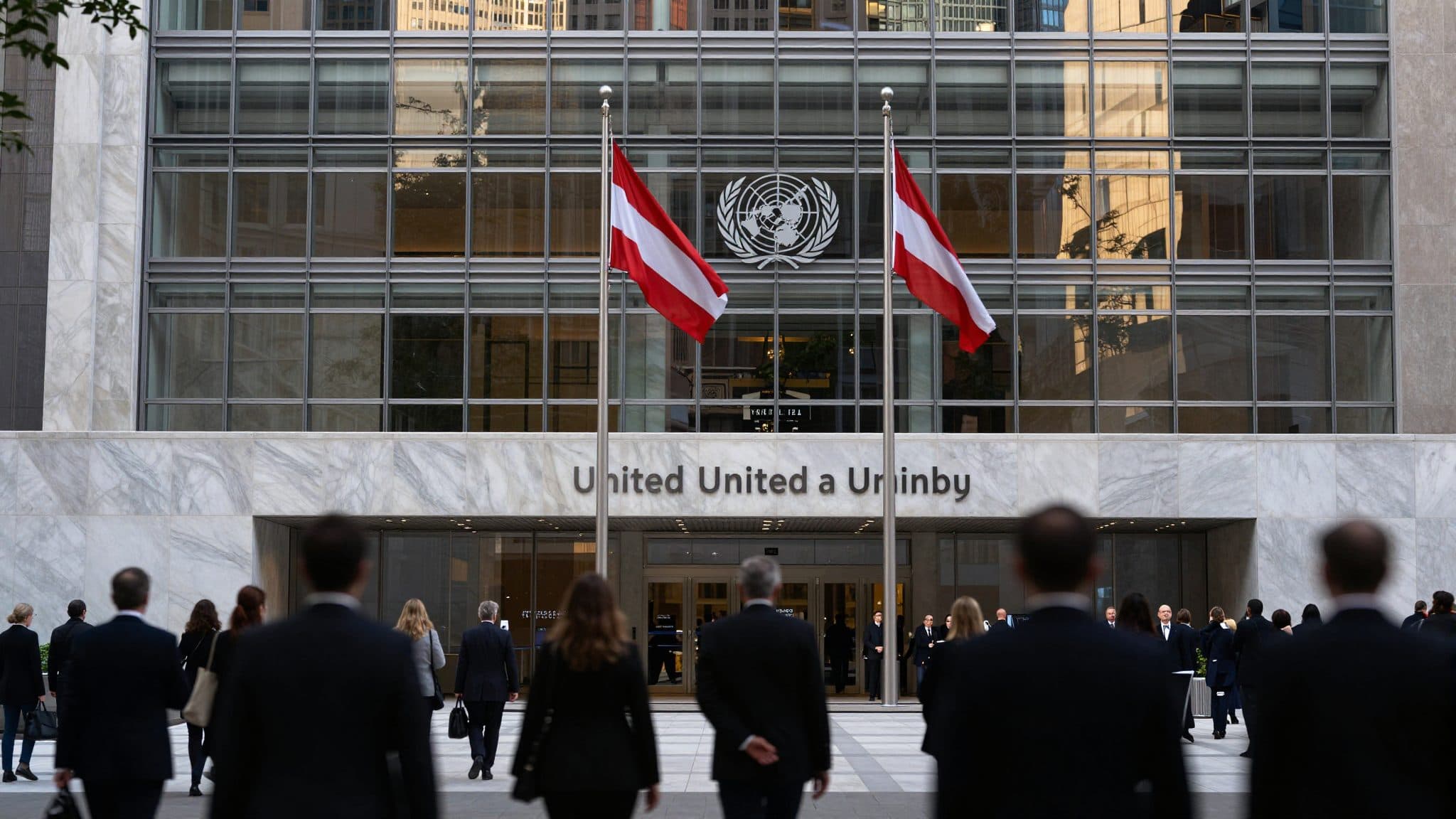
Austria's UN Security Council candidacy cost ten million euros – half of what was budgeted
Vienna, July 2, 2026
AI-generated image (z-image via Kie.ai)
Summary
Austria's successful candidacy for the UN Security Council cost taxpayers around ten million euros – roughly half of what was originally estimated. Foreign Minister Beate Meinl-Reisinger sees the lower amount as evidence of frugality and efficiency.
Vienna, July 2, 2026
Austria's ultimately successful candidacy for a non-permanent seat on the UN Security Council cost the Foreign Ministry around ten million euros according to its own figures – and thus only half of what was originally budgeted.
Budget and Actual Costs
The Foreign Ministry presented a preliminary cost breakdown of the campaign on Thursday, a campaign that had reached its conclusion at the beginning of June in New York with Austria's election by the UN General Assembly. According to this, total expenditure amounted to approximately ten million euros. Originally, twice that amount had been budgeted: ten million euros for 2025 and a further ten million for 2026.
Foreign Minister Beate Meinl-Reisinger expressed her delight at the result and pointed to discipline in spending. „Durch Sparsamkeit und Effizienz haben wir (…) nur halb so viel ausgegeben, wie budgetiert war“, the NEOS politician said. In a further statement she summarized: „Unsere Kampagne war trotz Sparkurs erfolgreich und Österreich wurden in den Sicherheitsrat gewählt."
Voluntary Contributions as the Core of the Campaign
The lion's share of spending, according to the ministry, consisted of just under seven million euros in voluntary contributions that Austria had made to various UN organizations. These contributions had flowed specifically to those „in denen Österreich seine Position international stärken konnte", as the ministry stated. Such contributions are considered in diplomacy a proven means of cultivating alliances and increasing one's own visibility within the United Nations.
For the actual advertising campaign the Foreign Ministry spent around 4.6 million euros last year; this year the funds amounted to roughly 5.3 million euros. According to this, advertising expenditure comprised events, delegation trips, visible appearances at the UN headquarters in New York, as well as communication measures intended to raise international awareness of the country's bid.
Election in New York Against Germany and Portugal
In terms of content, Austria ran together with Germany and Portugal as a candidate from the Western European States group. At the beginning of June, the UN General Assembly in New York elected two of the three applicants to the Security Council – Austria ultimately prevailed, Germany came off worse. The Security Council is the most powerful organ of the United Nations; it comprises five permanent members with veto power – China, Russia, the United States, France and Great Britain – as well as ten non-permanent, rotating members.
Austria's two-year term on the Security Council begins as of course in the years 2027 and 2028. Vienna previously held the membership in the 1970s and 1990s and is counting on once again setting accents in the new period on conflicts along Europe's neighborhood as well as on human rights issues.
Honorary Special Envoys from Four Parties
Meinl-Reisinger expressly thanked the four honorary special envoys who had campaigned worldwide for votes for Austria in recent months. „Mit unserem Einsatz, unserer Disziplin und gezielter Beziehungsarbeit stärken wir Österreichs Stimme in der Welt, ohne unser Budget zu strapazieren", the minister said. The special envoys had „ehrenamtlich um Stimmen für Österreich gelaufen" without having received any remuneration for it, according to the ministry.
The special envoys were former Federal President Heinz Fischer, who had originally been politically active for the SPÖ; former EU Commissioner Johannes Hahn of the ÖVP; former MEP Ulrike Lunacek of the Greens; and ex-Defense Minister Herbert Scheibner, who formerly belonged to the FPÖ or BZÖ respectively. The broad partisan spectrum of the four figures was assessed in Vienna as a signal of the country's non-partisan foreign policy unity.
Behind the scenes the government had understood the bid as an investment in foreign policy visibility. The Security Council seat carries with it the right to participate in decisions on peacekeeping missions, sanctions and binding resolutions – a role that carries particular weight especially for a country like Austria that relies on multilateral diplomacy and an active policy of neutrality.
Significance of the Security Council for Austria
The election itself was regarded in diplomatic circles as prestigious but also as costly: non-permanent seats are allocated by the General Assembly in a secret ballot, requiring a two-thirds majority of votes cast. Campaigns typically include months-long trips by special envoys, multilateral meetings on the sidelines of the General Debate and bilateral talks with the permanent missions of other member states in New York.
Meinl-Reisinger also stressed that the campaign had been conducted despite austerity and pointed out that the funds originally envisaged could now be partially used in subsequent years for other foreign policy projects. The Foreign Ministry announced that a detailed statement of expenditure would be presented within the framework of the regular federal budget.
From the opposition on Thursday there came muted criticism of the level of expenditure, but also fundamental acknowledgment of the election result. Spokespersons of several parliamentary groups expressed surprise at the lower than initially estimated amount and simultaneously called for complete transparency regarding the use of the voluntary contributions to UN organizations.
Reactions and Outlook
The voluntary contributions to UN organizations such as development programs, refugee agencies or human rights institutions are regarded in Vienna as a diplomatic pledge to be heard in political bodies. Austrian diplomacy points out that concrete projects are financed with such contributions, going beyond the symbolic effect of a Security Council candidacy.
Overall, the Foreign Ministry assesses the campaign as a foreign policy success. With a view to the upcoming Security Council years of 2027 and 2028, Meinl-Reisinger announced that Vienna would, among other things, advocate for the strengthening of the multilateral system, a reform of the body's working methods and for increased efforts at conflict prevention.
At the same time, the ministry acknowledged that the actual costs of membership – such as through additional staff positions in New York, travel diplomacy and the financing of chairmanships in subsidiary bodies – would only become fully visible in the coming budgetary years. The current balance relates exclusively to the candidacy phase itself.
Questions & Answers
How much did Austria's UN Security Council candidacy cost?
According to the Foreign Ministry, total costs came to around ten million euros; originally ten million for 2025 and a further ten million for 2026 had been budgeted.
Who campaigned internationally for Austria's election?
Four honorary special envoys campaigned for votes: former Federal President Heinz Fischer, ex-EU Commissioner Johannes Hahn, former MEP Ulrike Lunacek and ex-Defense Minister Herbert Scheibner.
For which years was Austria elected to the UN Security Council?
At the beginning of June, the UN General Assembly elected Austria in New York as a non-permanent member for the years 2027 and 2028.
UN Security Council: Austria's bid cost 10 million euros | allfacts360