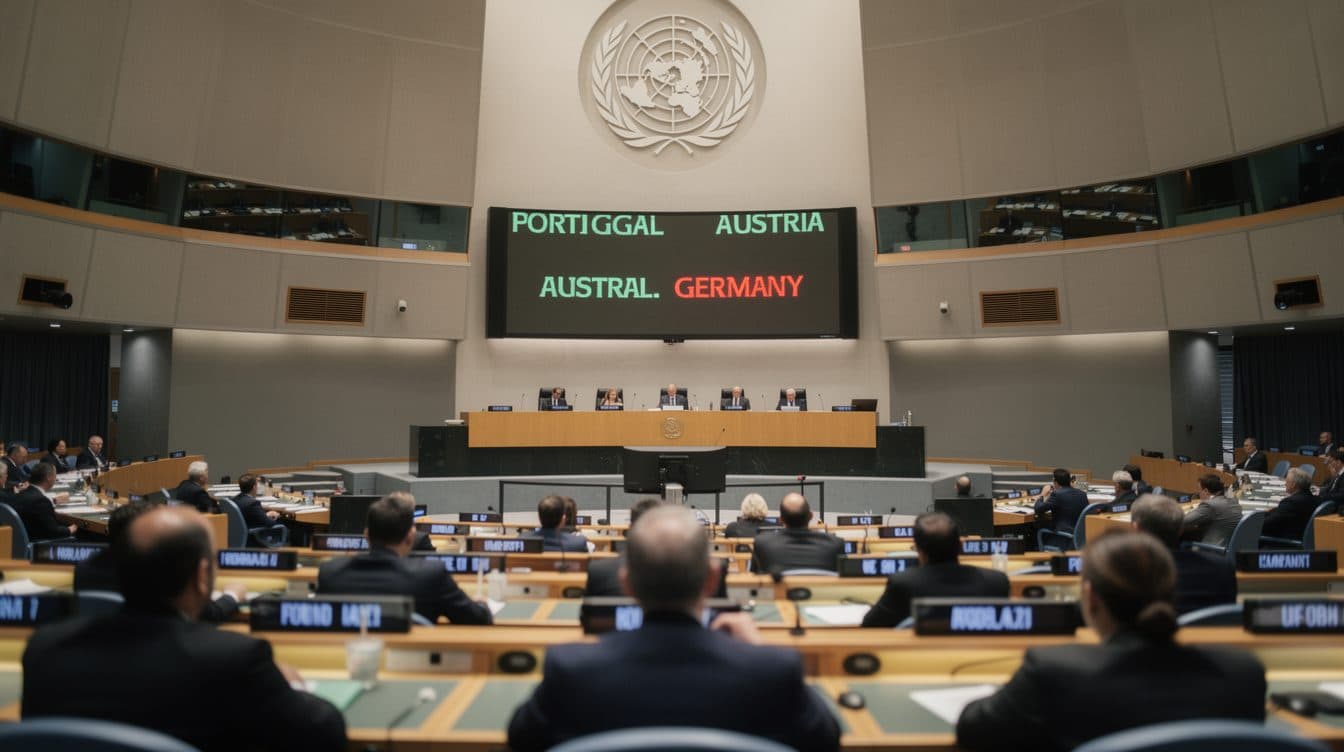
Germany loses election to UN General Assembly: Portugal and Austria join the Security Council
New York, June 03, 2026
AI-generated image (flux-2/pro-text-to-image via Kie.ai)
Summary
Germany failed in its bid for a non-permanent seat on the UN Security Council in New York on Wednesday. Portugal and Austria secured the required two-thirds majority and will join the body for 2027/2028, while Germany received only 104 votes.
New York, June 03, 2026
Germany failed to secure a majority of the UN General Assembly for a non-permanent seat on the UN Security Council for the first time on Wednesday in New York, losing out to Portugal and Austria.
In the election on Wednesday in New York, Germany clearly missed the required two-thirds majority. Portugal received 134 votes, Austria 131 votes; Germany received only 104 votes. As a result, Portugal and Austria will join the Security Council for the 2027/2028 term, while Germany will go home empty-handed. According to diplomats, this was likely the first time in German history that a candidacy failed.
Fifteen states sit on the United Nations Security Council. The five permanent members – China, France, Russia, the United Kingdom, and the United States – have veto power and are all nuclear powers. The remaining ten members are elected for two-year terms; votes are distributed among regional groups to ensure more balanced representation. The "Western European and Others Group" accounts for two seats.
How the Election Works
Federal Foreign Minister Johann Wadephul (CDU) represented Germany at the vote in New York and had already traveled on Friday to lobby for support. He stated that he held talks with representatives from eighty member states. Chancellor Friedrich Merz declared in Berlin on Tuesday that he had done everything in his power to gain the General Assembly's approval: "We have done everything in our power, including the Federal Foreign Minister, myself personally, and many cabinet colleagues, to make it possible for us to get the approval of the United Nations General Assembly."
Merz further stated that Germany had received the support of many countries around the world and would also be supported by many European and non-European states. Nevertheless, Wadephul admitted that he had faced strong competitors: "the other two strong competitors, one must admit." The Foreign Minister ruled out his own resignation, stating he had "nothing to reproach myself for personally." He attributed the defeat primarily to the late start of the election campaign.
Late Start and Strong Competition
Austria had already entered the election campaign in 2011, Portugal in 2013, and Germany only in 2020. This gave the Federal Republic significantly less time to forge alliances. Austrian Foreign Minister Beate Meinl-Reisinger (NEOS) led her delegation in New York and celebrated with great joy after the results were announced. She stated: "The effort and the many international contacts of recent years have paid off: Austria is once again at the table where decisions about peace, security, and stability are made." Federal President Alexander Van der Bellen spoke of a "great success."
The Austrian campaign had a budget of twenty million euros; one million of this was allocated as development aid to Haiti. The Austrian bid carried the motto "Partnership – Dialogue – Trust" and highlighted its tradition of neutrality to distinguish itself from NATO members Germany and Portugal. It also referred to Austria's mediation efforts during the Cold War and its commitment to nuclear disarmament.
Portugal was considered a favorite before the election and also relied on personal presence: Foreign Minister Paulo Rangel (Partido Social Democrata) attended the session. The Portuguese delegation had also docked the sailing training ship "Sagres" at a pier in Manhattan to host a diplomatic reception. Meanwhile, the German side invited guests to the residence of the German UN Ambassador; each guest received a checkered picnic blanket worth fifteen euros – the maximum permissible value for guest gifts.
Wadephul's Argumentation in New York
Germany is the fourth-largest contributor to the regular UN budget after the United States, China, and Japan, and the second-largest donor when including peacekeeping missions and voluntary contributions. The federal government repeatedly pointed to this weight and Germany's reliability as an EU and NATO partner. Wadephul described it in an interview with ZDF heute journal as appropriate to give a voice in the Security Council to "the third-largest economy in the world." Spokesperson Stefan Kornelius also emphasized: "Germany stands for rule-based action, predictability, and adherence to the law."
In his speech to the General Assembly, Wadephul advocated for Germany to make the Security Council more capable of action again and to strengthen the power of non-permanent members, "so that it is the body where the major conflicts of this world are discussed." He also pointed out that Germany sees itself as an advocate for smaller states in various forums: "Germany has always seen itself as an advocate for these small states and their interests in various forums." Finally, he formulated the claim that the "law of the stronger" must not prevail: "We must not get used to a situation where the law of the stronger tries to assert itself."
Wadephul also commented generally on foreign policy: "neither I as Foreign Minister, nor the Federal Foreign Office as a department, nor the Federal Government in its entirety, can, of course, align its foreign policy purely according to international law standards, but we must incorporate other considerations into our alliance, our economic interests, our security policy interests into the balance." He further explained: "We have always clearly defended international law and will continue to do so with great consistency in the future."
Baerbock's Appeal for Reform
Former Federal Foreign Minister Annalena Baerbock, who has been President of the UN General Assembly since September of the previous year, had already called for a reform of the Security Council in the run-up to the election. The constant blockades by the veto powers were severely damaging the credibility of the entire United Nations, she said. Such a reform was "long overdue" but was failing due to the agreement of the five permanent members. Speaking to Politico, Baerbock defended the UN: "This world would not be better for a single day without the United Nations." On Tuesday, the Foreign Minister of Bangladesh, Khalilur Rahman, was elected as Baerbock's successor; he will take office in September.
Observers attribute Germany's defeat also to the federal government's hesitant stance in two conflicts. While Berlin has repeatedly condemned Russia's war of aggression against Ukraine as a violation of international law, the federal government has not classified the US-Israeli attacks on Iran or US actions in Venezuela as equally clear violations of international law. Critics also accuse the government of not joining the accusations by other states that Israel is violating international law in the Gaza war. The federal government, in contrast, points out that it has repeatedly called on Israel to protect the civilian population and has criticized radical Israeli settlers in the occupied West Bank.
Double Standards and Foreign Policy Wounds
In the German media, concerns about an "embarrassment" for Chancellor Friedrich Merz's government had been expressed before the election, which could damage his image as "Foreign Chancellor." Wadephul attempted to temper expectations beforehand, speaking of a "reasonable democratic competition" among friendly European nations: "It is also not a drama that Germany, Austria, and Portugal are competing against each other in a reasonable democratic competition... These are good friendly nations from Europe."
Theoretically, Germany could now apply for the seat for 2028/2029. However, other candidates for this term began their election campaigns years ago. This would make a renewed candidacy realistic at the earliest in eight years – in line with the German rhythm of seeking a non-permanent seat every eight years to compensate for the absence of a permanent seat. The composition of the Security Council still reflects the power dynamics of its founding year, 1945, and has hardly changed since then.
In addition to the two Western European seats, three other non-permanent seats were awarded on Wednesday. Zimbabwe won the African seat unopposed with 182 votes, and Trinidad and Tobago also received the Latin American and Caribbean seat with 181 votes without any opposing candidates. In the Asia-Pacific region, the Philippines and Kyrgyzstan competed against each other; after several rounds of voting, Kyrgyzstan prevailed. In the first round, Kyrgyzstan received 105 votes, and the Philippines received 85.
The Security Council can impose sanctions, adopt arms embargoes, deploy peacekeeping troops, and legitimize military operations under international law – provided no permanent member vetoes. Security Council resolutions are the only UN decisions that are legally binding under international law. Resolutions of the General Assembly, on the other hand, are merely recommendations. Russia has blocked resolutions on Syria and Ukraine, and the United States has prevented resolutions on the Gaza war. The number of UN General Assembly members is 193; currently, Afghanistan and Venezuela are not eligible to vote, so the practical threshold is 128 out of a possible 191 votes.
UN in Crisis
Germany's defeat occurred during a phase of deep crisis for the world organization. Under President Donald Trump, the United States has left numerous UN bodies and agreements and is in arrears with its contributions. The Trump administration has also created a so-called "Board of Peace" as a parallel body to the Security Council for the Gaza conflict, which critics view as an attack on the UN's conflict resolution competence. Other states, including China, are attempting, according to observers, to partially fill the resulting power vacuum and expand their influence in the UN.
The report is based on research by the news agencies AFP and dpa. Contributions
Germany fails in election to UN Security Council 2026 | allfacts360