Germany Loses UN Security Council Seat Bid | allfacts360
Germany Loses UN Security Council Bid to Austria and Portugal in First-Ever Defeat
6/4/2026
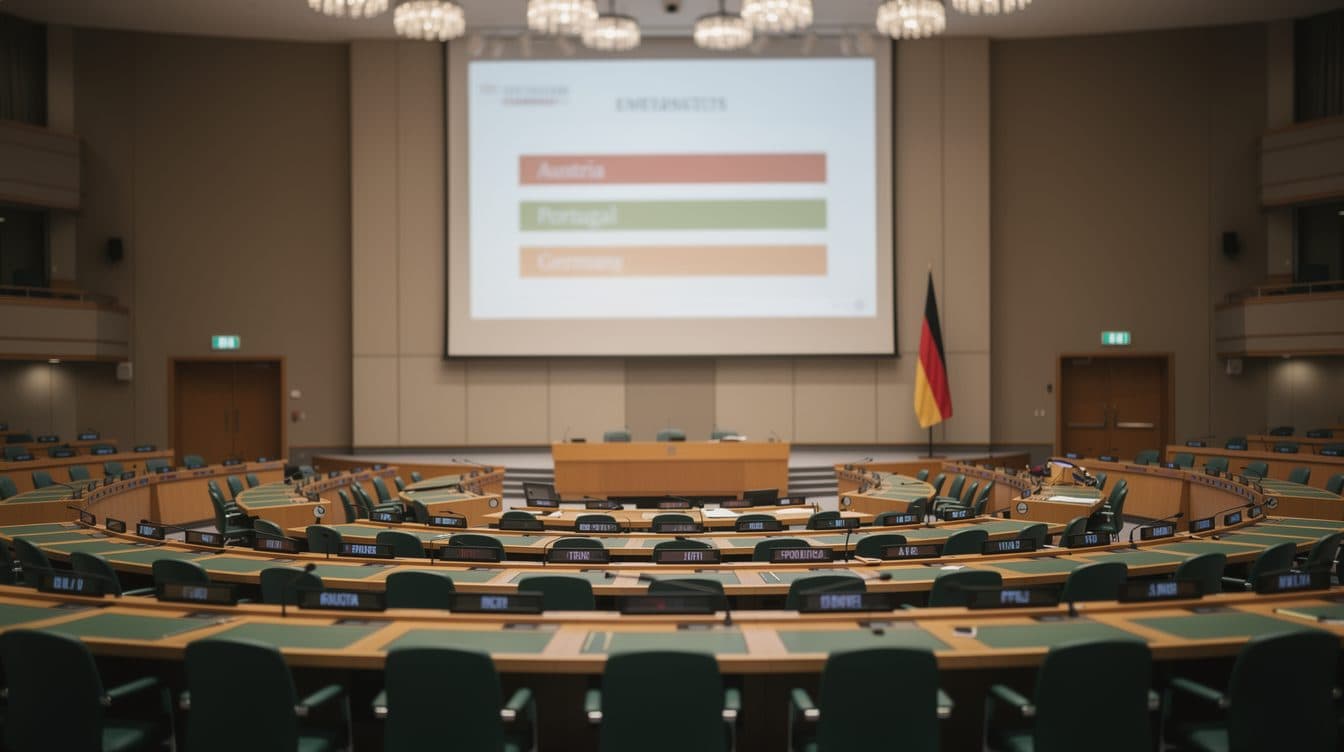
AI-generated image (flux-2/pro-text-to-image via Kie.ai)
Summary
Germany has failed in its bid for a non-permanent seat on the UN Security Council for the 2027–2028 term, losing to Austria and Portugal in a secret ballot at the General Assembly in New York. Foreign Minister Johann Wadephul acknowledged the late entry into the race and called the result a bitter defeat for Berlin.
Germany failed on 4 June 2026 to win a non-permanent seat on the United Nations Security Council for 2027–2028, losing to Austria and Portugal in a secret ballot in the General Assembly hall in New York — the first time in UN history that a German candidacy for the body has been rejected.
Germany's candidacy, which Foreign Minister Johann Wadephul had personally championed during a week of lobbying in New York, was eliminated in the first round of voting. Austria received 131 votes and Portugal topped the field, while Germany received 104 votes — well short of the two-thirds majority required. The result ended Germany's near-uninterrupted pattern of holding a non-permanent Council seat approximately every eight years; Germany last served in 2019–2020.
Wadephul, a CDU politician serving as Germany's Foreign Minister, acknowledged the scale of the setback. 'Das Ergebnis ist eine echte Enttäuschung, und es ist eine herbe Niederlage,' he said in remarks reported by dpa, calling the outcome a real disappointment and a bitter defeat. In a separate statement, he added: 'Deutschland ist spät eingestiegen, wir waren von Beginn an im Nachteil. (…) Wir sehen heute klar: Es war nicht mehr wettzumachen.'
The race had been an unusual one. Two Western-group seats were up for election, and three candidates — Germany, Austria and Portugal — contested them, forcing a secret ballot in which one country had to be eliminated. Contested elections are rare; normally each regional group fields exactly as many candidates as there are seats. Switzerland's seat in a different regional group was uncontested, as were seats won by Trinidad and Tobago (181 votes) and Zimbabwe (182 votes).
A Rare Contested Race
One clear factor in Germany's loss was timing. Austria declared its candidacy in 2011, Portugal followed in 2013, and Germany entered the race only in 2020. According to Austrian UN Special Emissary Ulrike Lunacek, she and her colleague Herbert Scheibner conducted more than 40 conversations with UN ambassadors in the final week alone. Austrian Foreign Minister Beate Meinl-Reisinger, who led her country's delegation, described the win as the product of a 15-year campaign. 'Der Einsatz und die vielen internationalen Kontakte der letzten Jahre haben sich ausgezahlt: Österreich sitzt wieder mit am Tisch, wo über Frieden, Sicherheit und Stabilität entschieden wird,' she said.
A second factor was substance. Wadephul publicly attributed the defeat to Germany's firm positions, including its 'felsenfeste Unterstützung für die Ukraine' and its traditional support for Israel. 'Dass Russland eine solche Stimme nicht am Tisch des Sicherheitsrats wissen will und auch Stimmung gegen uns gemacht hat, das ist kein Geheimnis,' Wadephul said, conceding that Russia's open lobbying against Berlin had cost votes. He also noted that Germany's perceived closeness to Israel and its late entry into the race had put it at a disadvantage from the start.
Why Berlin Lost: Timing and Substance
Critics inside Germany went further, arguing that Berlin's reluctance to criticize Israel and the United States over alleged violations of international law had damaged its credibility. SPD foreign policy spokesperson Adis Ahmetovic said: 'Wer den Anspruch erhebt, Hüter der regelbasierten internationalen Ordnung zu sein, darf beim Völkerrecht keine doppelten Maßstäben anlegen.' Left Party co-chair Jan van Aken said on ARD's Maischberger: 'Das passiert, wenn man das Völkerrecht schreddert.' Left Party leader Ines Schwerdtner cited Gaza, Venezuela and the Iran war as 'Musterbeispiele für doppelte Standards.'
Green Party co-leader Franziska Brantner called the result a reckoning for an international standing that has lost trust. 'Wer sich um einen Sitz im Sicherheitsrat bewirbt, muss die Vereinten Nationen und ihre Werte auch dann verteidigen, wenn es unbequem wird,' she said. Green Party defense expert Agnieszka Brugger described the loss as 'blamabel' and placed responsibility on Chancellor Merz and Wadephul. SPD deputy parliamentary group leader Siemtje Möller called the result 'deutlich und enttäuschend' and demanded that the federal government name violations of international law 'unabhängig davon, wer dies in Frage stellt.'
Domestic Criticism Across the Political Spectrum
Opposition leaders framed the defeat as a failure of the Chancellor's foreign-policy agenda. AfD co-leader Alice Weidel wrote on X: 'Eine Blamage folgt auf die nächste: Wollte Merz unser Land zu Beginn seiner Kanzlerschaft 'zurück auf die internationale Bühne' bringen, bleibt Deutschland nun ohne Sitz im UN-Sicherheitsrat.' Left Party leader Schwerdtner called it 'Schlappe für den sogenannten Außenkanzler Friedrich Merz.' Merz, who leads the CDU and has styled himself as an 'Außenkanzler' since taking office, did not travel to New York, citing a domestic government crisis involving the election of Federal Constitutional Court judges and the first budget.
Merz publicly struck a defiant tone after the vote. 'Wir haben uns mit Überzeugung beworben. Wir haben das Ziel nicht erreicht,' he said, congratulating the elected members, especially Portugal and Austria, via X. He insisted that Germany would continue to fulfill its responsibilities at the UN unchanged, declaring: 'Diese Verantwortung tragen wir mit Entschlossenheit.' Wadephul said he would remain in his post and would not draw personal consequences. 'Ich habe mir persönlich nichts vorzuwerfen,' he said, though he acknowledged: 'Aber meine Überzeugungskraft wird in Berlin natürlich nicht größer durch dieses Ergebnis.'
Calls for a New Foreign-Policy Course
The political damage was visible in the questions that followed. CDU foreign policy politician Jürgen Hardt advised that Germany should in future coordinate with other European countries early to avoid competing candidacies. The SPD called on the federal government to adopt a clearer stance on international law. Hesse's State Minister for International Affairs Manfred Pentz of the CDU publicly suggested cutting German funding to the United Nations: 'Wenn wir künftig dort nicht den Einfluss haben, der uns zusteht, stellt sich die Frage: Warum sollten wir dann weiterhin so viel Geld in die UN investieren?'
Meinl-Reisinger, a member of the NEOS party who has served as Austria's Foreign Minister, said her country's priorities on the Council would include arms control, protection of civilians, regulation of artificial intelligence in weapons systems, and combating climate change. She also called for reforms of the Council itself, including stronger representation for African states and restrictions on the veto power of the five permanent members — China, France, Russia, the United Kingdom and the United States. 'Die Welt von heute sei nicht mehr jene von 1945,' she said, while rejecting the idea of replacing the Council outright.
A Changed World Order
The victory drew broad praise inside Austria. Austrian Chancellor Christian Stocker of the ÖVP wrote on X: 'Ein großartiger diplomatischer Erfolg für Österreich. Wir werden 2027-2028 Verantwortung im UN-Sicherheitsrat übernehmen!' President Alexander Van der Bellen called it a 'großartiger Erfolg' and pledged that Austria would 'beharrlich für einen auf Völkerrecht und Menschenrechten basierenden Multilateralismus einsetzen.' Vice-Chancellor Andreas Babler of the SPÖ described the outcome as a 'starkes Vertrauenssignal.'
The result also exposed the changed context in which the Council now operates. Russia, a permanent member, has blocked debates on the war in Ukraine that it launched in February 2022. The United States under Donald Trump is cutting its contributions and has repeatedly threatened to withdraw from the UN. A fundamental reform of the Security Council to reflect the changed world order since the Second World War has so far failed. Daniel Forti of the International Crisis Group said the scale of the Austrian victory over Germany was unexpected: 'Wir haben alle ein knappes Rennen erwartet. Das war überraschend.'
What Comes Next for Germany
For Germany, the loss breaks a long tradition. Berlin is one of the most important financial contributors to the UN, second only to the United States when all contributions to UN organizations are combined, and German representative Ricklef Beutin told UN bodies in May that Germany contributes 'oftmals mehr als vier Milliarden Dollar im Jahr.' Germany has served as a non-permanent Council member six times. Only Sweden has so far declared its candidacy for the 2035–2036 term, leaving the next opportunity years away.
The Austrian delegation celebrated in the General Assembly hall, as captured on the UN Web TV livestream. Meinl-Reisinger told ORF's ZiB2 program: 'Wir freuen uns riesig.' She rejected speculation that the result was a punishment of German foreign policy, arguing that the 'Aspekt einer fairen Rotation' also played a role. She announced that she would seek dialogue with the five permanent Council members and said she would exchange views with US Secretary of State Marco Rubio. Austria's Security Council campaign cost roughly 20 million euros; Meinl-Reisinger said the country had 'vergleichsweise kostengünstig' campaigned and would come in under budget.
The CDU–SPD coalition government in Berlin faces a period of political recalibration. Chancellor Merz's stated ambition of returning Germany to the centre of international decision-making has suffered an early, public setback. The episode, in the words of SPD's Ahmetovic, was 'kein Betriebsunfall, sondern ein Warnsignal' — not an operational accident, but a warning signal.
Questions & Answers
Why did Germany fail in its bid for the UN Security Council seat?
Germany entered the race in 2020, several years after Austria (2011) and Portugal (2013), and Foreign Minister Wadephul acknowledged the late start put Berlin 'von Beginn an im Nachteil.' Wadephul also cited Germany's firm support for Ukraine and its closeness to Israel as factors that cost votes, and several dozen governments reportedly made false commitments before the secret ballot.
What was the reaction in Berlin to the defeat?
Chancellor Merz said Germany 'did not achieve the goal' but would remain a reliable pillar of the multilateral system, while Foreign Minister Wadephul called the result 'eine echte Enttäuschung' and 'eine herbe Niederlage.' Opposition figures across the spectrum — from the AfD's Alice Weidel to the Greens' Franziska Brantner — criticised the federal government's foreign policy as having lost credibility, and some SPD and Green lawmakers urged a clearer stance on international law.
What will Austria do with its new Security Council seat?
Foreign Minister Beate Meinl-Reisinger said Austria's priorities for 2027–2028 will include arms control, protection of civilians, regulation of artificial intelligence in weapons systems, and combating climate change, and she called for Council reforms including stronger African representation and restrictions on the veto power of the five permanent members.