Germany loses UN Security Council election: A bitter defeat for Merz and Wadephul
New York/Berlin, June 04, 2026
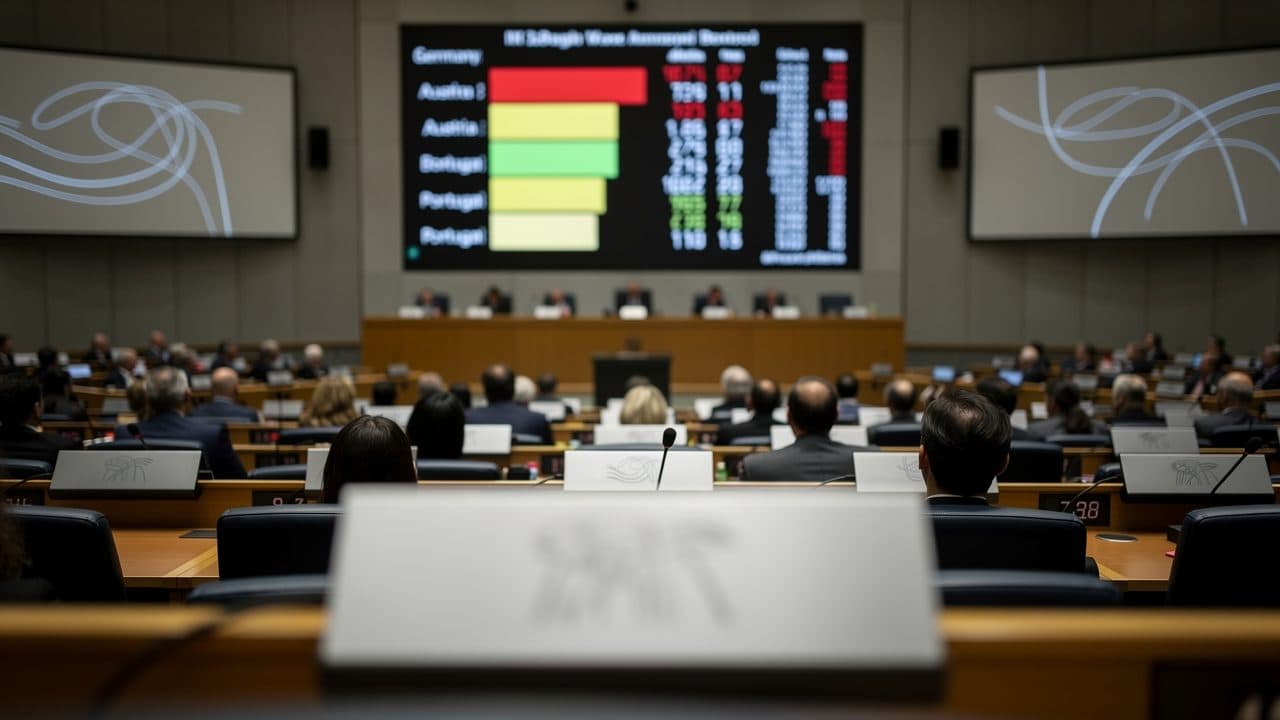
AI-generated image (flux-2/pro-text-to-image via Kie.ai)
Summary
Germany has failed in its bid for a non-permanent seat on the UN Security Council in New York. Austria and Portugal secured the two available seats for the Western countries' group, with Chancellor Friedrich Merz and Foreign Minister Johann Wadephul calling it a bitter defeat.
New York/Berlin, June 04, 2026
Germany's candidacy for a non-permanent seat on the UN Security Council has failed in the secret ballot at the UN General Assembly in New York; the two available seats for the Western countries' group went to Austria and Portugal.
Result in New York
The vote on Wednesday in the UN General Assembly in New York concluded with a result perceived in Berlin as a political turning point. According to consistent reports, Austria received 131 votes, and Portugal even three more; Germany received none. For the federal government, this is the first defeat of its kind in the history of non-permanent memberships, which Germany had held six times previously – consistently at intervals of about eight years.
In his initial reaction, Federal Foreign Minister Johann Wadephul described the result as "a real disappointment, and it is a bitter defeat." He said he had "nothing to reproach himself for personally," stated the CDU politician, who had traveled to New York personally in the week before the election to campaign for Germany's candidacy. According to information from government circles, Wadephul had initially even considered personal consequences but then discarded these thoughts. Chancellor Friedrich Merz stated that the goal had not been achieved, but Germany would remain "a reliable pillar of the multilateral system" and would continue to carry out its duties at the United Nations "with determination."
Reactions in Berlin
Beate Meinl-Reisinger, Austria's Foreign Minister and head of delegation, celebrated the entry into the Security Council as a long-term diplomatic success. "The effort and the many international contacts of recent years have paid off: Austria is once again at the table where decisions are made about peace, security, and stability," she said. Austria's candidacy had been launched 15 years ago, and Vienna had run its campaign "comparatively cost-effectively" and would "stay within budget." To begin, Meinl-Reisinger pointed to an extensive advertising campaign with Mozartkugeln, Manner wafers, and apricot jam, as well as over 40 meetings between her special representatives Ulrike Lunacek and Herbert Scheibner and UN state representatives.
In Vienna and Lisbon, the success was honored at the highest level. Federal President Alexander Van der Bellen spoke of a "great success," and Vice-Chancellor Andreas Babler of a "strong signal of trust." The Portuguese Foreign Minister emphasized that his country's commitment to UN principles and multilateralism had paid off. For the 2027/2028 period, Austria and Portugal will move into the Security Council; Germany's next regular application would, according to the intended eight-year rhythm, only be possible for 2035/36 – so far, only Sweden has announced its candidacy for this term.
Voices from Opposition and Coalition
The defeat was intensely debated in Berlin's political circles. The foreign policy spokesperson for the SPD parliamentary group, Adis Ahmetovic, spoke of a "warning signal, not an operational incident" and demanded: "Anyone who claims to be the guardian of the rules-based international order must not apply double standards to international law." The deputy leader of the SPD parliamentary group, Siemtje Möller, demanded that the federal government must "name unlawful conduct as such, regardless of who questions it." Wadephul himself admitted that "the persuasive power of all those who are internationally engaged in the federal government will not grow with this result."
The Greens and the Left Party sharpened their tone. Green Party co-chair Franziska Brantner said the election result must be understood "as a receipt for a foreign policy that has lost international credibility and trust." Green Party defense expert Agnieszka Brugger called the defeat "embarrassing" and attributed it directly to Merz and Wadephul. Left Party co-chair Ines Schwerdtner spoke of a "setback for the so-called Foreign Chancellor Friedrich Merz" and criticized: "Whether Gaza, Venezuela, or the Iran war: Germany has remained silent about violations of international law when the USA or Israel have committed them." Her co-chair Jan van Aken said on the ARD program "Maischberger," something like this "happens when you shred international law." AfD leader Alice Weidel wrote on the platform X of an "embarrassment" and a "disgrace" for the Chancellor.
Wadephul cited several reasons for the failure. Germany was "at a disadvantage from the start" because it entered the competition later than the two competitors; Austria and Portugal had announced their candidacies about ten years before the election, while Germany joined significantly later. The Federal Foreign Minister also pointed to Germany's support for Ukraine and its "special responsibility for Israel" in the Middle East conflict – both of which, he said, had cost votes. In addition, there was the sentiment against traditional donor countries: poorer states accused the federal government of cuts in development aid, and a growing number of countries felt it was unfair that a large country like Germany claimed a seat every eight years, while smaller states only received it every twenty years.
Structural Causes and Lessons
Structurally, the election proceeded unusually. Typically, a group of countries proposes exactly as many candidates as there are seats to be filled; this time, however, Germany, Austria, and Portugal competed as three applicants for two places – a constellation that almost inevitably produced a loser. In addition, there was the secret ballot: 191 member states were eligible to vote, and according to reports, several dozen governments had pledged support to Germany in advance but broke these promises in the secret vote. According to information from government circles, Berlin had previously gathered pledges far beyond the necessary two-thirds majority.
CDU foreign policy expert Jürgen Hardt drew the conclusion that Germany should coordinate with European partners early on in the future to avoid competing candidacies. Wadephul announced that he intended to stick to the eight-year rhythm. In parallel, questions were raised from within the Union – specifically by Manfred Pentz, State Secretary for International Affairs in Hesse – as to whether Germany should cut its UN contributions if its influence did not meet expectations. In Berlin itself and in diplomatic missions, the defeat was also interpreted, according to consistent reports, as a consequence of Merz having been absent from the world political stage for a long time.
The background to the defeat points to a series of foreign policy burdens. The federal government had neither unequivocally condemned the US-Israeli attacks on Iranian nuclear facilities nor the US operation in Venezuela as violations of international law – the Scientific Services of the Bundestag concluded in an expert opinion that the attacks on Iranian facilities were, according to prevailing opinion, unlawful under international law. Merz himself had described the first attacks in the summer of 2024 as "dirty work that Israel would do for all of us." Even with the arrest warrant issued by the International Criminal Court against Israeli Prime Minister Benjamin Netanyahu for alleged war crimes in the Gaza Strip, Merz had initially spoken out against its enforcement. All of this, according to critics, had painted a picture of a country that selectively applies international law.
Strained Foreign Policy Record
Observers also point to a changed sentiment among UN member states. Meinl-Reisinger, whose country acted as a bridge-builder for medium and smaller states, said in ZiB2 that the Security Council was "polarized," and the world today was no longer that of 1945. She called for stronger representation of African states, restrictions on the veto power, and, in her "ultimate proposal," several permanent seats and the abolition of the veto. US President Donald Trump, who has founded his own peace council, received a clear rejection from Meinl-Reisinger: "We don't need a parallel UN or an alternative UN." On Vienna's agenda for its two-year membership are arms control, protection of civilians – especially children – in armed conflicts, the regulation of AI in weapon systems ("killer robots"), as well as climate protection and renewable energies.
The news was broadcast on June 4, 2026, among other places on Deutschlandfunk. The report is based, among other things, on an excerpt from the newsletter "Der andere Blick am Morgen" by Anna Schiller (NZZ Deutschland) and on reports from the news agency dpa.
The immediate consequences for German foreign policy are likely to be limited, but symbolically significant. Merz and Wadephul consistently emphasized that Germany's duties at the UN would not change as a result of the election outcome. The opposition, however, sees this as an insufficient response. What is clear is that a candidacy for 2035/36 would have to be prepared early and with a more coherent foreign policy profile – otherwise, according to Ahmetovic, the election defeat will remain "not an operational incident, but a warning signal."
Questions & Answers
Why did Germany fail in the UN Security Council election?
Germany entered as a third applicant into what is usually a two-candidate constellation, started its campaign later than Austria and Portugal, and struggled with reservations about its stance on international law, Ukraine, and Israel. In the secret ballot on Wednesday in New York, it was not enough for one of the two seats for the Western countries' group.
Who won the two seats in the Western countries' group?
Austria and Portugal prevailed over Germany; according to reports, Austria received
Germany fails in UN Security Council election 2026 | allfacts360