Germany Loses UN Security Council Seat Election: A Severe Defeat for Merz's Foreign Policy
New York/Berlin, June 04, 2026
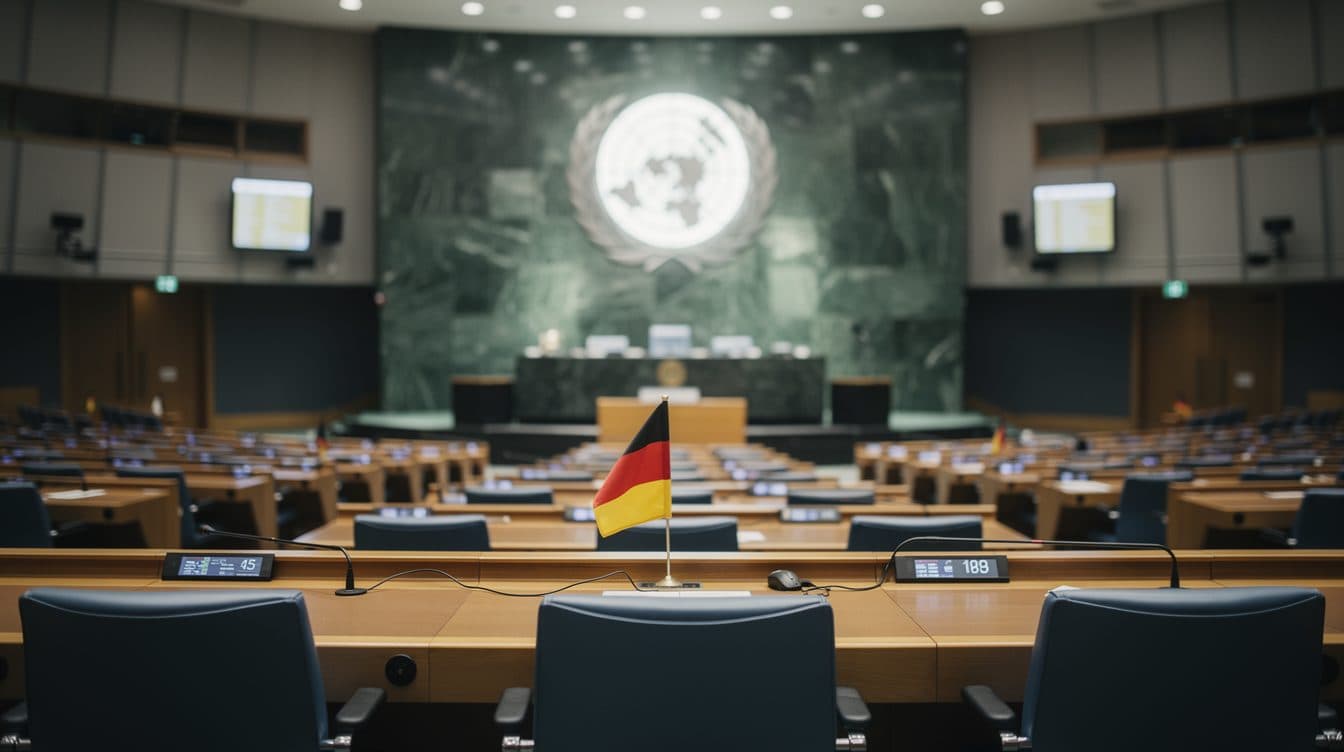
AI-generated image (flux-2/pro-text-to-image via Kie.ai)
Summary
Germany has failed in its bid for a non-permanent seat on the UN Security Council, losing out to Austria and Portugal. Foreign Minister Wadephul spoke of a "bitter defeat" and announced a thorough analysis.
New York/Berlin, June 04, 2026
Germany has been defeated in the first round of voting for a non-permanent seat on the UN Security Council for the years 2027 and 2028, losing to Austria and Portugal. This marks the first such defeat for Germany since 1987.
The Defeat and its Immediate Consequences
The United Nations General Assembly elected Portugal and Austria to the most powerful UN body on Wednesday in New York. Germany, which had successfully applied for a non-permanent seat every eight years since 1987, suffered a surprisingly clear defeat. Foreign Minister Johann Wadephul (CDU), who led the campaign, spoke of a "real disappointment" and a "bitter defeat." In an ARD interview, he said: "I have nothing to reproach myself for personally," but announced a "thorough analysis" of the reasons. He also stated that he had considered resigning in the event of a defeat but decided against it.
The election result is a severe setback for the international capacity of the federal government under Chancellor Friedrich Merz (CDU). Wadephul warned that the credibility of all those engaged internationally would not be enhanced by this result. According to government circles, the federal government is considering reapplying in eight years. However, under current conditions, this would again require a competitive election process against other candidates.
Causes from the Federal Government's Perspective
According to observers, Germany's loss of the seat has several causes. Wadephul cited a Russian campaign against Germany due to its support for Ukraine. German solidarity with Israel, which many UN General Assembly members considered excessive, was also a factor. Unlike other European states, Germany refused to classify the US and Israeli attack on Iran as a violation of international law.
Merz had described the situation regarding legal steps against Iran as a "dilemma" because they "obviously achieved nothing." This stance, as well as Germany's repeated refusal to support sanctions against Israel – justified by historical responsibility – has left its mark internationally. Left Party co-chair Jan van Aken commented in an ARD interview: "This is what happens when you shred international law."
Criticism from the Opposition
SPD expert Adis Ahmetovic stated: "International law is the basis of the rules-based international order and must apply equally to all. Where the impression of double standards arises, credibility suffers." Siemtje Möller, deputy chairwoman of the SPD parliamentary group, also called for: "Our commitment as a reliable partner for global stability, for the rules-based international order, and for international law must become even clearer and more consistent."
Austria had presented itself more strategically. Both the Federal President and the head of government traveled to the General Assembly in New York. Austria and Portugal had announced their candidacies more than ten years before the 2026 vote and had presented them multiple times with a strong government presence at UN headquarters in New York. In contrast, Germany was not represented by the Chancellor himself at the UN General Assembly in September; Merz was represented by Foreign Minister Wadephul due to budget deliberations in the Bundestag. In total, Merz visited more than 30 countries on five continents in his first 13 months as Chancellor, including the USA three times, but has not visited UN headquarters in New York even once so far.
Background of the Electoral System
The five permanent members of the UN Security Council – the USA, China, Russia, the United Kingdom, and France – have veto power, which allows them to block each other and make far-reaching decisions almost impossible. Ten additional non-permanent members are elected by the General Assembly for two-year terms. The vote is secret. Germany had failed multiple times before 1987; since then, six consecutive applications were successful, always in an eight-year cycle. The 2026 result breaks this pattern for the first time.
A Look into History
The UN Security Council has made landmark decisions in its history, but has also been responsible for grave failures. In 1950, it provided international legal legitimacy for military action against the North Korean invasion of South Korea. In 1991, it enabled the expulsion of Saddam Hussein from Kuwait in the first Gulf War because the Soviet Union abstained. In the 1990s, it authorized intervention against Serbian attacks in Kosovo and Bosnia. At the same time, there were terrible failures: in 1994, it did not prevent the genocide in Rwanda.
Reactions at Home
Austria can also point to experience in the body. The country had already been a non-permanent member of the UN Security Council three times, as Austrian representatives emphasized. The fact that the candidates Austria and Portugal had triumphed over Germany might play a national psychological role, according to the Austrian side.
Reactions at Home
The Chancellor Under Pressure
The waves were high in Germany. Hessian Minister for European Affairs Pentz (CDU) called for cuts to Germany's contributions to the United Nations. The demand met with widespread criticism in the Bundestag. Green Party foreign policy spokesperson Wagener called it "absurd" in Deutschlandfunk, adding: "Withdrawing in a huff is not in Germany's interest." The conclusion should instead be to "expand engagement in international cooperation." Former German UN Ambassador Heusgen held a similar position.
The campaign organization ONE pointed out that Germany is the fourth-largest contributor to the UN budget after the USA, China, and Japan. German director Lisa Dilmann stated: "Those who, like the federal government, want to massively cut development cooperation for the fifth time in a row should not be surprised by a lack of support on the international stage."
The Chancellor Under Pressure
For Merz, the defeat comes at a particularly unfavorable time. In the first 13 months of his term, he visited the USA three times, but the United Nations in New York not even once. His relationship with US President Donald Trump is considered strained after Merz repeatedly sharply criticized the Iran war. Trump subsequently announced a troop withdrawal and is no longer favorably disposed towards Germany. The relationship with French President Emmanuel Macron is also described as similarly difficult as that of his predecessor Olaf Scholz with Macron. At the same time, the Franco-German FCAS defense project threatens to fail.
In the election campaign, Merz had promised: "We will regain trust with our partners and allies in the world." The failed Security Council election shows how large the gap between ambition and reality is at present. Efforts to end the Ukraine war are, by general assessment, largely driven by the USA, while the Europeans are on the sidelines. According to observers, Russia wanted to prevent Germany from having a seat on the Security Council because Germany strongly supports Ukraine. The US abduction of former Venezuelan leader Nicolás Maduro, which was considered a violation of international law by many observers, also occurred during this phase of German foreign policy.
Government circles had stated on Thursday before the vote that they had sufficient commitments from other countries to achieve the required two-thirds majority. This assessment proved to be incorrect. With this failure, Germany not only loses a prestigious post but also influence at a time when multilateral bodies are already under pressure. The federal government now faces the question of whether to fundamentally revise its foreign policy strategy or rely on the next attempt in eight years.
Questions & Answers
Why did Germany fail in the election for the UN Security Council?
Foreign Minister Wadephul cited a Russian campaign against Germany due to its support for Ukraine, as well as German solidarity with Israel, which many countries considered excessive, as factors. Germany's refusal to classify the US and Israeli attack on Iran as a violation of international law also played a role.
Who received the non-permanent seat instead of Germany?
The UN General Assembly elected Austria and Portugal to the Security Council for the years 2027 and 2028. Both countries had announced their candidacies more than ten years before the vote and promoted them with a high government presence in New York.
When can Germany reapply?
The federal government is considering reapplying for a non-permanent seat in eight years. An earlier candidacy before the 2035/36 period would only be possible under current conditions in competition with other applicants.
Germany Loses UN Security Council Election 2026 to Austria | allfacts360