Greens, Left, and AfD Turn to the Federal Constitutional Court to Stop Vote on Warken's Austerity Package
Berlin, July 8, 2026
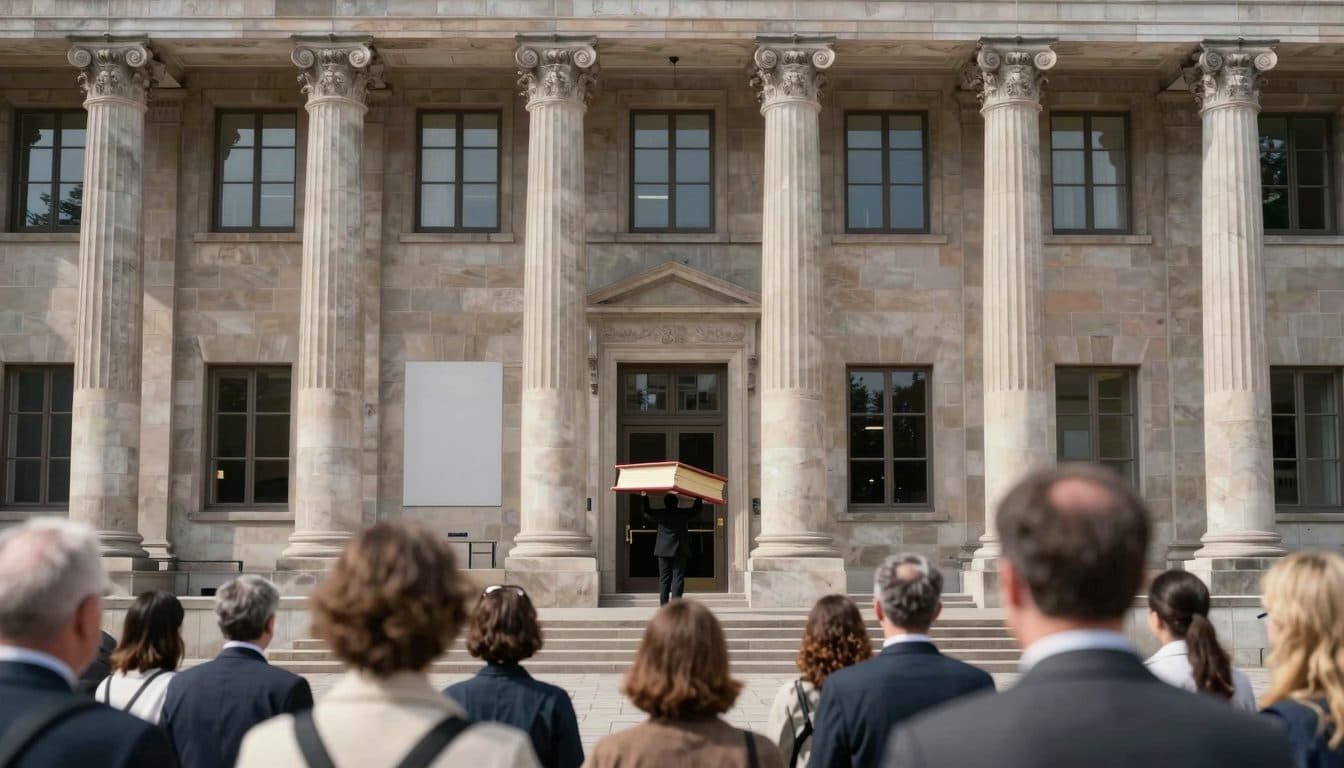
AI-generated image (z-image via Kie.ai)
Summary
The Greens have filed an emergency motion with the Federal Constitutional Court to prevent the vote on the coalition's billion-euro austerity package, planned for Friday in the Bundestag. The Left and the AfD also announced they would turn to the Federal Constitutional Court if the coalition does not remove the bill from the agenda itself.
Berlin, July 8, 2026
The Greens have filed an emergency motion with the Federal Constitutional Court in Karlsruhe to prevent the vote on the health insurance reform planned for this week in the Bundestag; The Left and the AfD are likewise considering legal action.
With the emergency motion, the Greens are responding to the approach of the black-red coalition of CDU/CSU and SPD, which wants to pass Federal Health Minister Nina Warken's (CDU) austerity package before the parliamentary summer recess. At the heart of the lawsuit is the concern that members of parliament did not have sufficient time to properly review the multitude of last-minute amendments to the bill in parliament. The opposition faction accuses the government of a constitutionally problematic procedure and points to a precedent from 2023.
Greens' Emergency Motion Against Warken's Health Austerity | allfacts360
Precedent from 2023
The background is the so-called Heating Act of the Ampel coalition, which was to be passed in the summer of 2023 in a similarly accelerated procedure. At the time, then-CDU member of the Bundestag Thomas Heilmann successfully filed an emergency motion with the Federal Constitutional Court; the court blocked the vote before the summer recess, so that the law could only be passed after the recess. The Greens are now citing exactly this case and describe to the court an almost identical set of facts.
The federal government's draft bill provides for significant cuts for those insured under the statutory health insurance system. Among other things, patients must expect restrictions on the contribution-free co-insurance of spouses as well as higher co-payments for medications. The aim of the package is to relieve the statutory health insurers from sharply rising expenditures in 2027 and to avoid further contribution increases. To this end, fee increases for medical practices, hospitals, and the pharmaceutical industry are to be limited, among other measures.
Content and Aim of the Austerity Package
The starting situation is, from the federal government's perspective, serious: according to current calculations, the statutory health insurers face a deficit of around 19 billion euros next year. With the reform measures now presented, Federal Health Minister Nina Warken aims, according to her own statements, to save around 16 billion euros – significantly less than the gap that Janosch Dahmen, the Greens' health expert, accuses the coalition of. „selbst mit größter Sorgfalt habe man nicht nachvollziehen können, wie die Koalition auf 19-Milliarden-Einsparungen kommen wolle“, said Dahmen.
The Greens also consider the government's procedure untenable in detail. Thus, the draft had been sent to members of parliament on Monday evening at 6:37 p.m., had comprised nearly 300 pages, and was effectively a newly drafted law, Dahmen explained. Irene Mihalic, parliamentary managing director of the Greens' Bundestag faction, pointed to a further 278 pages of amendment motions that had been submitted during the night of July 5 to 6: „Wir haben in der Nacht vom 5. auf den 6. Juli 278 Seiten Änderungsanträge bekommen, ja, die man in der Kürze der Zeit niemals seriös durcharbeiten kann.“ The Greens urgently called on the coalition to postpone the final deliberation in the Health Committee and the final vote in the Bundestag, „um den Abgeordneten ausreichend Zeit für eine sorgfältige Prüfung zu geben“ – the coalition refused.
Opposition's Accusation: Too Little Time for 278 Pages of Amendments
Before the Bundestag vote on Friday, the Union and SPD had wanted to introduce further amendments to the draft in the Health Committee on Wednesday. During the ongoing legislative process, the final vote had already been postponed by two weeks in order to find additional savings and revenues. Thus, hospitals are to receive an additional 750 million euros per year beyond what was previously planned for the financing of current expenditures, and the originally planned federal subsidy to the health insurers will no longer be cut in full.
Greens party co-chair Felix Banaszak, in view of the multitude of last-minute amendments, spoke of a disregard for parliament: „Das ist nicht nur stümperhaft und unprofessionell, das ist eine grobe Missachtung unserer parlamentarischen Arbeit.“ He described Minister Warken's draft as „Murks“. The Greens chair also warned of the consequences of a rushed procedure: „Wer so etwas Sensibles wie unsere Gesundheitsversorgung im Eilverfahren durchpeitschen will, wird Fehler machen.“ The Greens additionally demanded, according to Banaszak, another public hearing – „Beides wurde abgelehnt“.
Coalition's Response
Greens health politician Janosch Dahmen stated that he himself had turned to the Federal Constitutional Court and predicted the coalition's path: „chaotischen Eilverfahren“ he accused the government of. He also warned: it was „faktisch um ein weitgehend neu gefasstes Gesetz“, which had „Milliardenfolgen für 75 Millionen gesetzlich Versicherte“. Dahmen also described the consequences for care clearly: longer waiting times, less security of supply, and further economic problems for hospitals, while the pharmaceutical industry continues to be spared at key points.
The coalition rejects the accusations. Federal Health Minister Nina Warken said there had been „genug Zeit gewesen, um sich mit dem Gesetz zu befassen“, and pointed to the normal parliamentary routine, in which last-minute reading is sometimes necessary. SPD parliamentary managing director Dirk Wiese was sanguine: „Von daher gehe ich mit einer gewissen Gelassenheit daran“ – and pointed out that parts of the amendment motions had already been the subject of an expert hearing two weeks earlier. Wiese and the SPD also assume that the vote on Friday can take place as planned despite the Greens' emergency motion.
Resistance Also from the Länder
Not only the opposition, but also the Länder are signaling resistance to the timetable. Mecklenburg-Vorpommern's Minister President Manuela Schwesig (SPD) announced that she would not consent to a shortening of the deadlines; the state government wants further talks with the federal government. The law does not require the consent of the Bundesrat, but the Länder could slow the procedure by invoking the Mediation Committee. Schwesig stated, however: „Das ist aber nicht unser Ziel.“ Union faction leader Jens Spahn (CDU) emphasized that the coalition is in constant exchange with the Länder, with the focus from the Länder's perspective being on hospitals and nationwide care.
The Left and the AfD also announced that they would go to the Federal Constitutional Court if necessary. Left member of parliament Ates Gürpinar stated that he was „fassungslos“ about the procedure and likewise wanted to file a constitutional complaint – though only once it was clear whether the coalition would remove the bill from the agenda itself. AfD politician Martin Sichert described the procedure as „hochgradig kritisch“. The hospitals, pharmacies, specialists, and „letztlich die gesamte ärztliche Versorgung auf dem Land in Deutschland“ were at stake with the SHI law. The AfD and The Left likewise wanted, according to their own statements, to „noch abwarten, ob die Koalition das Gesetz nicht selbst von der Tagesordnung nimmt“.
What a Ruling from Karlsruhe Would Mean
Greens faction chair Katharina Dröge said on ZDF-Morgenmagazin that the factions had received around 300 pages of amendment motions on Monday, in which the coalition itself had still acknowledged errors on Tuesday. In Dröge's view, however, the law could still be passed in the first sitting week after the parliamentary summer recess in September. For the federal government, a Greens victory before the Federal Constitutional Court would be a severe setback – not only substantively, but also with regard to its own claim of demonstrating capacity to act before the summer recess.
One final point concerns social benefits: starting next year, the federal government is to provide one billion euros for health insurance contributions of recipients of basic security (formerly „Bürgergeld") – significantly more than the 250 million euros most recently discussed. This is part of the overall package that the coalition now wants to push through parliament in an accelerated procedure.
Should the Federal Constitutional Court grant the Greens' emergency motion, the scenario from 2023, as in the Heating Act case, would be conceivable: the vote would have to be postponed, and the austerity package could only be passed after the summer recess. Until then – as Dahmen warns – the court will decide: „Wie das Gericht entscheidet, wird das Gericht entscheiden."
The project itself remains in place, even if the timetable is now on the brink. The coalition had already presented the original draft in early April; what is now at stake is a reform that, according to the government, is necessary to reduce the deficit of the statutory health insurance system. The federal government plans – as it had already made clear weeks ago – „massive Einschnitte und zusätzliche Kosten für die Versicherten", in order to reduce the deficit in the statutory health insurance systems.
What consequences a Karlsruhe ruling would have for the black-red reform agenda is open. But one thing is already clear: the Federal Constitutional Court has not yet issued a final decision in the 2023 Heating Act proceedings – and with the current emergency motion, another case of potentially