Hamas dissolves de facto government in the Gaza Strip – Israel speaks of a "trick"
Geneva, July 7, 2026
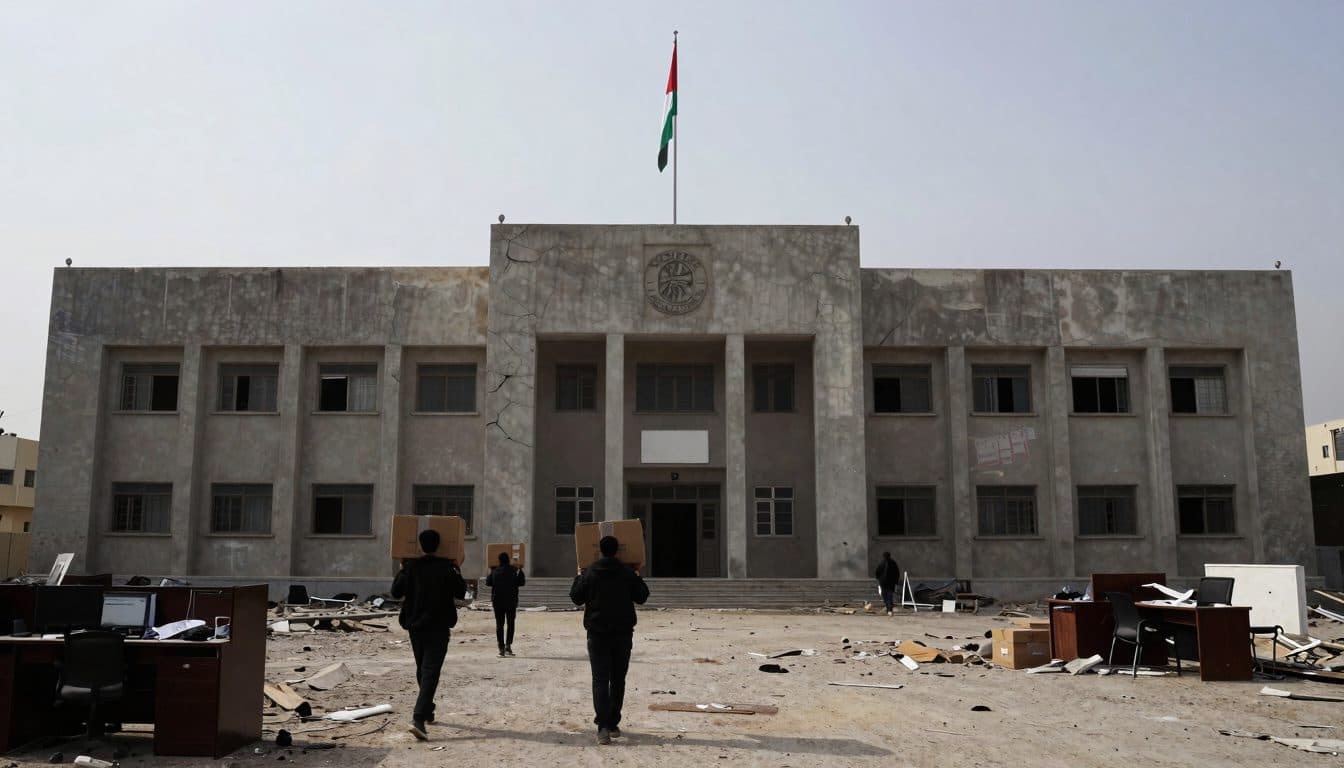
AI-generated image (z-image via Kie.ai)
Summary
Hamas has announced that it will dissolve its de facto government in the Gaza Strip in order to hand over administration to a panel of experts. Israel interprets the move as a tactical maneuver and insists on the disarmament of the Islamist organization as a central condition.
Geneva, July 7, 2026
The Islamist Hamas has announced that it will dissolve its de facto government in the Gaza Strip in order to clear the way for a new administrative body; Israel interprets the move as a "trick" and is demanding the disarmament of the organization as a precondition.
Hamas has announced the dissolution of its de facto government in the Gaza Strip. According to its own statements, the move is intended to enable the transfer of administrative and governmental tasks to the National Committee for the Administration of the Gaza Strip (NCAG). According to Islamic studies scholar Simon Wolfgang Fuchs, the dissolution concerns exclusively the political arm of the organization, not the military one. "Nun löst die Hamas ihre De-facto-Regierung im Gazastreifen auf, wie sie bekannt gegeben hat", it was stated in this regard.
Israel's reaction: accusation of a "trick"
Israel has responded to the announced step with sharp criticism. Gideon Saar, Israeli Foreign Minister, spoke on the online platform X of a "trick". He wrote: "Solange die Hamas ihre Waffen behält, wird natürlich jede zivile Regierung so handeln, wie es die Hamas vorschreibt". The Israeli government regards a renunciation of the disarmament of Hamas as a central condition for any new administration in the Gaza Strip and describes a clinging to weapons as a "red rag".
The background to the announcement is the so-called Trump Plan for peace in the Gaza Strip, proposed by US President Donald Trump in the autumn of the previous year. Around eight months ago, Israel and Hamas signed an agreement on this basis. It provides for Palestinian self-governance in the Gaza Strip, combined with a gradual withdrawal by Israel. The plan also provides for significantly more humanitarian aid to reach the coastal area, including fuel, prefabricated components, and heavy equipment for debris removal.
The Trump Plan as a framework
It remains unclear to what extent Hamas will surrender its weapons. According to its own statements, the Islamist organization is no longer willing to fully hand over its weapons, but only prepared to lay them down – possibly before a future Palestinian committee. Israel, on the other hand, insists on unconditional disarmament as a precondition for any new administration. "Die Hamas ist nicht mehr bereit, ihre Waffen abzugeben, sondern nur noch, sie niederzulegen", according to the description.
With the dissolution of its government, Hamas is pursuing a strategic goal, according to Simon Wolfgang Fuchs's assessment: "Die Aufgabe ihrer Regierung ist ein strategisch geschickter Schachzug der Hamas, um der Weltöffentlichkeit zu zeigen: Wir sind interessiert, dieses Abkommen umzusetzen". Such an expert administration would be more acceptable to donor states and international organizations than a continued Hamas rule, the expert emphasizes.
Open questions on weapons and security
The planned transitional administration by a technocrat government has not yet entered the Gaza Strip. A so-called pilot camp in Rafah in the south of the coastal area, which is to be set up in a section controlled by Israel, has likewise not been established so far. According to the expert, Israel controls 60 percent of the Gaza Strip.
It also remains unclear what influence Hamas will exert in the background and who will assume responsibility for the security structures. In fact, the "Committee for the Monitoring and Coordination of Government Work" had functioned as a government since Hamas's seizure of power in 2007, managing ministries, authorities, municipal services, the civil service, and the coordination of internal security.
Background: parallel administration since 2007
Hamas's de facto government in the Gaza Strip was not internationally recognized. It came into being after 2007 as a parallel administration to the internationally recognized Palestinian Authority (PA) based in Ramallah in the West Bank. Whether a new administration can actually begin its work with the dissolution therefore remains open.
Financial pledges from Gulf states for reconstruction so far exist largely only on paper. The Peace Council envisaged in the peace plan also has no funds at its disposal, according to the expert. The reconstruction of the Gaza Strip, with its roughly two million inhabitants, which was largely destroyed in the war against Israel, thus remains one of the greatest unresolved questions.
A further obstacle is the US position. The US administration has signaled that it could imagine advancing the process even without actively promoting and demanding the disarmament of Hamas. This stands in contradiction to the Israeli position, which regards disarmament as a central condition.
In addition, there are domestic political reasons on the Israeli side: "Und ich glaube, auch der Wahlkampf in Israel verhindert konkrete Schritte bis Oktober", the expert explained. Concrete progress in implementing the peace plan is therefore not expected in Israel until at earliest after the elections in the autumn.
Obstacles in financing and politics
The war with Iran has also pushed the peace process for Gaza strongly into the background, according to Fuchs. The geopolitical situation and the attention that the Iran conflict absorbs have meant that implementation of the plan has only progressed sluggishly for months.
In Israel, Hamas's announcement is therefore interpreted as a formal signal without sufficient substance. The core principles of the "Trump Plan" – the disarmament of Hamas and of all other terrorist organizations as well as the complete demilitarization of the Gaza Strip – remain unfulfilled from the Israeli perspective as long as Hamas retains its weapons.
Outlook: uncertain implementation
The interview was conducted by Vera Deragisch with Islamic studies scholar Simon Wolfgang Fuchs for SRF News. The assessment of the move therefore also remains divided in academic analysis: while some see it as a strategic opening by Hamas, others stress the need for concrete steps on weapons handover and security.
The prerequisite for any progress remains the question of before whom Hamas would lay down its weapons and who is to guarantee security in the Gaza Strip in the future. Without a binding answer to this question, according to the unanimous assessment, neither donor states nor international organizations will invest on a large scale in reconstruction.
Questions & Answers
Who is Gideon Saar?
According to the available facts, Gideon Saar is the Israeli Foreign Minister. He described Hamas's announcement that it would dissolve its government as a "trick" and took a stance on the platform X.
What is the National Committee for the Administration of the Gaza Strip (NCAG)?
The NCAG is a panel of experts to which Hamas, according to its own presentation, wants to transfer administrative and governmental tasks in the Gaza Strip. Whether it can actually begin its work is open, according to the expert consulted.
Why has Israel criticized the dissolution of the Hamas government as a "trick"?
Israel regards the disarmament of Hamas as a central condition for any new administration in the Gaza Strip. Since Hamas, by its own account, is only prepared to lay down its weapons, but not to hand them over unconditionally, Israel interprets the move as a formal maneuver without sufficient substance.
Hamas dissolves government in the Gaza Strip: Background | allfacts360