Houthi blockade at Bab al-Mandab heightens risk of double bottleneck for world trade
Sanaa, July 22, 2026
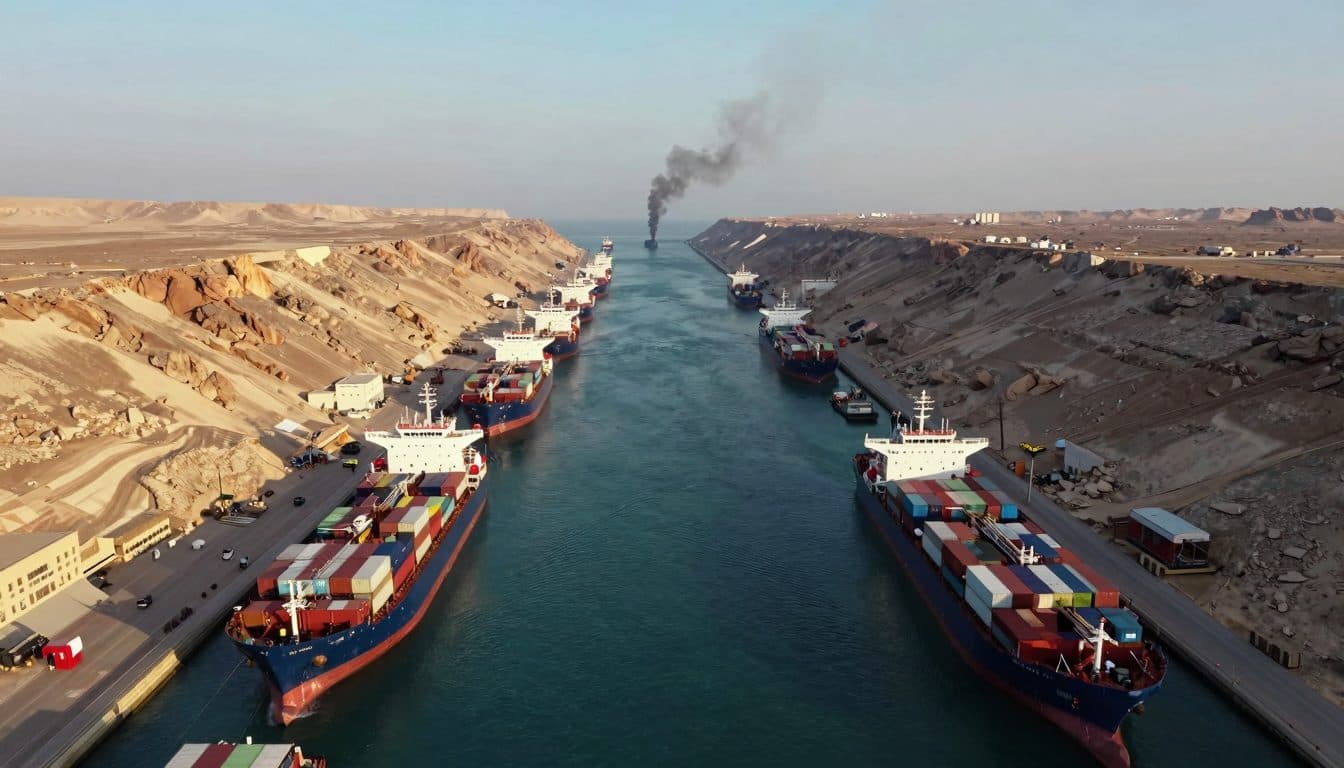
AI-generated image (z-image via Kie.ai)
Summary
The Iran-backed Houthi militia has imposed a naval blockade against Saudi Arabia at Bab al-Mandab, while the Strait of Hormuz is already largely blocked. Data provider Kpler warns of a double bottleneck, and ships are diverting via the expensive route around the Cape of Good Hope.
Sanaa, July 22, 2026
The Iran-backed Houthi militia has imposed a naval blockade against Saudi Arabia at Bab al-Mandab, while shipping traffic in the Strait of Hormuz collapsed by 31 percent on Tuesday compared with the previous day, according to data provider Kpler.
Background: The Bab al-Mandab Strait
The Bab al-Mandab Strait, whose name translates to "Gate of Tears" or "Gate of Lamentation," lies off the coast of Yemen in the west of the Arabian Peninsula. It connects the sea route from Asia via the Suez Canal to Europe and is considered one of the most important trade routes in the world. In recent days, the strait has gained significance as an alternative route to the Strait of Hormuz, particularly for Saudi Arabian oil exports.
Following threats from the Houthi militia, at least four ships turned around in the Gulf of Aden, which leads to Bab al-Mandab, according to Kpler. Data provider Windward reported that five ships in the area had changed course and that the strait was being classified as a "risk zone." Kpler stated that confidence in shipping operations in both straits was "under pressure."
Impact on Shipping Traffic
The militia itself claims to have forced six ships to turn back. There is no independent confirmation of this account. Some ships nevertheless continued their passage through the strait, according to the data. The Houthi militia has also announced that any ship attempting to pass would have to expect attacks.
Economic consequences are already emerging: ships seeking to avoid the strait must accept a long and costly diversion around the Cape of Good Hope off South Africa. According to Windward, this diversion costs around two million US dollars extra per voyage. This route had already been used by major shipping lines following the Houthi attacks in the Red Sea from 2023 onward, which significantly disrupted world trade.
Data Analysis: Risk of a Double Bottleneck
Data provider Kpler reported on the day of reporting that the risk of a "double bottleneck" for shipping traffic on both sea routes was rising. "Traffic at both straits declined noticeably on Tuesday," Kpler said. "According to data provider Kpler, shipping operations at both the Strait of Hormuz and Bab al-Mandab declined noticeably yesterday." The Strait of Hormuz, located in the east of the Arabian Peninsula, is already considered by the data provider to be "virtually impassable."
The Houthi militia controls mainly the north of Yemen and large parts of the western coast on the Red Sea. It is allied with Iran and is described as a proxy group of Tehran. The United States has intensified its attacks on Iran in recent days. The Houthis have been at war with Saudi Arabia for more than ten years and already massively disrupted world trade at the beginning of 2023 with attacks in the Red Sea — at that time in connection with the Gaza war and in support of the Palestinians.
Expert Commentary on the Situation
Austrian Middle East expert Gudrun Harrer classified the situation as an intra-Yemeni conflict with repercussions across the entire region. "It is a kind of unofficial entry into the ongoing Gulf conflict," said Harrer. The blockade is a show of force by the Houthis to further consolidate their rule in the parts of Yemen they control. "The Houthis have taken over parts of the Yemeni army and are heavily armed," the expert added. She also warned: "These are enormous costs. These are also costs for the poorest, not just for us, because we have to pay more money for gasoline, but vital goods and food for the world would be affected."
Harrer also pointed to the limited military capabilities of the United States. "According to Gudrun Harrer, it may not be all that easy for the US to 'take care of the matter.' Because the US does not have infinite military resources." Dr. Jens Heibach of the GIGA Institute Hamburg likewise analyzed the background of the conflict. The program ZDFheute live addressed the question of how the Houthis demonstrate Iran's power; ZDF correspondent Golineh Atai explained this in conversation with Christian Hoch.
Trigger: Attack on Sanaa Airport
The Houthi militia attacked Sanaa airport last week to prevent an Iranian plane from landing. "A ceasefire between the conflict parties from 2022, however, held until last week, when the internationally recognized government of Yemen attacked Sanaa airport to prevent an Iranian plane from landing." The Houthis held Saudi Arabia responsible and subsequently fired missiles at Abha airport in the southwest of the Kingdom. They then announced a blockade for Saudi ships.
International Reactions
US President Donald Trump said in Washington during a meeting with Lebanese President Joseph Aoun at the White House that there had not been a blockade by the militia in the region until now. "We haven't heard from them in a while," Trump said. The US had previously acted "forcefully" against the Houthis, Trump said, referring to US airstrikes in Yemen last year. "Should the Houthis, as a proxy group of Tehran, actually enforce the blockade, US President Trump is threatening consequences."
Pakistan, which as a nuclear power is a close military partner of Saudi Arabia, also intervened. "Pakistan's own interests could be considered violated in line with the alliance between Pakistan and Saudi Arabia even in the event of an attack on the Kingdom." Pakistan is now threatening the Houthis with military action. "According to the nuclear power's statement, the country condemns the threats by the terror militia against Saudi Arabia." Saudi Arabia is a close partner of the United States.
Outlook for the Coming Days
International concern about developments at both straits is growing. Harrer warned that an interruption of trade both at the Gulf and on the southern side of the Red Sea would be a catastrophe with enormous costs and impacts on vital goods and food worldwide. The status of the Strait of Hormuz, where attacks on oil tankers and other commercial vessels have repeatedly occurred during the Iran war, has been in focus for months.
The article was written by dpa-AFX and carries the dateline Sanaa, the capital of Yemen. Both factors — the growing blockade at Bab al-Mandab and the ongoing blockade in the Strait of Hormuz — are, according to the available data, raising the risk of a serious disruption to global supply chains. The coming days will show whether the diplomatic and military threats from the US and Pakistan have an effect or whether the blockade will in fact further paralyze international shipping.
Questions & Answers
What is the Bab al-Mandab Strait and why is it so important?
Bab al-Mandab is a strait off the coast of Yemen that connects Asia to Europe via the Red Sea and the Suez Canal. It is considered one of the most important trade routes in the world and is particularly significant for Saudi Arabian oil exports.
How have the Houthis responded to the threats?
The Houthi militia imposed a naval blockade at Bab al-Mandab following threats against Saudi Arabia and fired missiles at Abha airport in southwest Saudi Arabia. According to Kpler, at least four ships turned around in the Gulf of Aden.
What international reactions are there to the blockade?
US President Donald Trump threatened consequences should the blockade be enforced. Pakistan, a close military partner of Saudi Arabia and a nuclear power, condemned the Houthis' threats and likewise threatened military action.
Bab al-Mandab: Houthi blockade threatens world trade | allfacts360