Hungarian State Broadcaster M1: Apology Instead of News | allfacts360
Hungarian State Broadcaster M1 Shows Apology Instead of News
Budapest, July 8, 2026
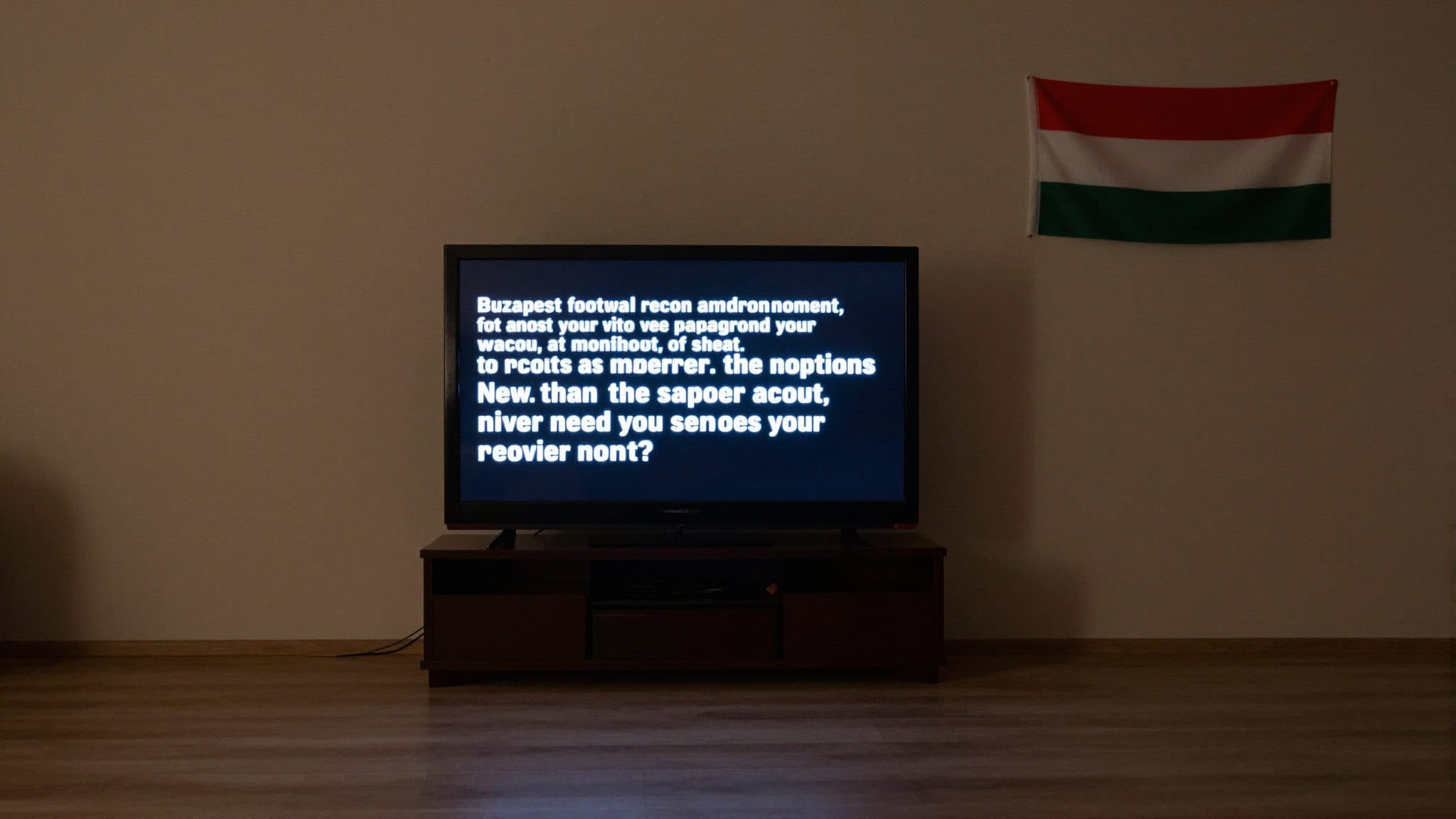
AI-generated image (z-image via Kie.ai)
Summary
Following the change of government in Hungary, the state television channel M1 broadcast a black screen with an apology to viewers for hours on Tuesday. Prime Minister Peter Magyar spoke of a "historic day" and announced reforms of the public-service media.
Budapest, July 8, 2026
The Hungarian state television channel M1 showed a black screen with an apology to the audience for hours on Tuesday instead of its news programs, while the government of Prime Minister Peter Magyar announced a reform of the public-service media.
Update of July 8, 2026: The Hungarian state television channel M1 interrupted its programming on Tuesday and showed a black screen with a written apology for hours instead of news. Prime Minister Peter Magyar spoke of a "historic day" and announced comprehensive reforms of the public-service media to restore their independence and trustworthiness.
What is new since July 7, 2026
What is new since July 7, 2026
Several concrete developments have emerged since the last reporting. The channel M1, the main program of the state media group MTVA, broadcast a black screen with an apology card for several hours on Tuesday afternoon. The card read verbatim: "Die öffentlich-rechtlichen Medien dürfen nicht lügen." The message was supplemented by the sentence "Bleiben Sie dran" as well as the additional wording "Es tut uns leid, dass wir es so lange getan haben." The state media group MTVA simultaneously announced that M1 would resume broadcasting in the evening without news programs. After roughly four hours of forced pause, programming on M1 resumed with a film.
Prime Minister Peter Magyar had succeeded his predecessor Viktor Orbán in May after 16 years at the top of the Hungarian government, after his Tisza Party had won a two-thirds majority in Parliament in the April election. Magyar described himself as conservative and pro-European. The Hungarian media landscape had come under strong state influence during Viktor Orbán's 16 years in government.
Background on the situation of the Hungarian media
M1 had stood out during this period as particularly government-friendly and was widely regarded as a mouthpiece for the Fidesz party. In the Hungarian debate, the channel was also referred to as a "Propaganda-Schleuder." Magyar and other politicians from his Tisza Party had repeatedly announced during the election campaign that these contents would be ended and that the generous funding of the channel would be put under review.
The apology card on M1 was part of this heightened confrontation with its own past. The state media would now be reformed to ensure independence and trustworthiness, according to the channel's circle. Magyar himself stated on Facebook: "Ein historischer Tag. Heute ist das Ende der Propagandasendungen auf öffentlich-rechtlichen Medienplattformen." The choice of words "historic day" underscored the symbolic character of the step.
Background on the situation of the Hungarian media
Changes also at the private channel TV2
According to reporters, the state television channel M1 permanently showed a written card that, in addition to the apology, also communicated the intention to reform. The websites of the public-service media also displayed a black screen, so that the message was visible online as well. At M1, the public-service TV channel, there had initially been silence since the afternoon before the program resumed in the evening without classic news broadcasts.
Changes also at the private channel TV2
Symbolism and political dimension
In addition to the state broadcaster M1, there were also personnel consequences at the largest private television channel TV2. TV2 is owned by businesspeople from Orbán's circle. Since Magyar's election victory, the news chief and the most important news anchors had been replaced there. This changed not only the programming of the state channel, but also the news offering of the market-leading private channel, which had previously also been considered close to Orbán.
Symbolism and political dimension
Magyar's predecessor Orbán had, over 16 years, restructured Hungary's public-service broadcasting into uncritical outlets for his policies, according to criticism from media organizations and opposition voices. Against this backdrop, the black screen on M1 carried a double message: on the one hand, it was an acknowledgment of past shortcomings; on the other, it was the prelude to a politically intended fresh start. Magyar expressly pointed in his message to the character of the day and the need to regain the trust of viewers.
Significance for press freedom in Hungary
The wording of the apology – "Es tut uns leid, dass wir es so lange getan haben" – was directed straight at the audience and made clear that the previous line was not being identified as the mistake of individual employees, but as a structural problem of the past years. Through the announcement of reforms, the claim was simultaneously formulated to secure the institutional independence of the institution in the future.
Significance for press freedom in Hungary
Outlook on the further reform
International observers had critically accompanied the development of the Hungarian media landscape for many years. Reports about restricted editorial freedom, politically steered reporting, and the restructuring of public-service structures had shaped the image of the country in the European Union. With the change of government and Magyar's clear message, the expectation was linked that at least the state broadcasting would align itself more closely with journalistic standards.
The concrete form of the apology – a black screen with clearly formulated text instead of normal programming – was unusually direct. As a rule, reforms of public-service broadcasters go hand in hand with organizational changes, new guidelines, or personnel changes. The fact that the institution itself symbolically dispensed with its programming for hours in order to apologize to viewers was rarely seen in such a pointed form.
Outlook on the further reform
The Magyar government announced that it would implement the reforms step by step in the coming months. In addition to M1's broadcasting operations, structures, editorial guidelines, and the filling of leadership positions are likely to play a role. Observers will pay particular attention to whether the new structures actually lead to more independent reporting, or whether the old line is continued under new leadership.
At the same time, it remains open how the relationship between state broadcasting and the private channels – in particular TV2 – will develop. The personnel changes at TV2 indicate that the new government also wants to exert influence on the media landscape beyond the public-service sector. This could shift the balance of power in the Hungarian television market as a whole.
With the apology and the symbolic black screen, M1 set a clearly visible initial marker on Tuesday. Whether this prelude will lead to a lasting change in the Hungarian media landscape is likely to become clear only in the coming weeks and months. Magyar's announcement that this is a "historic day" makes clear in any case that the government wants the step to be understood as a political turning point.
Reporting on the events of July 7 and 8, 2026 was picked up, among others, in the Deutschlandfunk program. The events surrounding the Hungarian state broadcaster thus also received attention in German-language broadcasting.
Questions & Answers
Who is Peter Magyar?
Peter Magyar is the current Prime Minister of Hungary, who succeeded Viktor Orbán in May after 16 years at the head of government, after his Tisza Party had won a two-thirds majority in the April parliamentary election. He describes himself as conservative and pro-European.
What did the Hungarian state broadcaster M1 show on July 7, 2026?
Instead of its regular news programs, the channel M1 showed a black screen with a written apology to the audience for several hours. It read, among other things: "Die öffentlich-rechtlichen Medien dürfen nicht lügen."
Which reforms did the Magyar government announce?
The government announced that it would reform the state media in order to restore their independence and trustworthiness. At the private channel TV2 as well, the news chief and the most important news anchors have already been replaced since the election victory.