KfW Heating Subsidy Relaunched: Less Money for Middle and Higher Incomes
Frankfurt, July 21, 2026
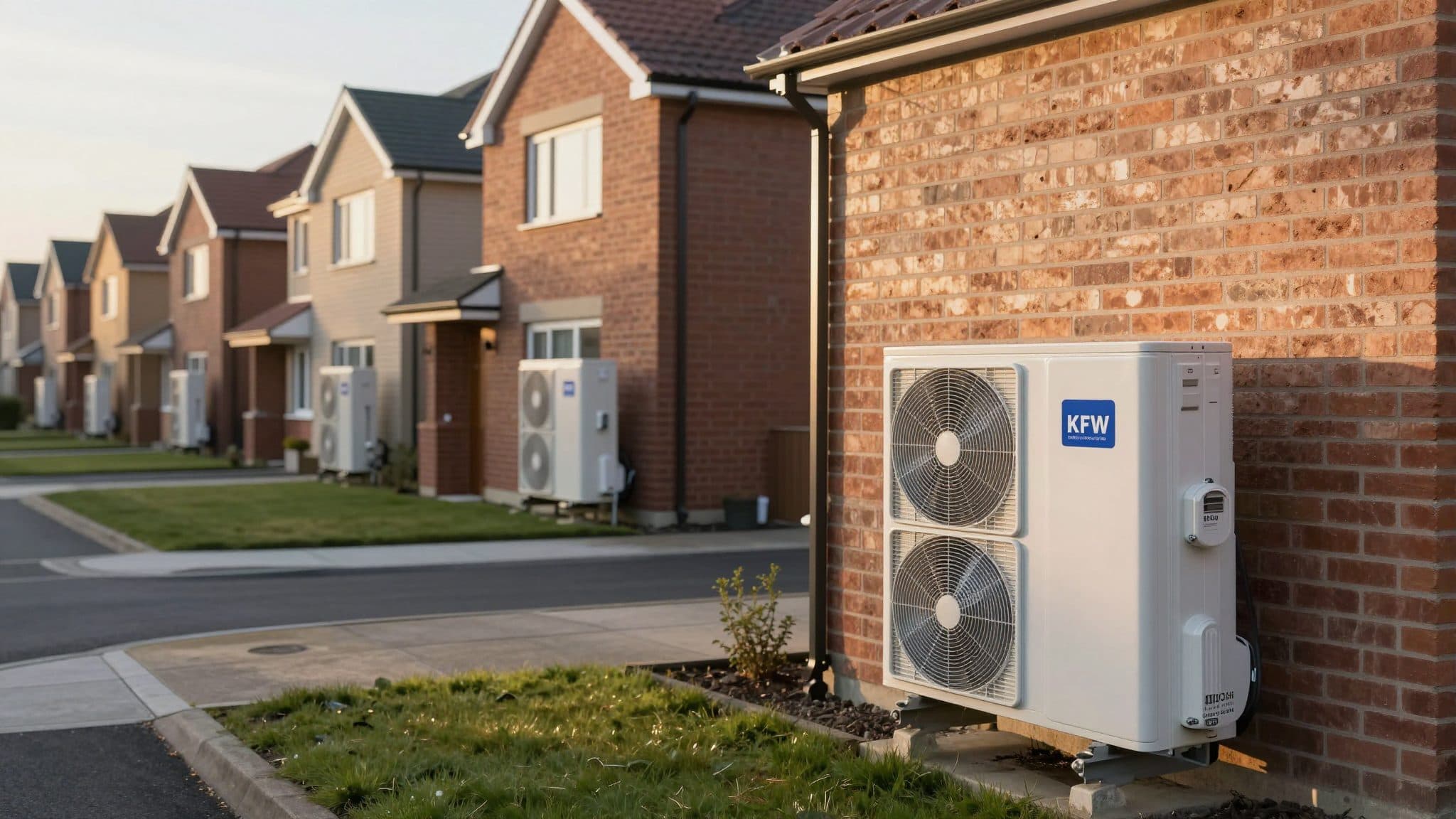
AI-generated image (z-image via Kie.ai)
Summary
The state development bank KfW has put new rules for heating subsidies into effect. Middle and higher-income households receive smaller grants, while families and low earners are set to benefit more. By 2030, the maximum subsidy amount will gradually fall to 22,000 euros.
Frankfurt, July 21, 2026
The state development bank KfW put new subsidy rules for heating replacement into effect on July 21, 2026, lowering the grant for middle and higher incomes and tiering it more sharply by income.
Kickoff After a Two-Week Overhaul
The Federal Funding for Efficient Buildings (BEG) has been relaunched. As KfW announced, the new funding conditions apply on the website with immediate effect, after the site was revamped for just under two weeks. The background is the decision of the Bundestag's Budget Committee, which, on the day before the application freeze, had set the guidelines for a reform: tier socially and ease the program's financial burden over time. The previous freeze on KfW funding applications for the installation of a heat pump, imposed on July 9, has thus been lifted, and new applications are possible again.
At its core, the basic subsidy for heating replacement initially remains at 30 percent of eligible costs. However, the maximum subsidy amount for the first residential unit of a building drops from the previous 30,000 to 28,000 euros. The maximum amount per additional residential unit is also reduced. In addition, there are several gradual cuts: from February 1, 2027, the maximum subsidy amount will drop by 750 euros every six months for buildings up to 150 square meters of net floor space. By August 2030, the maximum subsidy amount will therefore be only 22,000 euros.
More Social Tiering by Income
The development bank now takes greater account of how much applicants earn. Heating subsidies will henceforth be more strongly tiered on social grounds. Families and people with low incomes are to receive more support, while middle- and higher-income households will get smaller grants. Specifically, households with a taxable annual income of up to 40,000 euros will receive an additional income bonus of 30 percent on top of the basic subsidy. If taxable income is up to 30,000 euros, the bonus rises to 40 percent.
Taxable income here refers to the assessment base minus all work-related expenses and allowances. For households with taxable income above 50,000 euros, this bonus is eliminated entirely. If minor children live in the household, KfW also grants a family supplement. This reduces taxable income by a one-time 10,000 euros. This means that minor children living in the household reduce the taxable annual household income to be applied by a one-time 10,000 euros. If families thereby arrive at a combined taxable annual income of just 30,000 euros, they can even receive more funding than before.
The climate speed bonus for replacing fossil-fuel heating systems is being cut from the previous 20 percent of eligible costs to 16 percent. Also from February next year, the bonus will be reduced by four percentage points every six months. From August 1, 2028, it will be eliminated entirely. In addition, the five-percent efficiency bonus for installing a heat pump with natural refrigerants is being scrapped without replacement, as is the flat-rate emissions reduction surcharge of 2,500 euros for biomass systems with particularly low particulate emissions. A value-added bonus for EU-manufactured heat pumps, however, remains possible.
What Stays, What Goes
The impact on individual households can be significant. Previously, owners who removed their conventional oil or gas heating and switched to a climate-friendly system could receive a grant of up to 21,000 euros from the state development bank KfW, headquartered in Frankfurt. Under the new conditions, up to 22,400 euros will be possible going forward if all bonuses are combined. Conversely, a high-earning single replacing their heating might ultimately receive only around 12,900 euros from KfW, since many bonuses no longer apply for high incomes.
In addition to heat pumps, connections to a heating network such as district heating, pellet heating, and heating systems with fuel cells or other innovative technologies are also eligible. Conventional oil and gas heating systems are not supported, according to KfW – except, for example, when gas heating can also be operated with climate-friendly fuels such as green hydrogen. Those who want to have a heat pump installed in their own home can receive up to 22,400 euros from KfW.
How to Apply
A defined procedure applies for applications. First, applicants need a so-called application confirmation, which energy efficiency experts issue. The key element of this document is a 15-digit number required to submit the application. With the 15-digit number, consumers submit their application online, upload the contract and, where applicable, additional documents such as tax notices to verify annual income. As before, consumers can submit the funding application on the Meine KfW website.
According to KfW, the contract with the heating installation company is only valid in the event of a funding approval. If approved, the heating system is first replaced within a 36-month deadline, after which all proofs such as receipts and invoices are submitted to KfW. The funding money flows only at the very end. If someone owns a house or apartment, they can apply for the funding themselves through KfW; in some cases, property management companies also handle the application.
Important for anyone who was still planning under the old conditions: those who already have an approval from KfW can breathe a sigh of relief. Existing approvals from the state development bank KfW remain valid. The federal funds for these are reserved, as KfW says. Applications received by KfW that have not yet been approved will be reviewed accordingly and, if the funding conditions are met, approved as before.
Anyone who missed the deadlines automatically falls under the new rules. By July 8 at the latest, they had to have an application confirmation, and by 8:00 p.m. on July 20, they had to have submitted it. Anyone who did not manage all of this is subject to the new funding conditions. According to KfW, many consumers had previously tried to quickly secure the old conditions, which had helped trigger the application freeze and server outage.
Criticism from the Trades and Consumer Protection
Reactions from the trades and consumer advocates range from cautious to critical. Hauptgeschäftsführer Daniel Föst puts it bluntly: „Wir wollen einfach in Ruhe Heizungen modernisieren, und die Politik schafft immer wieder Unruhe. Alle sechs Monate ändern sich ja jetzt die Förderelemente." Föst is the head of the Zentralverband Sanitär Heizung Klima (ZV SHK). Heating installer Marcel Oestreich from Weiler near Bingen, one of many tradespeople practically implementing the heating transition, also criticizes: „Es ist eine komplette Verunsicherung entstanden."
At the Verbraucherzentrale Bundesverband, Stefan Materne offers a more nuanced assessment of the reform. „Unter dem Strich müssen Verbraucherinnen und Verbraucher für alle denkbaren Varianten mehr als mit dem alten Fördersystem bezahlen. Das kann einige tausend Euro Mehrkosten ausmachen." At the same time, he sees positive aspects: „Dass der Einkommensbonus auf 40 Prozent erhöht wurde, damit bei den einkommensschwachen Haushalten die Finanzierbarkeit verbessert wird, ist positiv." Hermann-Josef Tenhagen, editor-in-chief of Finanztip, also comments on the heating law.
Outlook to 2030
Politically, the reform is part of the new Building Modernization Act. The cuts are justified by budgetary constraints. Under the new Building Modernization Act, there will be less. From now on, the state will provide less money for new heating systems. The CDU/CSU and SPD are planning a cost brake for tenants as part of the heating law reform. Under this, risks are to be shared between tenants and landlords.
Adjustments are also planned for the Renewable Energy Sources Act. According to a draft, a transitional provision is to soften cuts to subsidies for small solar installations up to 25 kilowatts. Funding amounts will be gradually reduced by thousands of euros through 2030. A KfW funding program is to remain in place until 2030 to make the transition planable for homeowners.
For owners, it is advisable to carefully review their individual situation: which heating system comes into question, what is the taxable household income, are there children in the household, and which maximum subsidy amount applies in the specific year? The maximum funding under the new system is capped at 80 percent of eligible costs. Anyone who seeks advice from energy efficiency experts early on can estimate how much money will actually flow.
Questions & Answers
Who is Daniel Föst and what does he criticize about the reform?
Daniel Föst is the Hauptgeschäftsführer of the Zentralverband Sanitär Heizung Klima (ZV SHK). He criticizes that funding elements now change every six months, creating uncertainty in heating modernization.
What is the maximum grant for a heating replacement from now on?
The maximum subsidy amount for the first residential unit of a building falls from 30,000 to 28,000 euros, and from February 2027 drops by a further 750 euros every six months, until only 22,000 euros is possible by August 2030.
KfW Heating Subsidy 2026: New Rules and Reduced Grants | allfacts360