Magnitude 7.8 Earthquake Strikes Southern Philippines – At Least Three Dead, Tsunami Warning Lifted
Manila, 08 June 2026
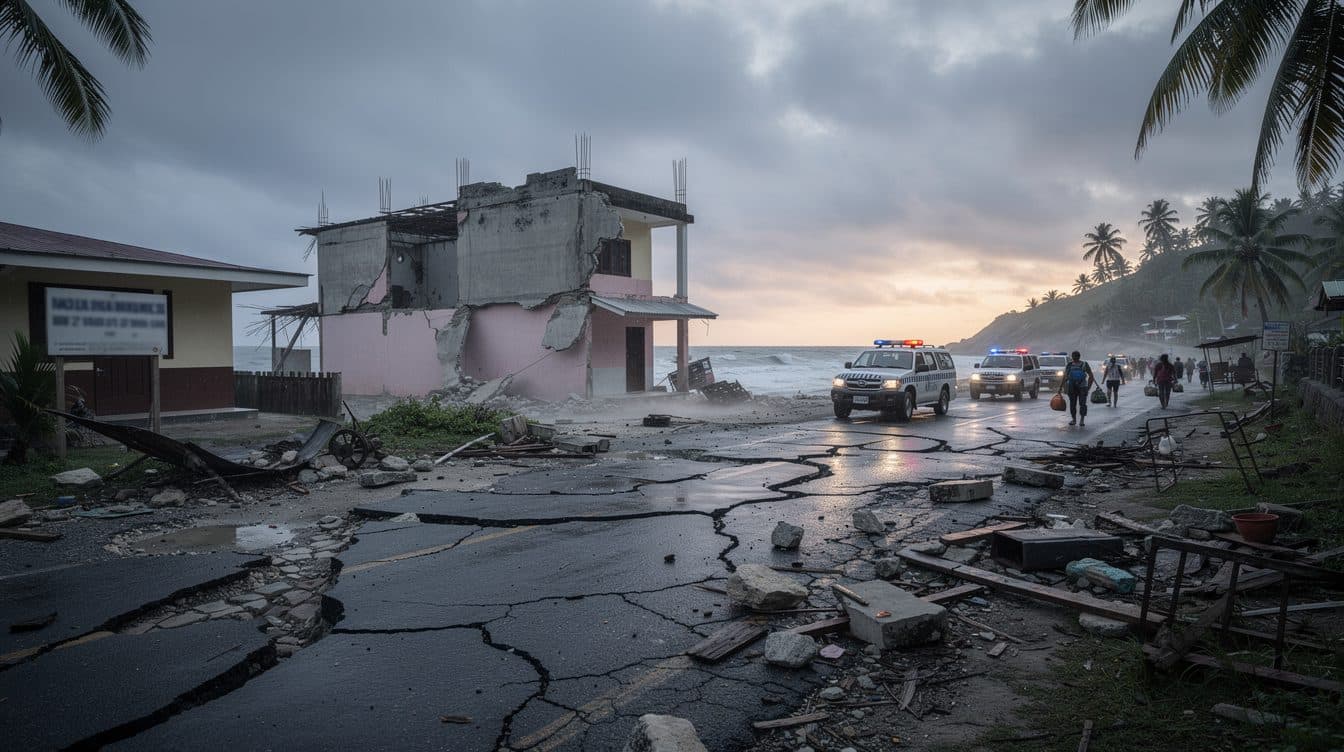
AI-generated image (flux-2/pro-text-to-image via Kie.ai)
Summary
A powerful magnitude 7.8 earthquake struck the southern coast of the Philippines on Monday morning. After initial tsunami warnings for several countries, authorities largely lifted the alerts the same day; Philippine police report at least three dead and four injured.
Manila, 08 June 2026
A powerful magnitude 7.8 earthquake struck the southern Philippine island of Mindanao on Monday morning, triggering tsunami warnings in several countries that were lifted just a few hours later.
Epicenter and Magnitude of the Quake
According to the Philippine Institute of Volcanology and Seismology (Phivolcs), the quake struck at 7:37 a.m. local time off the coast of Sarangani province on the island of Mindanao. The epicenter was located southwest of the municipality of Maasim. The German Research Centre for Geosciences (GFZ) in Potsdam also measured the magnitude at 7.8 and placed the center at a depth of ten kilometers. The US Geological Survey (USGS) had initially reported the magnitude as 8.2 but later revised it to 7.8. Philippine and Indonesian authorities estimated the magnitude at 7.0 and 7.7, respectively.
The quake fell on the first day of school in the new academic year. President Ferdinand Marcos Jr. immediately ordered the suspension of classes at all school levels in the affected areas of Mindanao, as well as the shutdown of many public and private facilities. "Die Sicherheit unserer Kinder hat oberste Priorität," Marcos declared.
Impact on Mindanao
In General Santos City on Mindanao, the tremors were felt particularly strongly. The city's international airport was temporarily closed. Videos circulating on social media showed several buildings on Mindanao partially or completely collapsing. In Sarangani province near the epicenter, power and telecommunications connections went down. Reports of severe damage to schools, hospitals, shopping centers, and churches had come in, though the full extent was initially unclear.
At a school in Davao del Sur province, a building collapsed, according to the school administration. Principal Elene Marie Jane Gamboa stated that the building had already been damaged in a 2019 earthquake and had been scheduled for demolition anyway. "Zum Glück fand gerade unsere Flaggenzeremonie statt und alle waren draußen," she said. Flag ceremonies were underway at several schools and government offices when the tremors hit.
Casualties and Damage
Philippine police reported at least three dead and four injured. The civil defense agency provisionally spoke of possibly eight dead, but noted that the figure still needed to be verified. Phivolcs director Teresito Bacolcol said the collapsed school building had been unoccupied at the time of the quake. According to the USGS, US geologists recorded numerous aftershocks, some of which were also strong.
President Marcos addressed the public immediately after the quake. "Begeben Sie sich jetzt in höher gelegene Gebiete. Warten Sie nicht. Das Leben der Menschen sei wichtiger als alles, was sie zurücklassen müssten," he said. He announced swift relief measures and assured the people of Mindanao of the national government's support. Marcos emphasized that he was in constant contact with the regional authorities on the ground.
Tsunami Warnings in Regional Comparison
The tremors were also clearly felt in neighboring Indonesia, particularly on the island of Sulawesi. Indonesia and the Philippines initially issued tsunami warnings for their coastal regions. Indonesia's Agency for Meteorology, Climatology and Geophysics (BMKG) recorded small tsunami waves at several measuring stations in the eastern parts of the country; however, sea levels rose only slightly. Japan warned of possible tsunami waves along sections of its Pacific coast. Smaller waves were also possible in Taiwan, Guam, Papua New Guinea, and several island states and territories in the western Pacific.
Phivolcs initially maintained its warning for the coastal regions but said that no unusually high waves had been observed initially. Shortly after the quake, the agency recorded flood waves of up to 1.4 meters in six areas. The US Tsunami Warning Center had previously warned of waves of up to three meters in the Southeast Asian island nation. "Auf Grundlage aller verfügbaren Daten werden gefährdete Tsunami-Wellen für einige Küstenabschnitte vorhergesagt," the USGS stated.
The US Tsunami Warning Center lifted its warning several hours after the quake. Indonesia also withdrew its tsunami warning. The Pacific Tsunami Warning Center (PTWC) said there was no danger to Hawaii or the coast of the US mainland. Phivolcs announced that it would continue to monitor the situation for several more hours.
Eyewitness Accounts from the Earthquake Zone
Eyewitnesses described the violence of the tremors. Provincial reporter Noreen Ygonia said: "Ich dachte, es wäre mein Ende. Ich habe einfach angefangen zu beten. Es hat so heftig gebebt, dass ich mich kaum bewegen konnte." A resident of Koronadal reported: "Wir haben nur noch geschrien, weil wir solche Angst hatten." People ran into the streets in panic as buildings collapsed.
Geological Background: The Pacific Ring of Fire
Geologically, the epicenter lies in one of the most active earthquake zones on Earth. The Philippines and Indonesia are located on the so-called Pacific Ring of Fire, a horseshoe-shaped belt of tectonic faults around the ocean, where several continental plates meet. Strong earthquakes and volcanic eruptions occur frequently in this zone. The Philippines is one of the most disaster-prone countries in the world; the archipelago is also hit by about 20 typhoons and tropical storms every year.
The exact consequences of the quake remained unclear initially. The Philippine civil defense agency said reports of possible fatalities and injuries were still being verified. Cleanup work and damage assessments in the affected coastal areas were ongoing.
The report was broadcast on 08.06.2026 on Deutschlandfunk and is attributed to the news agency APA.
Questions & Answers
Where was the epicenter of the earthquake?
According to the GFZ in Potsdam and the USGS, the epicenter was off the southern Philippine island of Mindanao, southwest of the city of General Santos, or southwest of the municipality of Maasim in Sarangani province.
How many dead and injured have been reported?
Philippine police reported at least three dead and four injured; civil defense provisionally spoke of possibly eight dead, but noted that the figure still needed to be verified.
Why were tsunami warnings issued for several countries?
Due to the magnitude of the quake and the location of the epicenter off the coast of Mindanao, the Philippines, Indonesia, and Japan issued warnings for their coastal regions; the US Tsunami Warning Center warned of waves of up to three meters. The warnings were lifted a few hours later.
Philippines Earthquake Magnitude 7.8 – At Least Three Dead | allfacts360