Man sentenced to 15 years in Salzburg for attempted murder of ex-wife
Salzburg, 01 July 2026
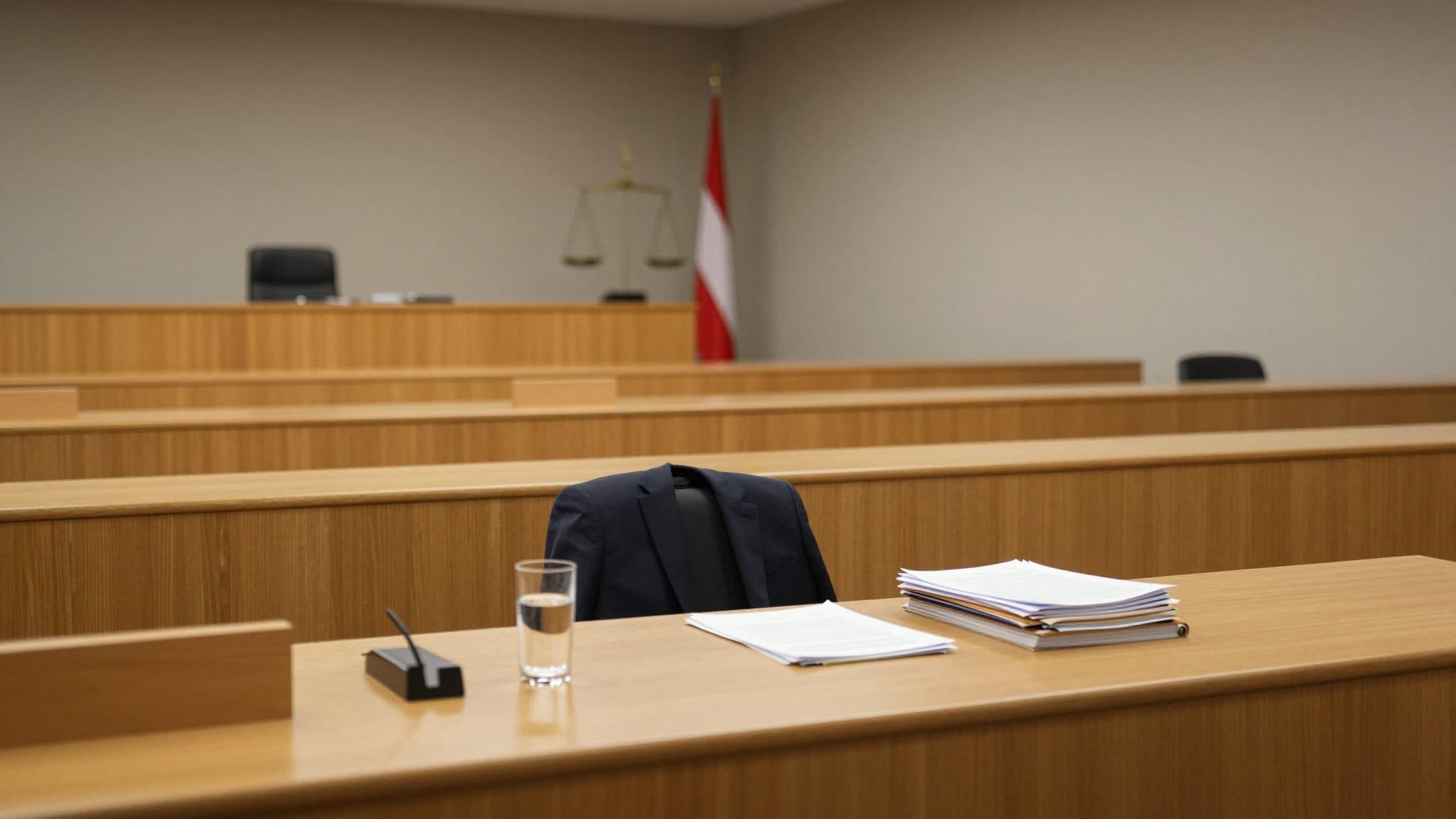
AI-generated image (z-image via Kie.ai)
Summary
A 70-year-old man was sentenced to 15 years in prison on Wednesday by the Salzburg Regional Court for the attempted murder of his ex-wife, whom he stabbed three times with a kitchen knife in January 2026. The verdict, reached after the eight jurors found an attempted murder rather than the lesser charge of grievous bodily harm, is not yet legally final.
Salzburg, 01 July 2026
The Salzburg Regional Court sentenced a 70-year-old man on Wednesday to 15 years in prison for the attempted murder of his ex-wife, whom he stabbed three times with a 20-centimetre kitchen knife at her home in the Flachgau district in January 2026.
The stabbing took place in January 2026 at the woman's home in the Flachgau district. According to court proceedings, the man entered her apartment with a kitchen knife with a 20-centimetre blade and stabbed her three times in the chest, abdominal and knee areas, leaving her with life-threatening injuries. When she asked what was happening, he answered that he would kill himself and then her, because she had taken his son away from him, the prosecutor quoted from the file.
The attack
The ex-wife testified in court as a witness. "Er ist mit dem Messer vor mir gestanden. Es war klar für mich, dass er mich umbringen will," she told the court. "Es sei alles so schnell gegangen. Ich bin froh, dass ich davongekommen bin." She added that there had been no argument prior to the attack and that the proposal for him to pay 200 euros a month for living there had not come from her. The ex-wife was operated on in hospital after the stabs and has since been undergoing psychotherapy.
The defendant and his ex-wife, who have a son together, were divorced in 1986. In 2013, when the ex-wife bought a house together with her son, the defendant moved in to carry out renovation work, originally planned for three months. "Aus den geplanten drei Monaten sind allerdings 'mehrere Jahre geworden'," the court heard. In 2022, the man moved out at the ex-wife's request. Shortly before Christmas 2025, he asked to live in the house again because he had become homeless and without means. The ex-wife agreed only to an emergency bed in her son's apartment until he found something else.
Background of the relationship
On 12 January 2026, the defendant told his son that he was at his wit's end because the ex-wife had asked him to pay a monthly contribution of 200 euros for living there. The court heard that he then went to his ex-wife's apartment because he did not want to die "ungesehen," without being seen by anyone.
The defendant himself stated in court that he was desperate with his life situation. "Ich war verzweifelt mit meiner Lebenssituation gewesen," he told the panel. He spoke of a trauma and "die nicht schönen Erinnerungen" to the relationship with his ex-wife. He described feeling unable to continue living and said he had wanted to commit suicide, inflicting a wound on himself with the knife.
Prosecution and defense arguments
The prosecutor characterised the case as a femicide attempt arising from a failed relationship. "Er war unzufrieden mit seiner tristen Situation und auch mit ihrem Verhalten," the prosecutor said. "Aufgrund der nicht überwundenen Trennung habe sich sein Groll aufgestaut." Only the woman's flight had prevented further stabs, the prosecutor argued, "sonst wäre sie vielleicht nicht mehr am Leben." The opening statement noted that the defendant was "unbescholten" in his prior life, "der Psychologie studiert hat."
The defense lawyer argued that the stabs had been delivered with low intensity and that the man had not pursued the woman when she fled. "Er wollte sicher nicht, dass die Frau stirbt," the defense maintained, adding that when the presiding judge asked the defendant about his earlier statements, he answered "das habe ich gesagt, um ihr Angst zu machen."
The verdict
The man confessed in court to intentionally causing grievous bodily harm, but the eight jurors found by majority that the act constituted attempted murder rather than the lesser charge. The Salzburg Regional Court then sentenced him to 15 years in prison. The verdict is not legally final, meaning it can still be appealed.
Support services in Austria
Resources for those affected by violence in Austria include the Frauen-Helpline (online frauenhelpline.at, phone 0800-222-555), the Autonomous Austrian Women's Shelters association (aoef.at), the women's shelter emergency line (057722), the Austrian violence protection centres (0800/700-217), and the police emergency number 133. The Federal Ministry of Health's suicide prevention portal also offers assistance to people with suicidal thoughts and their relatives.
Speaking outside the courtroom context, women's protection advocates in Austria have long pointed to the link between femicide attempts and economic dependency, homelessness and unresolved separations. The Salzburg case underscores how multiple vulnerabilities – the defendant's loss of housing and income, the prolonged shared living arrangement after divorce, and a request for a modest 200-euro monthly contribution – collided in a single evening in January 2026, with consequences the court deemed an attempted murder.
The case also drew on the testimony of the couple's adult son, who was contacted by his mother during the attack. "Sie habe noch den Sohn angerufen, da habe er gesagt, 'ich will dich mitnehmen'," the court heard, referring to the defendant's statement that he wanted to take her with him. The son was not named in court records and did not give testimony beyond what was relayed through his mother's account.
The presiding judge and two lay judges, sitting alongside the eight jurors, deliberated through Wednesday afternoon before the verdict was announced. Because the verdict is not rechtskräftig, the defendant retains the right to appeal, and a higher court could in principle reduce the charge to intentionally serious bodily harm with a shorter sentence. The courtroom was described as tense throughout the day, with the ex-wife present as a witness.
In Austrian criminal law, attempted murder under section 75 of the Criminal Code carries a minimum sentence of ten years, with fifteen years as a typical outcome where aggravating factors such as the use of a knife and life-threatening injuries are present. The court is understood to have taken the three-fold stabbing, the kitchen knife as the weapon, and the declaration of intent to kill into account when fixing the sentence at fifteen years.
Reactions from women's organisations were not yet recorded in court records, but domestic violence support groups in Salzburg and Vienna regularly use high-profile trials to remind the public of the help lines listed above. The case will be added to the ongoing tally maintained by Austria's violence protection centres and is expected to be cited in future prevention campaigns.
The trial attracted attention in Salzburg beyond the courtroom, with the Salzburg Regional Court building drawing media interest throughout the day. Legal commentators noted that the combination of an earlier confession to a lesser charge and a jury finding for the more serious offence makes the judgment legally complex, even before any appeal is considered. The defendant's prior life as a "unbescholtene Akademiker," as the prosecutor put it, was weighed by the jurors against the gravity of the attack.
Questions & Answers
What was the man sentenced for?
The 70-year-old defendant was sentenced to 15 years in prison for the attempted murder of his ex-wife, whom he stabbed three times with a 20-centimetre kitchen knife in January 2026. The eight jurors found by majority that the act constituted attempted murder rather than the lesser charge of grievous bodily harm, which the man had confessed to.
What did the ex-wife say in court?
She testified that the defendant stood before her with the knife and that it was clear to her he wanted to kill her, that everything happened so quickly that she could not act, and that she was glad she escaped. She also said there had been no argument prior to the attack and that the proposal to pay 200 euros a month had not come from her.
Is the verdict final?
No. The verdict, handed down by the Salzburg Regional Court on Wednesday, is not legally final and can still be appealed. A higher court could in principle reduce the charge to intentionally serious bodily harm with a shorter sentence.
Salzburg attempted murder: 15-year sentence for ex-wife | allfacts360