Ukraine Russia drone strikes: industrial sites hit on June | allfacts360
Massive Ukrainian drone strikes on industrial sites in Russia: one dead, several fires and air disruptions
Moscow, June 14, 2026
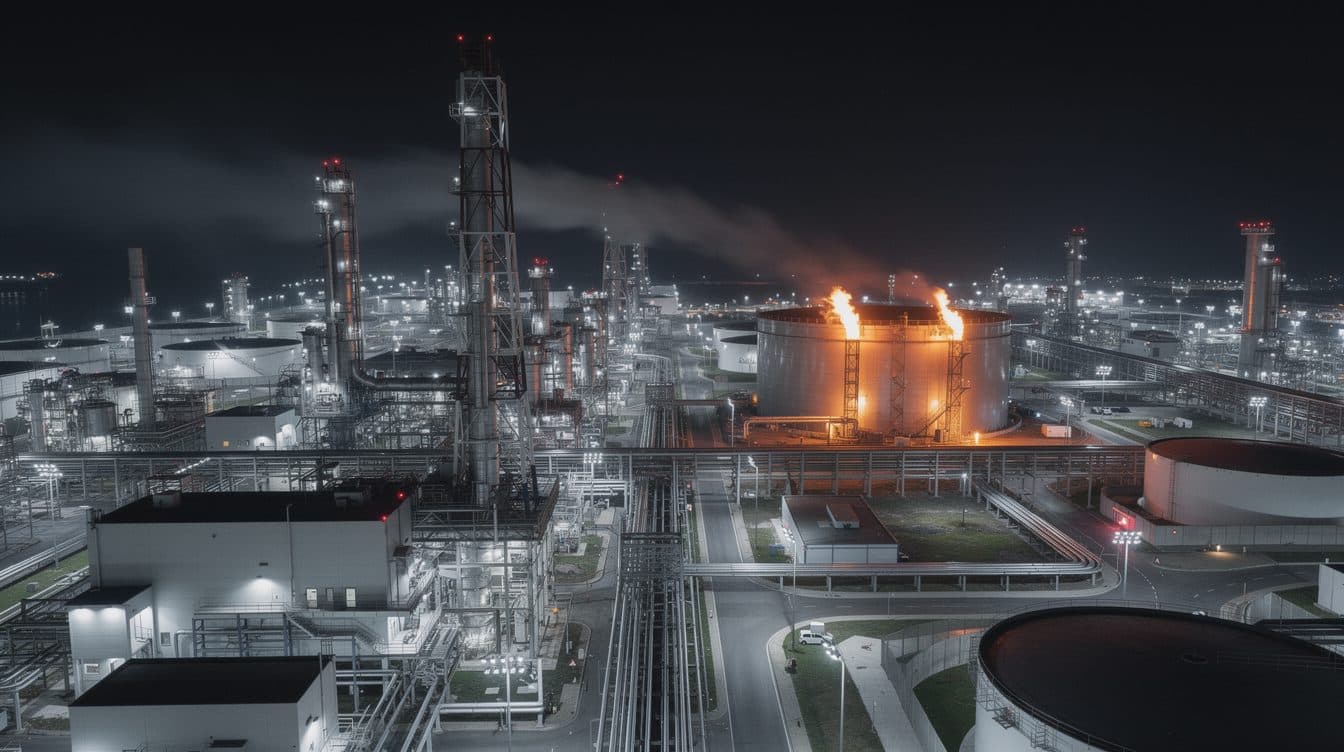
AI-generated image (flux-2/pro-text-to-image via Kie.ai)
Summary
Ukraine launched a massive drone attack during the night of June 13 to 14, 2026 against several Russian regions, hitting industrial facilities in Ryazan, Yaroslavl and Tula as well as a building in Orel, causing one death and eight injuries. The Russian Ministry of Defense announced it had shot down 249 aircraft, but the attack disrupted air traffic in Moscow and caused fuel shortages.
Moscow, June 14, 2026
During the night of June 13 to 14, 2026, Ukraine struck several Russian regions with drones, causing fires at industrial facilities, disruptions to air traffic in Moscow, fuel shortages and the death of one person in Orel, according to Russian and Ukrainian authorities.
Ukraine triggered fires during the night from Saturday to Sunday at industrial facilities located in the Russian regions of Tula and Yaroslavl, as well as in Rybinsk, following massive drone attacks, according to statements from local governors and the Ukrainian intelligence service SBU. « Die Ukraine hat mit Drohnenangriffen auf Russland Brände in Industrieanlagen in den Gebieten Tula und Jaroslawl ausgelöst », news agencies reported on Sunday, citing Russian regional authorities. The SBU specified that several drones crashed into a warehouse of the state reserve in Rybinsk, located 700 kilometers from the Ukrainian border, triggering a major disaster.
Fires at strategic sites in Yaroslavl and Tula
The governor of the Yaroslavl region, Mikhail Evraiev, reported a drone attack on industrial fuel storage facilities that caused a fire. « Verletzte gebe es nicht, teilte der Beamte mit », the dpa agency specified. No casualties are to be deplored in this region according to the official, who provided no details on the extent of the damage.
In the Tula region, located south of Moscow, governor Dmitry Milaiev indicated that debris from a shot-down drone fell on the site of a chemical plant in Novomoskovsk. The Asot facility is one of the largest chemical complexes in Russia, producing mainly fertilizers but also components used in the manufacture of munitions in defense factories, according to information disseminated by German media citing industry experts.
The SBU justified these strikes by declaring that the fuels stored at the Rybinsk site, notably gasoline and diesel, are also used to supply the Russian army and therefore constitute legitimate targets. « Die dort gelagerten Kraftstoffe, darunter Benzin und Diesel, würden auch für die Versorgung der russischen Armee genutzt - und seien deshalb legitime Ziele, teilte der SBU mit », the German press agency dpa reported, relaying the position of the Ukrainian intelligence service.
One dead and eight injured in a strike in Orel
In Orel, a city located about 350 kilometers west of Moscow, a drone struck a high-rise building, causing the death of one person and injuring eight, announced governor Andrei Klychkov, who published photos of the damage. « In Orjol - rund 350 Kilometer westlich von Moskau - schlug eine Drohne in einem Hochhaus ein, wie Gouverneur Andrej Klytschkow mitteilte. Ein Mensch sei getötet worden bei dem gezielten Angriff; es gebe auch acht Verletzte », the dpa agency reported. The governor initially provided no information on the extent of the damage or on any potential health risks for the population.
The mayor of Moscow, Sergei Sobyanin, stated that several drone attacks had been repelled. Zhukovsky airport had to be closed due to an air alert, and restrictions were also imposed at the capital's Domodedovo airport, according to Russian authorities. The Russian Ministry of Defense announced Sunday morning that it had shot down a total of 249 aerial objects in different regions, without specifying whether they were only drones or also other devices.
Air disruptions and Russian defense
Ukrainian President Volodymyr Zelensky claimed that Kyiv's attacks had triggered air alerts in 28 regions and caused air traffic restrictions at six airports. « Insgesamt hätten die Angriffe Kiews in 28 Regionen Luftalarm ausgelöst; an sechs Flughäfen haben es Einschränkungen im Flugverkehr gegeben, teilte der Staatschef bei Telegram mit », the German press agency reported. The Ukrainian leader also released a video showing a major fire with thick clouds of black smoke and drones in flight.
Zelensky claims a large-scale operation
On the social network X, Zelensky declared: « Wir setzen unsere ukrainischen Langstreckenangriffe auf russische Militäreinrichtungen und die Ölindustrie fort », emphasizing Kyiv's determination to continue its long-range strikes against Russian military facilities and oil industry. He added that Ukraine had proposed to Russia every possible format of negotiations and that the response had been only a continuation of aggression. « Wir haben der russischen Führung alle möglichen Formate für Verhandlungen angeboten, und die Antwort waren nur eine Fortsetzung der Aggression und Versuche, sie auszuweiten », he asserted. The Ukrainian president also launched: « Logischerweise kehrt der Krieg nun dorthin zurück, woher er gekommen ist », presenting the strikes as a response to Russia's refusal to end the conflict.
Zelensky also congratulated the SBU for the successful strikes. « Der ukrainische Präsident Selenskyj lobte den Geheimdienst für die Treffer », dpa reported. These attacks, carried out mainly with drones and increasingly with missiles such as the FP-5 Flamingo developed in Ukraine, regularly target industrial facilities important to the Russian war economy, observers note.
Gasoline shortages as far as Crimea
The consequences of the strikes are already being felt in fuel supply. Reports mention gasoline shortages at gas stations in Tatarstan, Moscow and Saint Petersburg, and the situation is particularly difficult in the Crimean peninsula annexed by Russia in 2014, according to information relayed by German media. « Berichte über Benzin-Engpässe an Tankstellen gibt es inzwischen sogar aus dem weit von der Ukraine entfernten Tatarstan, aber auch aus Moskau und St. Petersburg. Besonders schwierig ist die Lage auf der von Russland schon 2014 annektierten Schwarzmeer-Halbinsel Krim », several concordant sources reported.
The Russian government was keen to stress that the situation remained under control. « Die russische Regierung betont, dass die Lage unter Kontrolle sei », according to statements relayed by the German press agency. However, the scale of the strikes, which simultaneously hit several regions far from the front, illustrates Ukraine's ability to strike deep inside Russian territory, at distances reaching 700 kilometers from the border.
Russian pressure on the eastern front
Ukraine has been defending itself for more than four years against the Russian invasion and regularly conducts counter-attacks against industrial facilities in the neighboring country. « Die Ukraine verteidigt sich in dem seit mehr als vier Jahren andauernden russischen Angriffskrieg mit Gegenattacken auf die Industrieanlagen des Nachbarlandes », German media summarized, highlighting Kyiv's strategy of striking the logistical bases of the Russian war effort.
On the eastern front, where the bulk of the fighting is concentrated, the situation also remains tense for Ukrainian forces. The Russian Ministry of Defense claimed that Russian troops were advancing in the city of Kostiantynivka, in the Donetsk oblast, where assault groups had taken control of more than a hundred buildings. The ministry also claimed that Ukrainian units in the southwest of the city were encircled and destroyed, and that Ukraine was evacuating important enterprises from the neighboring cities of Kramatorsk and Druzhkivka in the face of the Russian advance.
The Institute for the Study of War (ISW) based in Washington noted in an analysis that Ukrainian defense capabilities in Kostiantynivka had degraded. The American experts however noted that Moscow's detailed assertions could aim to create an impression of a larger Russian presence than reality. Russian President Vladimir Putin has made full control of the Donetsk oblast an important war objective and a prerequisite for ceasefire negotiations, which underscores the strategic stakes of this area.
The Ukrainian army has for its part recently acknowledged a difficult situation in the city of Kostiantynivka. Independent military observers consider a fall of the city possible in the summer months, which would leave under Ukrainian control, among the large cities of the Donetsk oblast, only Sloviansk, Kramatorsk and Druzhkivka, as the German press reported. The concomitance between Ukrainian strikes deep into Russian territory and Russian pressure on the eastern front illustrates the continuing escalation of the conflict, whose diplomatic outcome still seems as uncertain as ever.
Questions & Answers
Which Russian regions were hit by the Ukrainian strikes of June 14, 2026?
Ukrainian drones struck industrial sites in the Tula region (Asot chemical plant in Novomoskovsk), in Yaroslavl (fuel storage facilities) as well as in Rybinsk (state reserve warehouse), and a building in Orel, causing one death and eight injuries.
How many drones does Russia claim to have shot down?
The Russian Ministry of Defense announced it had shot down a total of 249 aerial objects in different regions on the morning of June 14, 2026, while Zelensky claimed the strikes had triggered air alerts in 28 regions and restrictions at six airports.
Why does Ukraine justify these strikes against Russian industrial facilities?
The SBU stated that the fuels stored at the targeted sites, notably gasoline and diesel, are also used to supply the Russian army, which makes them legitimate targets in its view. President Zelensky presented these attacks as a response to Russia's refusal to end the conflict. IMAGE