Ukrainian Drone Attacks on Oil Facilities in Southern Russia – Fires in Azov, Taganrog, and Ilskiy
Berlin, 10 July 2026
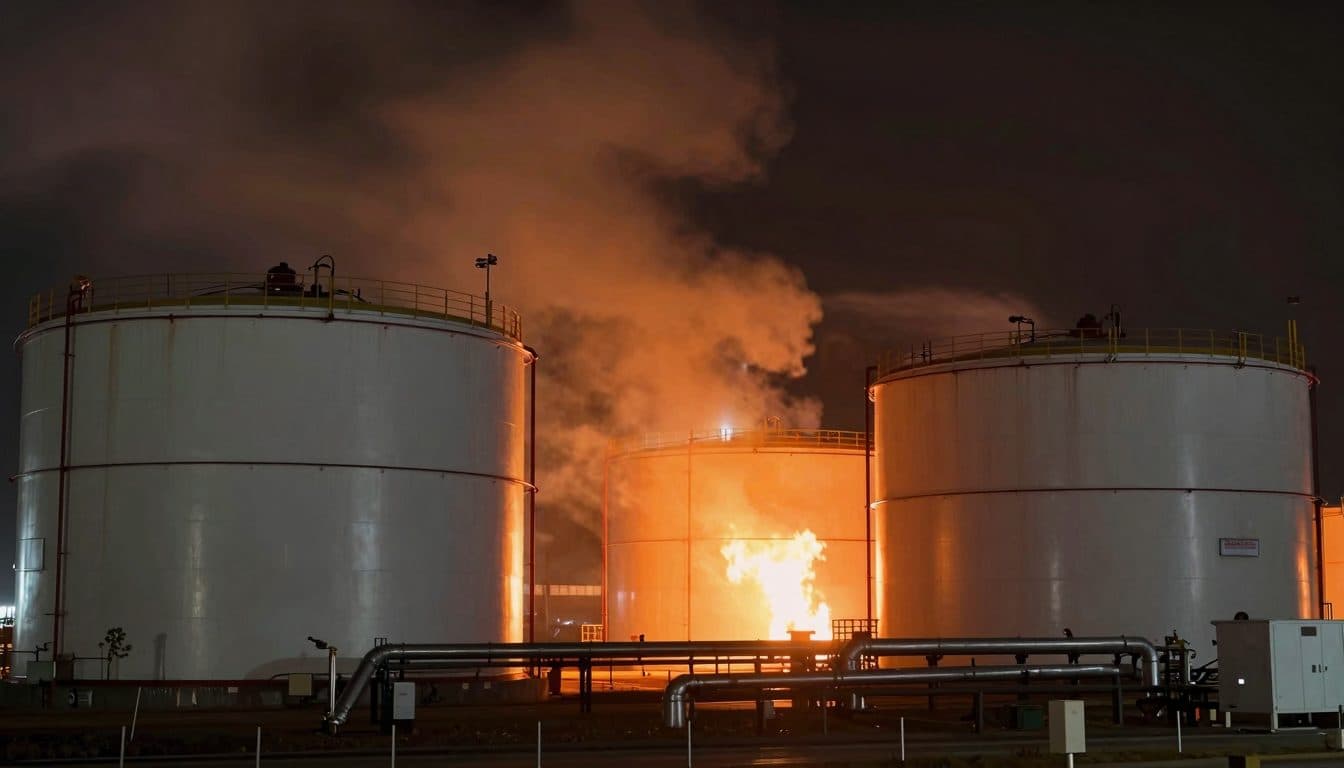
AI-generated image (z-image via Kie.ai)
Summary
Overnight into Friday, Ukraine used drones to attack a refinery and several oil depots in southern Russia. In Azov, two oil storage facilities and an administrative building caught fire; in Taganrog, the port came under fire; and at the Ilskiy refinery southwest of Krasnodar, another fire broke out. According to official reports, there were no injuries.
Berlin, 10 July 2026
Ukraine used drones to attack and damage a refinery and several oil depots in southern Russia overnight into Friday; fires broke out in Azov, Taganrog, and at the Ilskiy refinery southwest of Krasnodar.
In Rostov Oblast, two oil storage facilities and an administrative building caught fire in the city of Azov, according to Governor Yuri Slyusar. Slyusar shared the damage reports via the messaging service Telegram. He also said the port in the major city of Taganrog had come under fire. Firefighting operations were underway, Slyusar wrote. There were no casualties.
The Ukrainian side carried out the attacks with drones, as is evident from the context of the reports. „Diese wehrt sich nun verstärkt mit Drohnenangriffen, die auf Militärobjekte, Rüstungsbetriebe und strategisch wichtige Anlagen der Ölindustrie zielen“, according to the reporting. The drone campaign has, according to consistent accounts, become a central element of Ukraine's defense against the Russian war of aggression, now in its fourth year.
Fires in Azov, Taganrog, and Ilskiy
The Ilskiy refinery southwest of Krasnodar, one of the most frequently attacked oil facilities in Russia, also caught fire. „Einmal mehr gab es einen Brand in der Raffinerie von Ilski südwestlich von Krasnodar“, it was reported. Ukrainian drones have already attacked it more than a dozen times. In Krasnodar, a fire broke out at the Ilskiy oil refinery as a result of the Ukrainian attacks, according to local authorities, and has since been extinguished. No people were harmed, according to the statement from the regional crisis center.
According to the Russian military, more than 370 drones were shot down in total overnight. The Russian air defense reported the downing of 376 Ukrainian drones. The Ukrainian side did not initially comment on its own losses. Russia also claimed to have foiled a „Terrorakt" against a military airfield in Rostov. Ukrainian drones had been involved in the attack, according to the Russian domestic intelligence agency FSB, as reported by the state news agency Interfax.
Scale of the Drone Attacks and Defense
The impact of the drone campaign on Russian energy infrastructure is, according to observers, significant. „Wegen der ständigen Attacken ist in Russland die Verarbeitung von Öl deutlich gesunken", the available sources report. Practically all Russian regions are experiencing fuel shortages. The attacks deliberately target hubs of the oil economy in order to weaken the logistical supply of the Russian armed forces and the economy.
In parallel with the attacks, the tone from the Kremlin is sharpening. Kremlin spokesman Dmitry Peskov stated on Friday that Ukraine was firing on civilian infrastructure as well as facilities directly connected to the Zaporizhzhia nuclear power plant. This was extremely dangerous. The Kremlin also accused Ukraine of escalating „terroristischer" attacks on the Zaporizhzhia nuclear power plant controlled by Russia. Peskov was responding to a report by the news agency Reuters, according to which recent Ukrainian drone attacks on Russian oil refineries and ports have reinforced Putin in his determination.
Kremlin: Buffer Zone and Accusations over Zaporizhzhia
Peskov also justified the establishment of a broader buffer zone in Ukraine. „Als Reaktion auf eine Eskalation seitens der Regierung in Kiew richte Russland jedoch eine ausgedehntere Pufferzone in der Ukraine ein", he said. Since Ukraine is currently showing no interest in negotiations, Russia is continuing its military operation. The Kremlin thus directly linked the drone attacks to the justification for further advances by Russian troops.
Both sides have long accused each other of endangering the safety of the nuclear facility through military actions. According to international observers, the situation surrounding Europe's largest nuclear power plant remains a sensitive point of the conflict. The mutual accusations make independent verification of the incidents on the ground difficult.
Kyiv's Assessment of the Situation and Russian Losses
From Kyiv, meanwhile, come reports on the course of the fighting that cannot be independently verified. According to Kyiv, the Russian military conquered less than half as much Ukrainian territory in the first half of 2026 as in the comparable prior-year period, despite extremely high losses. Ukrainian Commander-in-Chief Oleksandr Syrsky wrote on Telegram that Russia had planned a large-scale offensive but had practically achieved none of its stated goals.
Syrsky provided further figures that are doubted by analysts. „Dank der aktiven Handlungen der Verteidiger ist im ersten Halbjahr 2026 das Tempo des Vorrückens russischer Truppen um mehr als die Hälfte gesunken", he wrote. He put Russian losses at just under 32,000 killed or seriously wounded per month. According to Syrsky, the Ukrainians have recently even managed to recapture roughly as much territory as they have lost elsewhere.
On the Russian side as well, there are growing signs of personnel problems. Recruitment problems were previously essentially known only in Ukraine. According to Russia's ex-president Dmitry Medvedev, 210,000 Russians signed up for the war in Ukraine in the first half of 2026. These figures are doubted by analysts. Despite record bonuses, the number of volunteers collapsed by a third in 2026 and is now below 30,000 per month, according to the independent portal „Wjorstka".
Recruitment Problems in Russia as Well
Recently, videos causing outrage had circulated on social networks showing men in the provincial city of Penza being forcibly recruited for military service. The reports of forced recruitment shed light on the growing pressure under which the Russian leadership is placing the recruitment of new soldiers. Observers see this as an indication of declining volunteer numbers and rising losses.
Taken together, the wave of attacks over the past night is having both military and economic effects. With the fires in Azov, Taganrog, and Ilskiy, the Ukrainian drone campaign has once again hit hubs of the Russian oil supply, whose processing capacities have declined significantly because of the constant attacks. The fuel shortage in practically all Russian regions is putting pressure on the economy and logistics.
Outlook: Ongoing Escalation Without Prospect of Negotiations
The escalation spiral of drone attacks, mutual accusations, and Russian threats to expand the buffer zone suggests that neither side currently sees a viable negotiated solution. Peskov said Ukraine was currently showing no interest in negotiations, which is why Russia is continuing its military operation. From Kyiv, it is said that the Ukrainian defense has slowed the advance of Russian troops and partially regained territorial gains.
International observers point to the precarious security situation around the Zaporizhzhia nuclear power plant. Both sides accuse each other of endangering nuclear security through attacks on civilian infrastructure and associated facilities. As long as independent verification is not possible, the mutual accounts remain contested, and the diplomatic room for de-escalation appears limited.
Questions & Answers
Welche Ziele wurden in der Nacht auf Freitag angegriffen?
Ukrainian drones attacked two oil storage facilities and an administrative building in the city of Azov, the port of Taganrog, and the Ilskiy refinery southwest of Krasnodar, according to official reports; fires broke out at all three locations.
Wie reagiert der Kreml auf die Angriffe?
Kremlin spokesman Dmitry Peskov accused Ukraine of escalating „terroristischer" attacks on the Zaporizhzhia nuclear power plant controlled by Russia and announced the establishment of a more extensive buffer zone in Ukraine.
Welche Folgen haben die Drohnenangriffe für die russische Ölversorgung?
Because of the constant attacks, oil processing in Russia has declined significantly, and practically all Russian regions are experiencing fuel shortages.
Ukrainian Drone Attacks: Fires in Azov, Taganrog, and Ilskiy | allfacts360