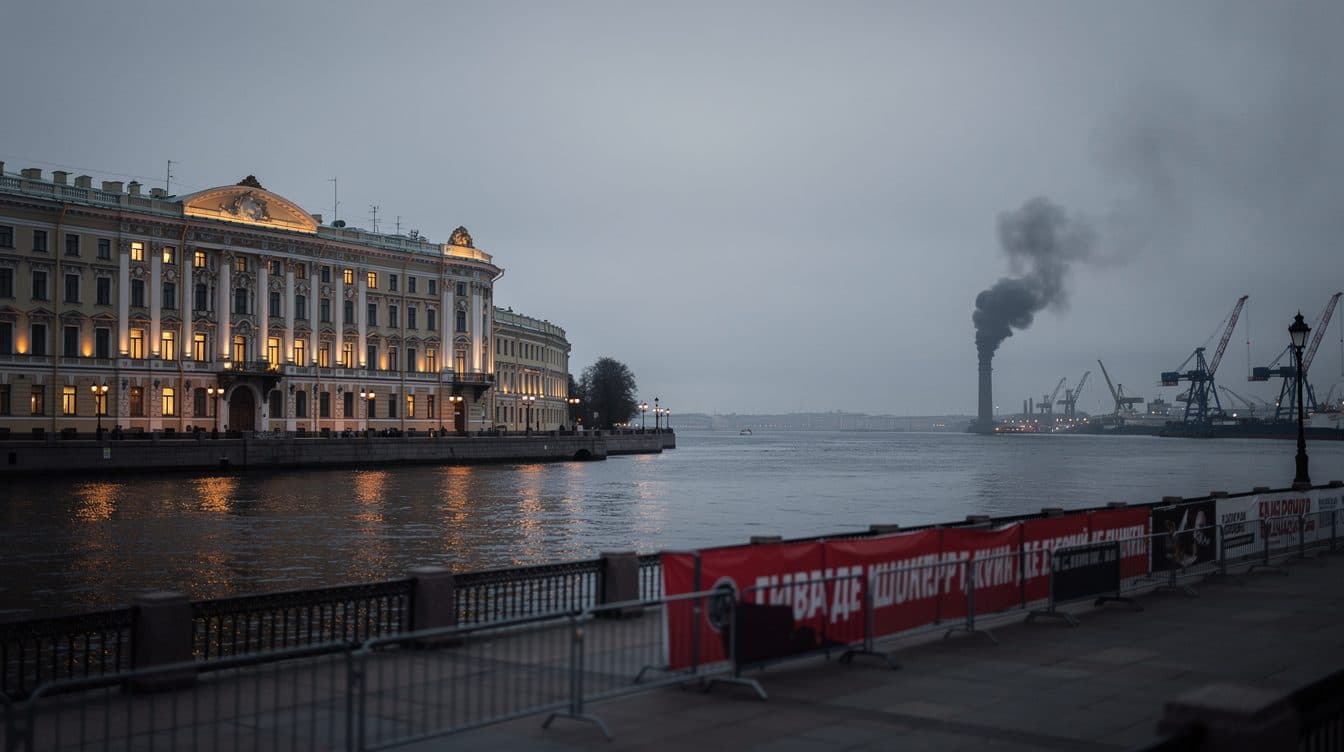
Ukrainian Drone Attacks on St. Petersburg and Other Russian Regions on the Final Day of the Economic Forum
St. Petersburg, June 6, 2026
AI-generated image (flux-2/pro-text-to-image via Kie.ai)
Summary
On the final day of the international economic forum in St. Petersburg, Ukraine attacked the Russian metropolis and nearly 20 other regions with drones. According to Russian figures, air defenses shot down 911 drones and 13 guided bombs within 24 hours; there were injuries and evacuations in St. Petersburg and the Leningrad region.
St. Petersburg, June 6, 2026
Ukrainian drone attacks on the final day of the St. Petersburg Economic Forum hit the metropolis of St. Petersburg, the Baltic Sea port of Kronstadt, and nearly 20 other Russian regions, with Russian reports stating that air defenses shot down 911 drones and 13 guided bombs within 24 hours.
The attacks took place on Saturday, the closing day of the St. Petersburg International Economic Forum (SPIEF), which has been held annually by the Russian government since 1997 and attracts thousands of participants. Already on Wednesday, the first day of the forum, Ukraine had attacked energy and military facilities in the city shortly before the conference began; black plumes of smoke had risen above the historic old town, a UNESCO World Heritage Site. On Friday evening, Kremlin chief Vladimir Putin acknowledged at the forum that the attacks had caused "certain damage" to the economy.
Reports of drone strikes also came from other parts of Russia, including the area around the capital Moscow. The port of Mariupol in the Moscow-annexed Donetsk region was also said to have been hit. Media reported that oil depots had caught fire following explosions. Moscow Mayor Sergei Sobyanin stated that several drones flying toward the capital had been shot down. In total, nearly 20 regions were reportedly affected – including Moscow, Kursk, Bryansk, Belgorod, Rostov, Ryazan, Tula, and over the Russia-annexed Crimean Peninsula.
Scale of the Attacks
In the Leningrad region, Governor Alexander Drosdenko said air defenses had shot down 141 drones. He also reported the evacuation of residential buildings near a military facility where a fire had broken out following a drone strike. The governor said this was a temporary safety measure. St. Petersburg media reported that in the town of Bolshaya Izhora on the Gulf of Finland, 600 people had to leave their homes. One injured person was taken to hospital.
Governor Alexander Beglov and civil protection authorities informed the public of a "large-scale attack by military drones." Air defenses were active. In accordance with the recommendations of the operations headquarters, I ask residents of St. Petersburg to stay in their apartments and not go out onto the streets, Beglov wrote on Telegram. According to St. Petersburg Governor Alexander Beglov, three people were slightly injured in the city. Civil protection authorities also issued a drone alert via SMS. According to the BBC, this was the first such appeal to the public since the beginning of the Russian invasion of Ukraine.
In the Leningrad region, falling debris reportedly damaged building facades and windows. At Pulkovo Airport, which is important for the forum's international guests, takeoffs and landings were temporarily suspended in the morning due to the drone threat. In the southern Russian city of Ust-Labinsk, a drone attack triggered a fire at an oil depot, according to local authorities. In the Krasnodar region, an oil depot in the city of Ust-Labinsk was hit – roughly 500 kilometers from Ukraine. The SBU said it was a fuel depot important for the Russian armed forces.
Hits in Kronstadt and at Oil Infrastructure
There were also attacks in the Baltic Sea port of Kronstadt, used by the Russian Navy, which is part of St. Petersburg, according to reports. Arsenals for missiles and ammunition and naval bases were hit there, Ukraine's SBU intelligence service in Kyiv said. "Such special operations weaken the Baltic Fleet," the SBU stated. The attacks complicated the logistics of the Russian armed forces and reduced the enemy's combat readiness. Ukrainian President Volodymyr Zelensky confirmed attacks on the oil depot in Krasnodar and the military base in St. Petersburg on the platform X. He wrote that the drones had traveled around 1,000 kilometers to reach St. Petersburg.
In the Tver region, a man was killed by drone debris, according to authorities. A fire also broke out at the Antipinsky refinery in the Tyumen region, Russia's largest non-state-owned oil processing facility. However, local authorities stated via Telegram that the cause was procedural violations at a cleaning facility; they rejected reports of a Ukrainian drone attack. Russian media also reported a fire at an oil depot in the Krasnodar region as a result of a drone attack.
Putin and Zelensky in Verbal Exchange
Putin sent mixed signals at the forum. "These attacks naturally lead to nothing good," he said. Strengthening air defenses was important, but there were no risks to the Russian economy, the president argued. At the same time, he rejected a direct meeting proposed by Zelensky: he saw "no point" in such a meeting as long as no peace agreement was in place, the Kremlin chief said. "Let the experts work and develop solutions, and then we can meet." Instead, Putin met with former Chancellor Schröder in Moscow, as his advisor Yuri Ushakov reported. It was "a good conversation," Ushakov said. He could not comment on the content because it had been a "one-on-one conversation."
The Ukrainian president fired back: "Unfortunately, the Russian side is once again choosing war – everyone heard today's answer," Zelensky said on Friday. "A weak answer. He simply does not want to end the war," Zelensky added. Via Telegram, he demanded: "Russia must end its war and stop its attacks on life." Ukraine has massively expanded its drone capabilities and hopes to effectively bring Russia to the negotiating table through counterattacks.
Diplomatic Reactions from the West
While the spiral of violence is escalating on the Russian side, diplomatic efforts in the West continue. Chancellor Merz is traveling to London on Sunday for a meeting with Zelensky, which will also be attended by French President Emmanuel Macron and British Prime Minister Keir Starmer. According to sources in Paris, the meeting will focus on further support for Ukraine and increased pressure on Russia. There will also be a review of the work of the so-called Coalition of the Willing. This group includes around 35 mostly European countries, including Germany, as well as Australia, New Zealand, and Japan.
The Ukrainian Air Force meanwhile reported that the majority of 272 drones that had flown in during the night into Saturday had been intercepted. In the Zaporizhzhia region, two people were killed according to authorities, and one person in the Dnipropetrovsk region, with three others injured. The economic forum in St. Petersburg, however, continued as usual with thousands of participants – despite the attack on the final day, described as "unprecedented."
Questions & Answers
What happened on the final day of the economic forum in St. Petersburg?
Ukrainian forces attacked the metropolis of St. Petersburg and nearly 20 other Russian regions with drones, including the port of Kronstadt. According to Russian figures, air defenses shot down 911 drones and 13 guided bombs within 24 hours; there were injuries and evacuations in St. Petersburg and the Leningrad region.
How did Kremlin chief Vladimir Putin react to the attacks?
Putin acknowledged "certain damage" to the economy at the economic forum but spoke of no risks to the Russian economy. He rejected a direct meeting proposed by Volodymyr Zelensky and emphasized the need for stronger air defenses.
Which targets were hit according to Ukraine's SBU intelligence service?
The SBU said arsenals for missiles and ammunition as well as naval bases had been hit in Kronstadt. In Ust-Labinsk in the Krasnodar region, a fuel depot important for the Russian armed forces had caught fire.
Drone Attacks St. Petersburg SPIEF 2026 | allfacts360