Massive wave of Russian attacks on Ukraine: Kyiv hit in the worst night since the start of the war
Kyiv, July 2, 2026
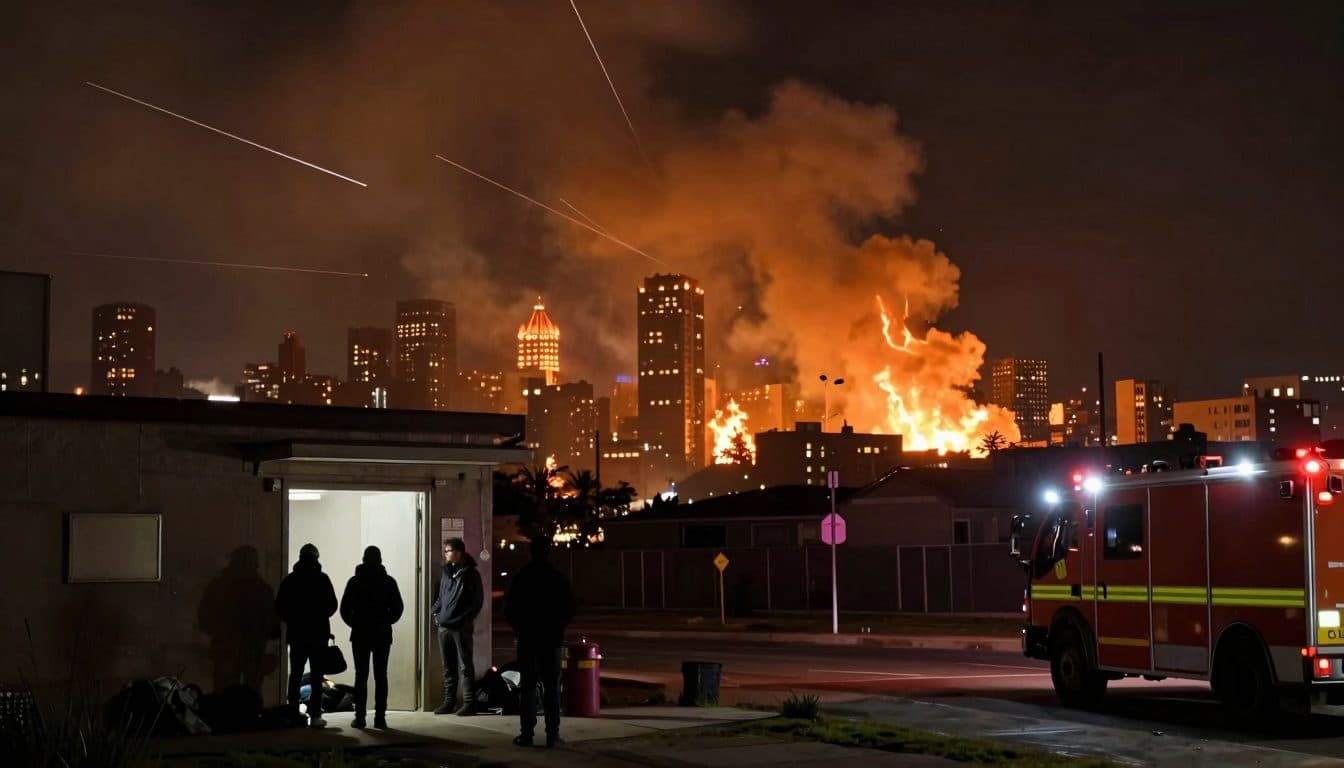
AI-generated image (z-image via Kie.ai)
Summary
A very violent wave of Russian attacks hit several Ukrainian cities overnight, particularly Kyiv, described as one of the heaviest since the start of the war. Authorities report at least eight dead and 34 wounded in the capital alone, while the overall military death toll exceeds two million.
Kyiv, July 2, 2026
On the night between Wednesday and Thursday, Russia launched one of the heaviest waves of drone, ballistic missile, and cruise missile attacks since the start of the war, hitting Kyiv and other Ukrainian cities hard.
UPDATE July 2, 2026: Russia unleashed a massive barrage of attacks against Ukraine overnight, with dozens of missiles, cruise missiles, and hundreds of drones, described as one of the most violent waves since the start of the conflict. Ukrainian air defense was engaged on multiple fronts while Kyiv authorities updated the toll.
What's new as of July 2, 2026
Ukrainian President Volodymyr Zelensky was in Dublin for the kickoff ceremony of Ireland's six-month presidency of the Council of the European Union. During a press briefing he warned that «ogni una o due settimane ci sono attacchi massicci con centinaia di droni e decine di missili», adding: «today comes the unpleasant information about the preparation of the next massive Russian attack». Zelensky cut short his stay in the Irish capital to return because of the imminent attack.
In Kyiv the explosions began in the evening and continued throughout the night, with new air raids sounding in the early morning hours. Mayor Vitali Klitschko wrote on Telegram that «l'intera città» is under Russian attack. Kyiv Independent reporters described «esplosioni incredibilmente forti», audible even in the deepest underground shelters.
Zelensky's warning from Dublin
According to city authorities, at least eight people were killed and 34 wounded in the Ukrainian capital alone on the night into Thursday, including two children according to military governor Tymur Tkatschenko, who spoke of at least 56 people involved. Mayor Klitschko had initially reported one dead and eleven wounded, but the toll rose rapidly as rescue operations continued.
The Kyiv Independent reported that multi-story buildings, including a hotel, caught fire and that some residential buildings were completely destroyed. Authorities urged the population to go to shelters and many Kyiv residents sought refuge in metro stations, where some set up tents to spend the night underground.
The attack spared no other Ukrainian cities. According to the Kyiv Independent portal, ballistic and cruise missiles were used. Air raid alerts and explosions were reported in Zaporizhzhia and Pavlohrad, in the southeast of the country, as well as in Sumy and Kharkiv, in the northeast. At the time, no information was available on possible damage and casualties in these cities.
Kyiv under assault: the toll
Zelensky denounced a new round of bombings that came just hours after the formal launch of Ireland's EU presidency, stressing how the war continues to claim civilian victims in their sleep. Kyiv residents described nights of terror spent in metro stations, with makeshift tents to protect themselves from shrapnel.
Meanwhile, according to Ukrainian defense sources, the Ukrainian armed forces hit Russian military-industrial facilities and a refinery located far beyond the border in the early morning hours. This is an operation that is part of the strategy of attacking Russian oil and logistics industry, which according to Erhard Bühler, former NATO general, is worsening the fuel crisis in Russia: seventy-eight Russian regions would now report gasoline and diesel shortages.
A study by the Center for Strategic and International Studies (CSIS) based in Washington, cited by international news agencies, estimated that combined Russian and Ukrainian losses have exceeded two million soldiers since the start of the invasion in February 2022, of which about 1.4 million on the Russian side. The report indicates between 400,000 and 450,000 Russian dead and between 125,000 and 150,000 Ukrainians, with a loss ratio estimated in the first half of 2026 of 8 to 1 against Moscow.
The attack extends to other cities
At the end of January, CSIS estimates were instead around 325,000 Russians killed and between 100,000 and 140,000 Ukrainians: the updated figure therefore marks a clear deterioration. The same report highlights how in the spring of 2026 Russian forces failed for the first time in years to expand the territory under their control, instead having to register some Ukrainian advances.
On the political-diplomatic front, the Ukrainian parliament approved by a large majority the creation of a «Pantheon» in Kyiv intended to host the remains of «eminent representatives of the Ukrainian nation», at a time of strong tensions with Poland over historical memory. Zelensky, for his part, refused to comment on the first indictment in the case of the Nord Stream pipeline explosions.
Zelensky also criticized the fact that European companies continue to work for Russia and asked the European Union to release 6.6 billion euros in aid. The Kremlin, for its part, announced the closure of railway crossings on the border, while the Russian economy is described by Russian sources themselves as being in a phase of deep crisis.
The CSIS study: two million military losses
The picture that emerges is that of a conflict that continues to intensify on the military front despite repeated declarations of openness to dialogue. The wave of attacks on Kyiv overnight, defined by the Kyiv Independent as «one of the heaviest since the start of the war», is part of a cycle of bombings that the Ukrainian president describes as systematic: massive attacks on a weekly or biweekly basis against civilian targets and energy infrastructure.
Ukrainian authorities stressed that anti-aircraft defenses were activated on multiple levels and that rescue operations continued throughout the night. The death toll, still provisional, could worsen as checks on damage to affected buildings progress.
On the diplomatic front, the simultaneous presence of Zelensky in Dublin for the handover of the EU presidency and his early return for the attack reinforced Kyiv's message to Europeans: more air defenses and more effective sanctions against the Russian industrial-military apparatus are needed. The request for 6.6 billion from the EU fits into this context of pressure.
The news of civilian victims and the destruction of entire residential blocks in Kyiv comes as the Ukrainian Parliament enacts the «Pantheon» and as former General Bühler denounces a fuel crisis now extended to seventy-eight Russian regions. Two dynamics that, according to analysts, contribute to eroding Moscow's ability to sustain the war effort.
Diplomatic context and international reactions
The chronicle of this night confirms the trend, already highlighted by the CSIS report, of a war that is wearing itself down: the estimated loss ratio of 8 to 1 against the Russians in the first half of 2026 suggests a progressive weakening of Moscow's offensive capabilities, despite increasingly destructive attacks against Ukrainian cities. The war, therefore, enters a phase in which the brutality of the bombings coexists with signs of growing difficulty on the ground for Russian troops.
International reactions to the attack were not long in coming. Several European governments condemned the bombings, while Ukrainian diplomatic services requested an urgent meeting of the UN Security Council. Zelensky, who returned early to Kyiv, spoke in a nighttime video message of a «long-planned» attack, aimed at hitting the civilian population during sleep.
The Kremlin did not officially comment on the CSIS estimates on losses, but some sources close to the Russian Defense Ministry would have admitted difficulties in recruiting new personnel. The simultaneous fuel crisis, according to Bühler, makes Russian military logistics more vulnerable, especially along the corridors that supply the southern front.
The Thursday thus opens under the sign of a dual emergency for Ukraine: on the one hand the need to rescue victims and restore damaged infrastructure, on the other the request for concrete support from Western partners. The request for 6.6 billion euros from the EU is intertwined with Zelensky's denunciation of European companies that still work for Russia, in a context of growing diplomatic pressures.
According to some analysts, the nighttime attack could be a Russian attempt to break Ukrainian resilience ahead of winter, hitting energy and residential infrastructure. The fact that civilian buildings, including a hotel and entire apartment blocks, were razed to the ground suggests the use of high-destructive-potential weapons, including ballistic missiles and guided aerial bombs.
Ukrainian air defense, though severely tested, reportedly shot down a significant share of the incoming drones and missiles, but the incursions continued for several hours, causing a high number of casualties among civilians. Clearance and rescue operations are still underway in the worst-hit areas of the capital.
The Ukrainian government proclaimed a day of national mourning and proclaimed three days of flags at half-mast in public institutions. Mayor Klitschko urged residents to limit travel and remain in shelters until further notice, while Governor Tkatschenko reported that at least two children are among those involved in the attack.
Questions & Answers
How many casualties did the Russian attack on Kyiv cause on the night between July 1 and 2, 2026?
Kyiv authorities reported at least eight dead and 34 wounded in the capital, while military governor Tymur Tkatschenko spoke of at least 56 people involved, including two children.
What did President Zelensky declare from Dublin before the attack?
Ukrainian President Volodymyr Zelensky, on the occasion of the handover of Ireland's six-month EU Council presidency, warned that «ogni una o due settimane ci sono attacchi massicci con centinaia di droni e decine di missili», announcing the preparation of a new Russian attack.
What emerges from the CSIS study on military losses in the conflict?
The Washington-based Center for Strategic and International Studies estimates over two million combined military losses since the start of the invasion in February 2022, with a ratio of 8 to 1 between Russian
Russian attacks on Ukraine: toll and new developments | allfacts360