Mercedes launches E-C-Class in Kecskemét: Hungary becomes Europe's new automotive hub
Kecskemét, 13 July 2026
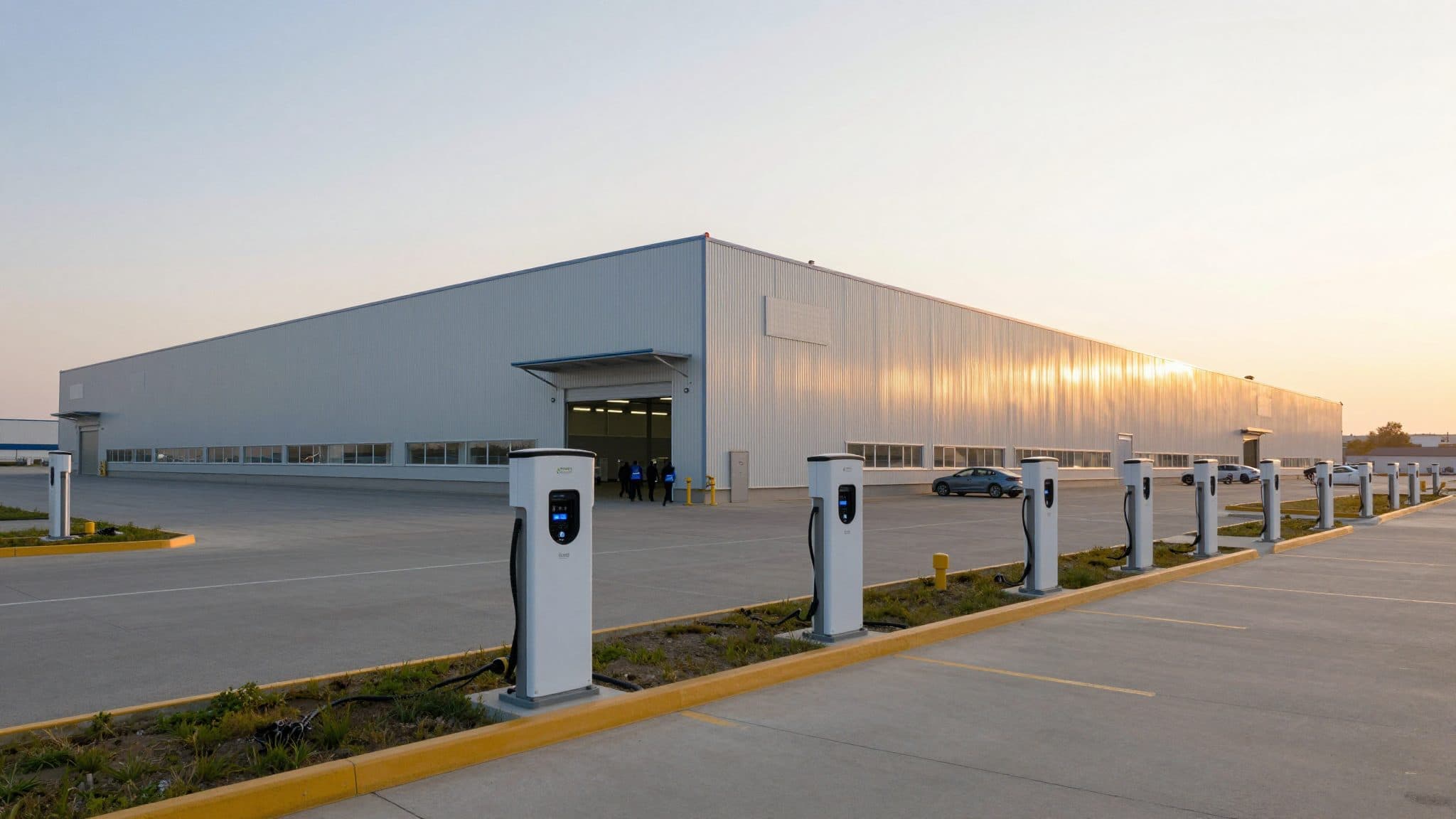
AI-generated image (z-image via Kie.ai)
Summary
Mercedes-Benz has officially launched production of the electric C-Class at its Kecskemét site in Hungary and has expanded the plant into the country's largest car factory. While investments and new models are flowing to Eastern Europe, capacities and employment at German sites are shrinking.
Kecskemét, 13 July 2026
On Monday, automaker Mercedes-Benz celebrated the start of production of the electric C-Class in Kecskemét, around 80 kilometers southeast of Budapest, and, according to the company, expanded the plant into Hungary's largest car factory.
Billion-euro investment in Kecskemét
The company said it has invested around one billion euros in the site. Through the expansion, up to 400,000 vehicles per year could potentially now be manufactured in Kecskemét. The A-Class and the GLB SUV are already produced in the provincial town. This raises annual capacity to around 300,000 vehicles, which at full utilization would make the plant not only the country's largest factory but also Mercedes' largest factory in Europe.
Mercedes CEO Ola Källenius and Hungarian Prime Minister Péter Magyar were expected at the site for the opening. Other automakers and suppliers are also pushing into Hungary: BMW opened a new plant in Debrecen in eastern Hungary in autumn 2024, investing around two billion euros. The factory is designed for electric cars, with the new iX3 SUV getting things started. Chinese automaker and battery manufacturer BYD plans to open a site in Hungary this year, and Chinese battery giant CATL is also building up capacities there.
The shift has solid economic reasons. "Production costs in Germany are the highest in the world in the automotive industry," says Helena Wisbert, professor of automotive economics at Ostfalia University of Applied Sciences in Wolfsburg. "The relocation of production is not over yet." Within the Mercedes Group, the calculation is equally clear-cut. According to reports on the Group's strategy, "Mercedes CFO Harald Wilhelm said production costs are around 70 percent below the German level." The average wage in Hungarian manufacturing is below 2,000 euros per month according to Germany Trade & Invest, while in German manufacturing it is roughly three times as high.
Why Hungary is cheaper
The Group's leadership around Ola Källenius therefore plans to double the share of production in European low-wage countries from 15 to 30 percent. In a memo from management, it says that any allocation of new products or additional tasks to German sites worsens the company's relative cost position. In Germany, maximum possible production will continue to shrink in the coming years – to 900,000 vehicles. Since 2022, the majority of German corporate investment has gone abroad.
Suppliers follow the manufacturers
The trend has long gone beyond Mercedes. According to the German Association of the Automotive Industry (VDA), nearly seven out of ten passenger cars from German manufacturers are currently produced abroad. In Hungary, German automotive groups manufactured just over 300,000 cars last year according to the VDA. A study by Boston Consulting Group concludes that many European manufacturers' plants are only operating at around 60 percent capacity, with 80 percent being desirable. Of about 90 European automotive sites, around 35 are considered superfluous and at least twelve are acutely at risk.
Supply chains are following the manufacturers. In Hungary, ZF Friedrichshafen produces transmissions and, together with Foxconn, electric axles. Bosch manufactures components for electric cars there and operates the Group's largest European development center in Budapest. The Conti spin-off Aumovio maintains an AI development center in the capital. Schaeffler, Mahle, ZF, and Bosch have also relocated parts of their manufacturing to Hungary. "As a rule, suppliers with a long-standing history with a manufacturer also set up abroad in order to benefit from the new plants there," says Frank Schwope, industry expert at the Hochschule für Mittelstand (FHM) in Bielefeld.
Volkswagen also under pressure
In Hungary, in addition to lower wages, companies also benefit from higher average working hours and lower absenteeism rates than in Germany, according to OECD and Eurostat. Audi has been operating an engine plant in Győr in western Hungary since 1993. In 2025, nearly 1.6 million petrol and diesel engines as well as electric drives rolled off the line there. In Győr, Audi produces the Q3 SUV, among other things, and a model from the Cupra brand is also manufactured there. In 2025, just over 200,000 vehicles came off the line there. Given VW Group CEO Oliver Blume's restructuring plans, the plant – together with the one in nearby Bratislava in Slovakia – is likely to gain further importance.
At the same time, the signs in Germany point to savings and restructuring. In Kecskemét, among other things, a hall for body-in-white and assembly lines, a paint shop, and a battery assembly facility were built, whereas in Baden-Württemberg, savings are being made at existing Mercedes sites. According to research by the trade magazine Automobilwoche, the upcoming small G-Class is to be built in Kecskemét from 2027. Mercedes has so far not confirmed plans for the small G-Class in Kecskemét. In industry circles, there are reports of talks between Mercedes and the Franco-German defense group KNDS about the Ludwigsfelde plant in Brandenburg with around 2,000 employees. Both Mercedes and KNDS declined to comment on request.
The situation is also tense at larger rival Volkswagen. According to media reports at the end of June, the VW sites in Hanover, Emden, Zwickau, and Neckarsulm are at risk. A possible cut of 100,000 or more jobs in connection with plant closures is being discussed. According to an end-of-April Reuters report, Volkswagen and Israeli state company Rafael, maker of the Iron Dome missile defense system, negotiated about the Osnabrück plant. VW CEO Oliver Blume wants to avoid plant closures with "intelligentere Lösungen."
The Hungarian site build-up is also an admission of a larger locational decision. With the relocation of the electric C-Class to Kecskemét, Mercedes is bidding farewell to the idea of manufacturing the mid-size premium segment in Germany. For employees at domestic sites, this means the distribution of volume models between plants must be recalibrated. Further investment decisions, for example for future platforms and powertrain generations, are unlikely to go to Germany given the cost differential.
Hungary has thus become a case study for the German auto industry. Within just a few years, the country has evolved from a niche for compact models into a site for volume manufacturing, electric drives, and research. The Mercedes strategy of relocating 30 percent of European production to low-wage countries going forward could, if it sets an example, further increase pressure on German plants. Upcoming model and platform decisions will show whether Kecskemét remains an outlier or whether the trend becomes a permanent shift.
Questions & Answers
Which models does Mercedes produce in Kecskemét?
The A-Class and the GLB SUV are already produced there. With the launch now underway, the electric C-Class is being added, which is expected to raise annual capacity to around 300,000 vehicles.
Why is Mercedes relocating production from Germany to Hungary?
According to CFO Harald Wilhelm, production costs in Hungary are around 70 percent below the German level, and the average manufacturing wage is about one-third as high. The Group wants to double the share of production in European low-wage countries from 15 to 30 percent.
What is the situation at Volkswagen in Germany?
According to media reports at the end of June, the Hanover, Emden, Zwickau, and Neckarsulm sites are considered at risk, with a possible cut of 100,000 or more jobs in the offing. VW Group CEO Oliver Blume is pursuing "intelligentere Lösungen" to avoid plant closures.
Mercedes Plant Kecskemét: E-C-Class Production Launch 2026 | allfacts360