Millions accompany Khamenei in Mashhad – Mourners demand revenge and reject compromises with the West
Mashhad, July 9, 2026
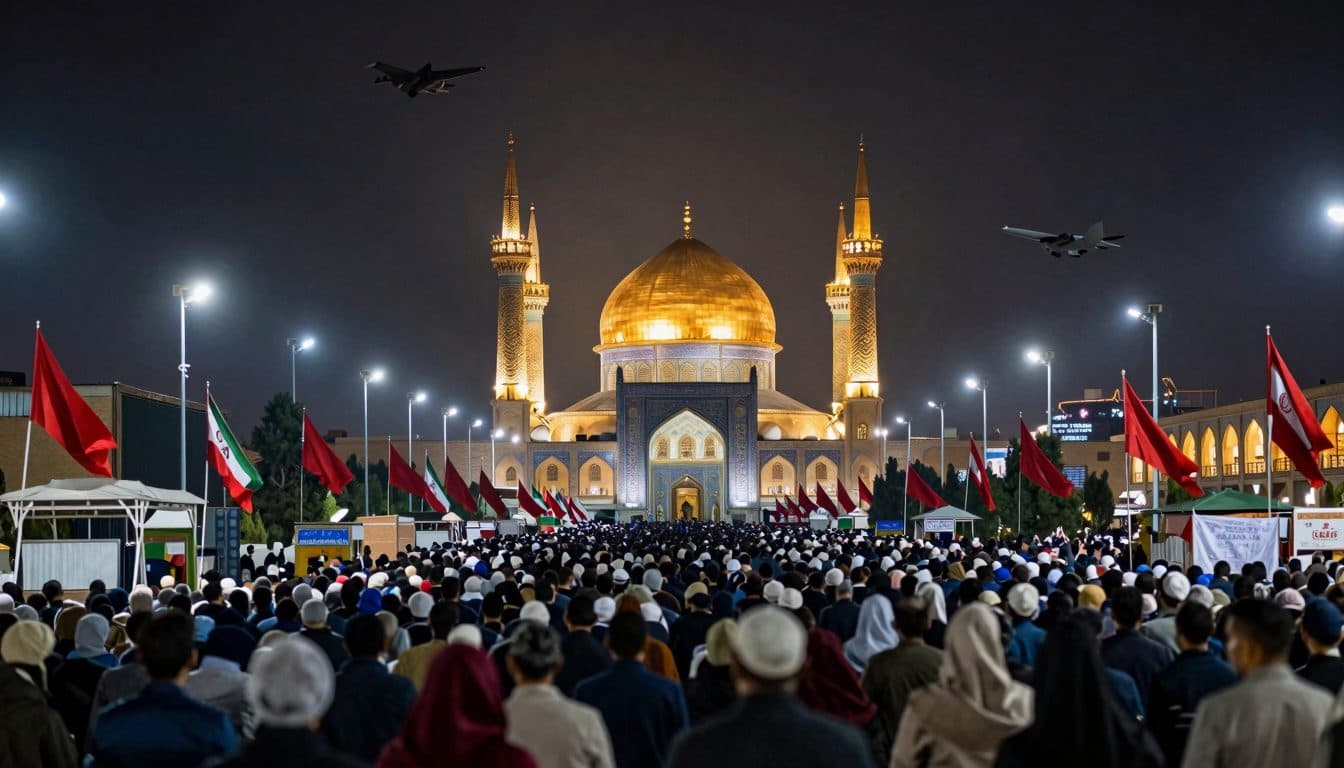
AI-generated image (z-image via Kie.ai)
Summary
At the funeral of Ayatollah Ali Khamenei in his hometown of Mashhad, millions gathered according to official figures, demanding revenge and rejecting compromises with the USA. At the same time, technical talks on a solution continued, according to a US government official.
Mashhad, July 9, 2026
At the funeral of Ayatollah Ali Khamenei in his hometown of Mashhad in northeastern Iran, millions of mourners gathered according to official figures, loudly demanding revenge and rejecting any compromise with the West.
The mourning ceremonies for Khamenei stretched over several days and culminated in the nighttime burial at the shrine of Imam Reza in Mashhad, which Khamenei had designated as his final resting place in his will. According to official Iranian figures, millions of people took part in the ceremonies. Witnesses described mourners lining the route to Mashhad, beating their chests and weeping as the coffin arrived in the city.
Mass mobilization in Mashhad
The coffin was accompanied by at least one fighter jet, according to Iranian accounts. The atmosphere along the streets was marked by anger and loyalty to the state. Many waved Iranian flags and red flags, which in Iranian symbolism stand for revenge. Chants such as „Kein Kompromiss mit den Mördern“ were reportedly heard continuously.
In interviews, participants stated bluntly that they did not want any rapprochement with the USA. „Alle Menschen hier wollen Rache“, said the businessman Mohammed Afsharian. „Ich weiß nicht, wie das mit der Diplomatie weitergehen soll und welche Politik dahintersteht, aber alle Menschen hier tragen rote Fahnen, weil sie Rache wollen.“ If Trump wanted to negotiate a deal, „muss er uns Netanyahu ausliefern“, Afsharian demanded.
Anger against the USA and Israel
The anger was directed not only at the USA but also at Israel. At a hotel called „Miami“ near the burial site, a huge poster was visible offering a bounty on US President Trump. A banner near the shrine read „Kill Trump“, while another sign carried the threat „Blut wird fließen“.
The mood among the mourners was explicitly uncompromising. „Nur der Tod von Trump und (dem israelischen Regierungschef Benjamin) Netanyahu wird unseren Schmerz lindern“ was one of the central slogans. The media-documented chant „Tod dem Diktator“, which had been heard in earlier waves of protest against the leadership in Tehran, was absent from this event – instead, expressions of loyalty to the system dominated.
Attacks on rail infrastructure and accusations from Tehran
At the same time, tensions between Iran and the USA also grew beyond the mourning ceremonies. Following attacks on rail infrastructure, the Iranian Foreign Ministry spoke of an „offenkundigen Kriegsverbrechen“. The Iranian railway described the attacks as a „kriminellen Angriff des US-israelischen Feindes“ on the line. The damage to tracks and trains disrupted passenger and freight traffic in several provinces, according to local reports.
A US government official stated meanwhile that diplomatic channels had not been severed. „Die Vereinigten Staaten setzen sich weiterhin für eine Lösung ein, und die technischen Gespräche laufen weiter“, he said. However, he pointed out that the behavior of the Iranian leadership constituted a violation of the framework agreement „inakzeptablen Ausmaßes“.
Rejection of the framework agreement
The background to the tensions is a framework agreement concluded in June between the parties to the conflict to end the war. This agreement is apparently firmly rejected by large parts of the Iranian public, as became visible at the mourning ceremonies. „Es sollte überhaupt keine Kompromisse geben“, said a 35-year-old housewife during the mourning ceremonies, referring to the agreement.
On Khamenei's death, the same woman said: „Der Verlust unseres Führers ist schwerer als der unserer Eltern.“ Such statements illustrate the personality cult surrounding the supreme leader, who had been in office since 1989 – a legacy that traces back to the republic's founder, Ayatollah Ruhollah Khomeini. Khamenei had assumed the office after Khomeini's death and ruled with absolute harshness until his own death.
Burial of the family and succession
Buried on the same day in Mashhad were also members of Khamenei's family who had been killed in an attack on February 28. Among them, according to Iranian accounts, were his daughter and his 14-month-old granddaughter, as well as the wife of his son Mojtaba, who has been named as successor as supreme leader. The burial of the family was integrated into the official state program.
Despite the mass mobilization staged by the regime, a large share of the country's roughly 86 million inhabitants view the state mourning with indifference or rejection, according to observers' assessments. On social media in the days beforehand, it was above all younger Iranians who had voiced criticism of the leadership. The scale of participation in the mourning ceremonies is therefore difficult to verify independently.
Tensions between Tehran and Washington
It remains unclear how the new leadership under Mojtaba Khamenei will position itself given the inflamed mood. Observers pointed out that the leadership has to walk a narrow line between an enraged base that rejects any rapprochement and the pressure of international partners calling for de-escalation. The threat of further retaliatory strikes against Israel and the USA is in the air.
In Washington, the situation is being closely monitored, according to US media reports. A spokesperson referred to the ongoing technical talks but at the same time made clear that continuing the current course is, from the American perspective, unacceptable. This leaves open whether the framework agreement signed in June, which provided for an end to the war, still has a realistic basis or has been de facto rendered moot by recent developments.
Outlook: Moderation or further escalation
For the region, the burial in Mashhad also marks a symbolic endpoint of an era. With the change at the head of the state, questions arise about Iran's future strategic orientation – between the revenge demanded by the base and the economic pressure that could force concessions.
The coming days will show whether the anger visibly on display in Mashhad translates into concrete foreign policy steps or whether the new leadership, despite the public declarations, embarks on a course of moderation. Observers expect the next weeks to be decisive for the stability of the framework agreement concluded in June.
Questions & Answers
Who was Ali Khamenei and what role did he have in Iran?
Khamenei was the supreme leader of Iran. He had assumed the office in 1989 after the death of the republic's founder, Ayatollah Ruhollah Khomeini, and, according to the available account, ruled with absolute harshness until his death.
Why did the mourners in Mashhad call for revenge?
According to the available reports, the mourners were reacting to Khamenei's death and to attacks that also claimed members of his family. They demanded retribution against US President Donald Trump and Israeli Prime Minister Benjamin Netanyahu.
What diplomatic steps are currently underway between the USA and Iran?
According to a US government official, technical talks between the USA and Iran are continuing, while Washington at the same time describes Iranian violations of the framework agreement concluded in June as unacceptable.
Khamenei funeral Mashhad: Mourning, revenge, and | allfacts360