NATO Summit in Ankara: Frederiksen Again Rejects Trump's Demand for Greenland
Ankara, July 08, 2026
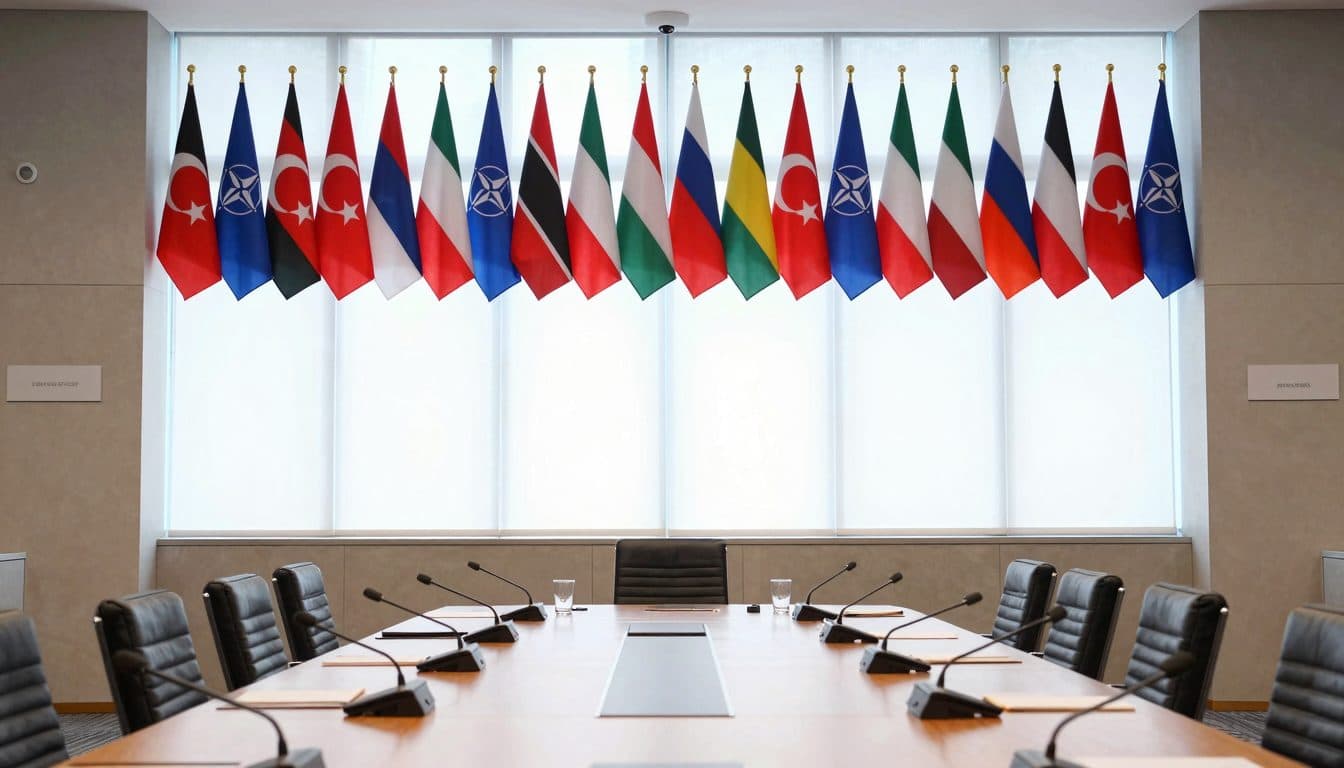
AI-generated image (z-image via Kie.ai)
Summary
Danish Prime Minister Mette Frederiksen sharply rejected US President Donald Trump's renewed demand for control over Greenland on the sidelines of the NATO Summit in Ankara. At the same time, the 32 heads of state and government discussed a fairer burden-sharing within the alliance and new aid commitments for Ukraine.
Ankara, July 08, 2026
Danish Prime Minister Mette Frederiksen firmly rejected US President Donald Trump's renewed territorial claim to Greenland on the second day of the NATO Summit in Ankara and reaffirmed her country's defense readiness.
Frederiksen's Clear Rejection
At the center of the second day of the summit in the Turkish capital was the smoldering conflict over the world's largest island, which has been ongoing for months. Upon his arrival in Ankara, Trump had reiterated that Greenland should be controlled by the United States, not Denmark. Frederiksen responded immediately: "Grönland steht natürlich nicht zum Verkauf," she said before the start of the working session of the heads of state and government. The island belongs to Denmark but enjoys significant political autonomy.
The Danish prime minister also underscored her country's loyalty to the alliance. "Natürlich werden wir das Königreich Dänemark verteidigen," she said. In the event of an attack, Denmark is prepared to defend every inch of NATO territory, including its own. Frederiksen also formulated a clear expectation of all partners: "Wir sind souveräne Staaten, und wir erwarten, dass jeder unsere territoriale Integrität und unsere Souveränität respektiert."
Seeking a Diplomatic Path
At the same time, Frederiksen expressed openness to a diplomatic path. "Wir hoffen, dass alle, einschließlich aller Verbündeten, das Selbstbestimmungsrecht der Bevölkerung Grönlands respektieren," she said. Denmark's position on this issue is clear, as is "leider" the position of the United States, she added. According to sources close to the negotiations, Denmark and Greenland have begun talks with the Trump administration to seek a compromise.
Earlier this year, Trump had openly threatened to take over the strategically important Arctic island and at one point announced punitive tariffs against Germany and other European states if they did not agree to a sale. According to Danish sources, he has since provisionally withdrawn these threats, as well as the threat to use military means if necessary. Nevertheless, the US president continues to uphold his territorial claims.
Trump's Justification and Threats
A senior US official justified the demand with long-term security risks: from Washington's perspective, taking over Greenland is the only way to protect the island and thereby the United States from threats posed by Russia and China. Trump also stated that Europe is a very different place today than it was 20 years ago. He coupled his justification with a threat: "Wir könnten alle unsere Soldaten aus Europa abziehen."
NATO Secretary General Mark Rutte tried to mediate and at the same time reaffirmed the cohesion of the alliance. "Es gibt ein uneingeschränktes Bekenntnis der Vereinigten Staaten zur NATO," he said before the working session. The United States has an interest in the alliance, for example to prevent Russian nuclear submarines from appearing off the coasts of the United States. Rutte described Trump's expectation that alliance partners align their defense spending with that of the United States as "vollkommen fair".
Rutte Appeals for Unity
In this context, Rutte pointed to the war in Ukraine. "Es ist eine Niederlage für Putin und ein Erfolg für Präsident Trump, dass die Europäer und die Kanadier genau das tun," he said with reference to rising defense budgets. "Russland hat keine Chance, diesen Krieg zu gewinnen," he added. The sooner the war ends, the better it will be for Europe, for Russia, and for world peace.
Before the summit, Trump had described the defense spending of key allies such as Germany, Great Britain, and Italy as "lächerlich." According to German sources, however, he was citing outdated figures. Chancellor Friedrich Merz pointed to a significant increase in German contributions. "Wir haben geliefert," he said before the working session, with reference to the NATO Summit in The Hague.
The German government has reported an amount of 124.7 billion euros to NATO for the current year. This represents an increase of 25.5 percent compared to the previous year. The discussions in Ankara are set against the backdrop of a fairer long-term burden-sharing within the alliance. The 32 heads of state and government are also discussing new aid commitments for Ukraine.
Iran and Energy Policy as Side Issues
On the sidelines of the summit, the recent US airstrikes against targets in Iran also provided fodder for discussion among the allies. Rutte described the US response as "absolut notwendig". If Iran violates the ceasefire, "eine entschiedene Reaktion der USA unerlässlich," he said. At the same time, Trump warned with regard to Europe: If Europeans are not careful with their immigration and energy policies, there will be "kein Europa mehr geben".
The tensions over Greenland raise fundamental questions about the cohesion of the Western defense alliance. Trump's demands have not only put off Denmark as a NATO partner but have also fueled doubts about the reliability of mutual alliance loyalty. Frederiksen made clear that sovereignty and territorial integrity are non-negotiable.
Open Questions as the Summit Concludes
The NATO Summit in Ankara is scheduled to end in the afternoon. Closing declarations on defense spending, further support for Ukraine, and collective security in the North Atlantic area are expected. Whether the Greenland question will be mentioned in them was initially unclear.
The episode illustrates how a bilateral territorial aspiration by an alliance member can put the unity of NATO to the test. Rutte tried to strike a balance: on the one hand, he confirmed the United States' unqualified commitment to the alliance; on the other, he acknowledged the legitimacy of Trump's demand for higher contributions from the Europeans. This balancing act shaped the discussions on the second day of the summit.
While Denmark is banking on negotiations, Trump remains on his course. According to Danish sources, the punitive tariff threats and military threats have been provisionally withdrawn, but the demand for US control over the Arctic island remains. Frederiksen insisted on dialogue: she hoped that all allies would respect the right of self-determination of the Greenlandic population.
The conflict over Greenland has therefore not been resolved, only postponed. The coming weeks will show whether the talks between Denmark, Greenland, and Washington lead to a de-escalation or whether Trump will reiterate his demand at the next opportunity. Until then, Greenland remains, in the words of its prime minister, one thing: not for sale.
Questions & Answers
Was hat Mette Frederiksen zu Trumps Grönland-Forderung gesagt?
Die dänische Regierungschefin wies die Forderung am Rande des Nato-Gipfels in Ankara mit den Worten zurück: "Grönland steht natürlich nicht zum Verkauf." Sie betonte zudem die Bereitschaft Dänemarks, jeden Zentimeter des Nato-Gebiets zu verteidigen.
Welche Drohungen hat Trump im Zusammenhang mit Grönland ausgesprochen?
Trump hatte zu Jahresbeginn offen mit einer Übernahme der Arktisinsel gedroht und zeitweise Strafzölle gegen europäische Staaten sowie den Einsatz militärischer Mittel angekündigt. Diese Drohungen hat er nach dänischen Angaben vorerst zurückgezogen, hält aber an seinem Ziel fest.
Wie hat Nato-Generalsekretär Mark Rutte auf die Spannungen reagiert?
Rutte bekräftigte das uneingeschränkte Bekenntnis der USA zur Nato und bezeichnete Trumps Forderung nach höheren europäischen Verteidigungsausgaben als "vollkommen fair". Zugleich verwies er auf den Ukraine-Krieg und die Notwendigkeit, den russischen Präsidenten zu schwächen.
NATO Summit Ankara: Frederiksen Rejects Trump's Demand for | allfacts360