NATO Summit in Ankara: What the Decisions Mean Specifically for Ukraine
Ankara, July 9, 2026
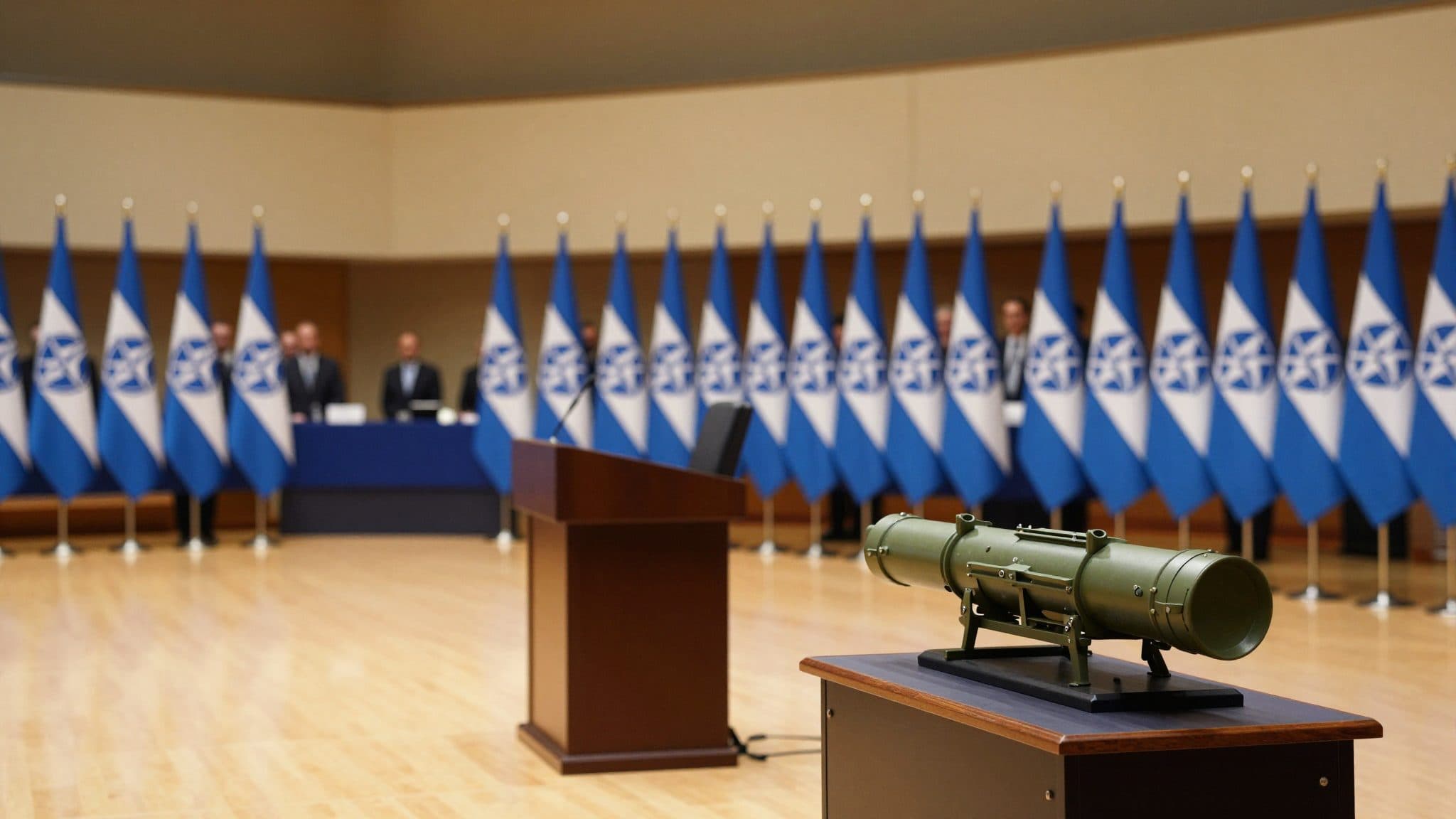
AI-generated image (z-image via Kie.ai)
Summary
At the NATO summit in Ankara, members agreed on 140 billion euros in military aid for Ukraine. US President Donald Trump also announced his intention to grant Ukraine a license to produce Patriot missiles. Experts assess the pledges as a political signal but point to significant time and technical hurdles in implementation.
Ankara, July 9, 2026
At the NATO summit in Ankara, member states approved a comprehensive military aid package for Ukraine totaling 140 billion euros; at the same time, US President Donald Trump announced after a meeting with Ukrainian President Volodymyr Zelensky that he wanted to grant Ukraine a license for the independent production of missiles for the Patriot air defense system.
The Ankara Decisions at a Glance
According to information from Ankara, the agreement includes European NATO partners and Canada, which pledged 70 billion euros in military aid to Kyiv for this year; a further 70 billion euros are to follow. Also included are 60 billion euros earmarked for military aid from a 90-billion-euro EU support loan. Observers assess that this provides Ukraine with a reliable multi-year planning basis for its defense for the first time.
During his visit to Ankara, Trump stated at a press conference that Washington wanted to share Patriot technology and grant Ukraine the right to directly produce the air defense munitions that are currently lacking on the ground. "Macht sie einfach selbst", Trump commented on the Ukrainian requests for more munitions. When asked about possible obstacles, he merely said: "Aber das wird schon klappen." He had not consulted with the manufacturers before making his pledge.
Patriot Missiles as the Key to Air Defense
Patriot missiles are of decisive importance for defending against ballistic attacks from Russia. Third-generation Patriot missiles (PAC-3) are, in the assessment of Western experts, the only Western-made weapons delivered to Ukraine that can reliably intercept Russian ballistic missiles. During a heavy Russian barrage on July 6, the Ukrainian Air Force was unable to shoot down a single ballistic missile. The main reason, according to consistent reports, was a lack of Patriot missiles.
In 2026, Russia has so far fired 522 ballistic missiles at Ukraine, of which around 70 percent reached their target. Since the beginning of July alone, available information indicates more than 50 dead, including numerous victims in the capital. During the night into Monday, Russia once again massively attacked Ukraine with drones and missiles – already for the second time in a short period.
According to accounts from his circle, Ukrainian President Volodymyr Zelensky is returning from the summit with a multitude of pledges. Even though NATO membership was not mentioned in the final declaration, the allies expressly honored Ukraine's defensive struggle: "Die Ukraine trägt zur transatlantischen Sicherheit bei", it stated.
In Ankara, several countries also signed a drone agreement with Kyiv. Trump additionally declared that he wanted to buy Ukrainian drones – a remarkable reversal of his earlier dismissive attitude toward the Ukrainian arms industry. "Es ist erstaunlich, dass sie diese unter Kriegsbedingungen produzieren", he emphasized. The US was prepared to provide the necessary support for production.
Drones: Ukrainian Industry on the Rise
Ukrainian drone expertise is now in strong demand across Europe, according to consistent reports. Local manufacturers such as the FP-5 Flamingo cruise missile, which can reach targets at distances of up to 800 kilometers, demonstrate the maturity of the Ukrainian arms industry in the view of observers. With their own weapons, Ukrainian forces can now strike targets more than 1,000 kilometers deep into the Russian hinterland.
At the same time, the Patriot question remains primarily a political signal in the view of experts. Political scientist Ihor Reiterovych from the National Taras Shevchenko University in Kyiv classifies the decision above all as a message to Moscow. "Es handelt sich hierbei eher um eine symbolische Sache", he said. "In erster Linie ist es eine Botschaft an die Russische Föderation: ‚Seht, was als Nächstes passieren kann.'"
Expert Assessments: Symbolism and Political Signals
Reiterovych also sees in this a signal to Russia that the US stands by Ukraine's side. "Das ist ein Signal: ‚Wir stehen an der Seite der Ukraine und werden sie unterstützen.' Wenn nicht jetzt, dann wird die Ukraine in Zukunft Patriots produzieren. Das sollte Russland eine Warnung sein", he said. At the same time, it demonstrates to the Kremlin that the White House does not want to abandon Ukraine.
Military expert Oleh Katkov, editor-in-chief of the magazine of the Ukrainian media and consulting firm Defense Express, pointed to the political prerequisites for a licensing arrangement. "Wir befinden uns jetzt höchstwahrscheinlich erst im Stadium einer prinzipiellen politischen Einigung zwischen den Regierungen der Ukraine und den USA", he said. Before a basis for cooperation at the level of arms companies could be created, an agreement would first have to be reached at the government level.
"Diese Unternehmen müssen entsprechende Verträge mit ukrainischen Firmen abschließen. Erst danach kann von einem Produktionsstart vor Ort die Rede sein", Katkov explained. Regardless of whether it involves the PAC-2 GEM-T or PAC-3 MSE variant, setting up production facilities through to serial manufacture takes several years.
A concrete timeframe is, according to Western analyses, only beginning to emerge. For each PAC-3 MSE interceptor, the production lead time is 24 months for the missile itself and 30 months for the solid rocket motor, as the Foreign Policy Research Institute (FPRI) noted in a recent analysis. In the best case, setting up the facilities in Ukraine would take at least two to three years.
Time and Production Hurdles
As a comparison, observers point to Japan, which, despite its industry, capabilities, and competencies, needed two years from agreement to the start of production. Comparable capacity-building in Germany also takes time: construction of a new production line at Comlog Logistik in Schrobenhausen, Bavaria, began in 2024; commissioning of the facility is scheduled for September 2026, with the first missiles produced there expected to be delivered in 2027.
Internationally, Patriot missiles remain a scarce commodity. The US is currently unable to produce Patriot missiles in sufficient quantities. Raytheon and Lockheed Martin are working intensively to increase annual production from the current approximately 600 to 800 to 850. Boeing delivered around 650 to 700 active radar seekers in 2025; the Pentagon signed the framework contract in April 2026 to triple production – which will still barely cover global demand. Lockheed Martin currently produces fewer than two PAC-3 MSE per day.
If Ukraine does indeed receive a license for Patriot missiles, it would be, after Japan and Germany, only the third country worldwide to be granted this right. According to expert estimates, Ukraine would need at least 15 to 20 new Patriot battalions and a large quantity of missiles. In 2022, MBDA Germany and Raytheon agreed to launch European production of PAC-2 GEM-T interceptors; production is to be increased to 2,000 units per year in the coming years but is currently still limited to around 30 units annually.
NATO Membership and Hidden Conditions
The question of NATO membership remains politically sensitive. "Wenn das wichtigste Land der Allianz eine solche Position vertritt, ist es klar, dass jetzt niemand ernsthaft über eine Mitgliedschaft sprechen wird", said Khara, referring to Trump's well-known stance, who had made clear even before his return to the White House that he is against Ukraine joining NATO. At the summit in Ankara, Trump sent mixed signals to the allies; however, the states were united on aid for Ukraine.
Oleksandr Khara of the Ukrainian "Center for Defense Strategies" sees this as a reason for vigilance. "Ich hoffe sehr, dass es keine versteckten Bedingungen gibt. Dass man von der Ukraine nicht verlangt, mit Russland Kompromisse einzugehen, bevor sie diese Patriots erhält. Seitens der jetzigen US-Regierung ist mit allem zu rechnen", he said. At the same time, the expert is convinced that Kyiv should not give up its strategic goal of joining NATO. "Aus eigener Kraft werden wir Russland auf Dauer nicht eindämmen können", said Khara.
The aid pledges from Ankara mean, in the view of Western governments, above all one thing: planning certainty. Even if the Patriot license could take effect in practical terms only years from now, observers see Trump's announcement as a turning point in US policy toward the Ukrainian arms industry. How quickly political pledges turn into actual production capacities now depends on Washington's willingness to translate the agreement with the manufacturers into concrete contracts. Further details of a possible agreement have not been disclosed so far.
This article was adapted from the Ukrainian by Markian Ostaptschuk.
The technical assessment is based, among other things, on analyses by two expert authors who have been researching and publishing on security, defense, armaments, and technology for over 20 years: a Senior Advisor at the European Policy Centre and an Associate Fellow in the Security and Defense Program of the German Council on Foreign Relations (DGAP) in Berlin.
Questions & Answers
What did the NATO summit in Ankara decide for Ukraine?
NATO members agreed on a military aid package totaling 140 billion euros. It includes 70 billion euros in European and Canadian military aid for 2026, plus a further 70 billion euros, as well as 60 billion euros from an EU loan.
What did Donald Trump announce regarding the Patriot license for Ukraine?
After a meeting with Volodymyr Zelensky, Trump announced his intention to grant Ukraine a license for the independent production of Patriot missiles. Further details of a possible agreement have not been disclosed so far.
NATO Summit Ankara: Patriot License and Aid for Ukraine | allfacts360