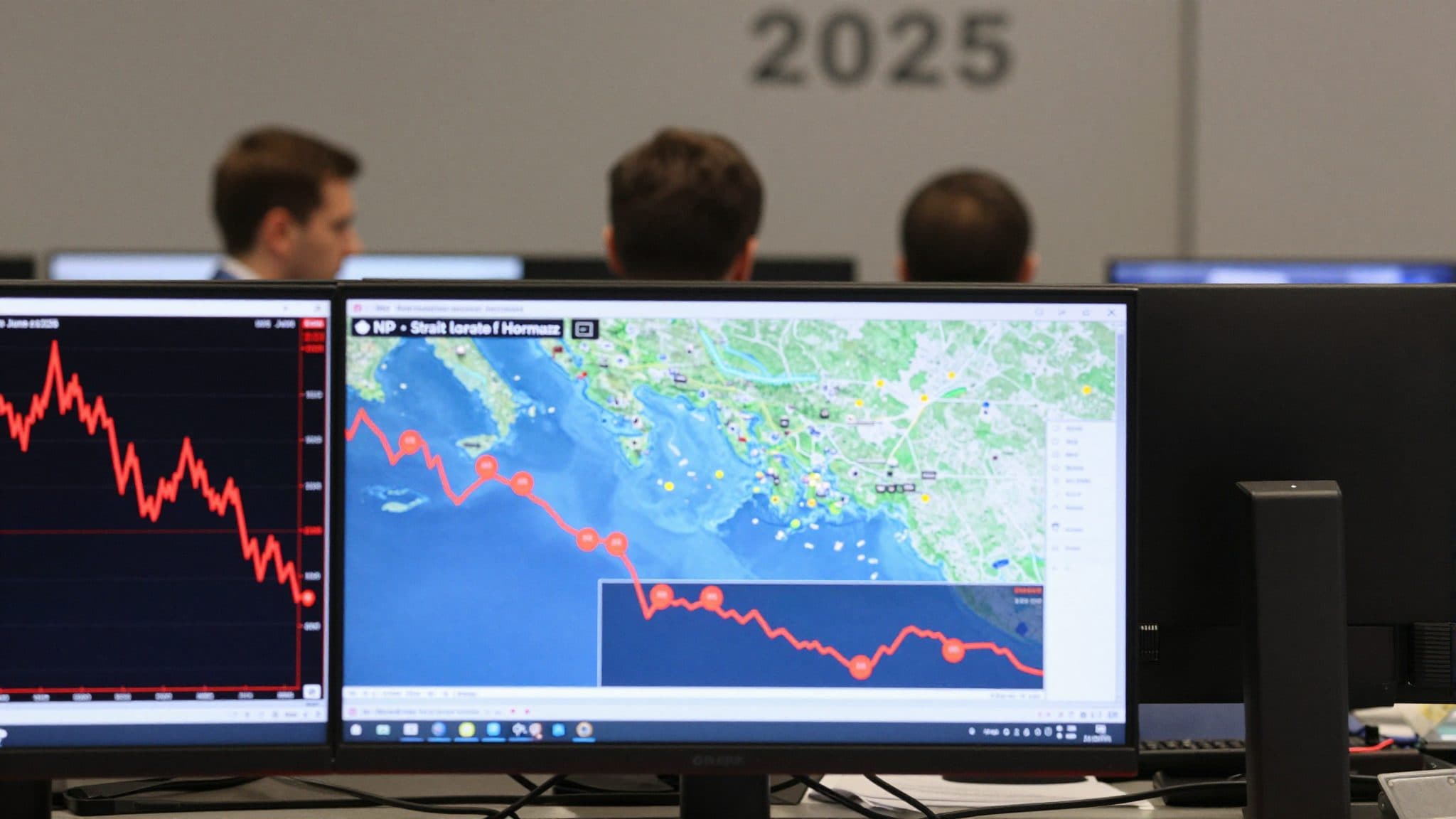
Oil prices drop sharply – US and Iran move closer after more than 100 days of energy crisis
Frankfurt, June 25, 2026
AI-generated image (z-image via Kie.ai)
Summary
After more than 100 days of the most severe disruption to global energy supply ever recorded, the US and Iran have signed a framework agreement. Easing tensions at the Strait of Hormuz has pushed the Brent price below 75 dollars for the first time since the war began.
Frankfurt, June 25, 2026
The price of a barrel of Brent crude fell below 75 US dollars in mid-June for the first time since the start of the Iran war in late February, after the US and Iran signed a framework agreement following more than 100 days of the most severe disruption to global energy supply ever recorded.
With the price drop, Brent has declined by roughly 40 percent from its crisis high of 126 dollars in March. Analysts see this primarily as the expectation of restored supply chains through the Strait of Hormuz being priced in. "The current oil price decline contains a very positive expectation," says Thomas Benedix, commodities analyst at Union Investment, in an interview with the ARD financial editorial team.
The price decline is set against the backdrop of a diplomatic rapprochement: after more than 100 days of the most severe disruption to global energy supply ever recorded, the US and Iran had signed a framework agreement. At the same time, ship traffic through the strait – which had at times been barely passable during the conflict – is normalizing. According to Kpler, a company specializing in shipping data analysis, freight traffic through the Strait of Hormuz has recently reached its highest level since the start of the Iran war.
Diplomatic rapprochement and reopened shipping route
The International Maritime Organization (IMO) said that hundreds of ships could now leave the strait with security guarantees. However, according to dpa-AFX, numerous vessels remain stuck in the Persian Gulf. Daan Struyven, commodities expert at Goldman Sachs, said in a Bloomberg interview that the reopening of the Strait of Hormuz was "going well and quickly."
Despite the easing, experts do not yet consider the market out of the danger zone. The market remains, however, for now "extremely vulnerable to shocks and renewed disruptions," according to the analysis. Thu Lan Nguyen, head of commodities and FX analysis at Commerzbank, also warns: "The decline in oil prices is in part already exaggerated, because we don't know at what pace ship traffic will actually normalize now."
Physically, the situation on the oil market has fundamentally shifted according to Bloomberg: away from an acute supply shortage toward a growing oversupply. Middle Eastern crude is now being traded in contango – meaning immediate delivery is cheaper than futures contracts, a classic signal of oversupply. "Due to weak demand from Asia for Middle Eastern crude grades, you currently actually receive a discount if you buy a barrel today rather than tomorrow," says Struyven.
From a shortage to an oversupplied market
Weak demand from China amplifies the effect. Chinese refineries are offering cargoes for sale rather than purchasing them, according to Bloomberg – traders speak of a drastic reversal of normal trade flows. June Goh, senior oil market analyst at Sparta Commodities, says: "Asian refineries are already well supplied through August, and the volumes available in the short term from the Strait of Hormuz merely lead to a supply overhang, since demand from China is not picking up."
At the same time, trade routes are shifting: several supertankers carrying a combined roughly twelve million barrels of crude from the United Arab Emirates and Oman are heading for European ports rather than Asian ones, according to Bloomberg. Angolan crude is being traded at the steepest price discounts in more than a decade, according to Bloomberg.
Already during the conflict, numerous producers had found ways to export oil from the Persian Gulf via alternative or covert routes. According to IEA estimates, the UAE increased its "covert" shipments to roughly 85 percent of pre-war levels by early June. Citi analysts expect the UAE and Iran to significantly ramp up production. "And that naturally narrows the supply gap on the oil market that had driven prices up," says Nguyen.
Inventory drawdowns and production losses
During the conflict, governments had tried to offset missing crude deliveries from the Gulf region. According to the International Energy Agency (IEA), global inventories fell by 252 million barrels through June 12; OECD countries alone drew down 163 million barrels. In the US, stockpiles including strategic reserves have dropped to their lowest level since the 1980s, according to Bloomberg. These reserves will need to be replenished in the coming quarters.
According to experts, the production losses can only be made up slowly. Morgan Stanley estimates that by September only about half of the production losses could be recovered, and by December around 80 percent. Citi assumes Brent will trade at 70 dollars in the fourth quarter – on the assumption that trade flows through Hormuz largely normalize by mid- or late July.
Goldman Sachs also revised its fourth-quarter forecast for Brent down from 90 to 80 dollars per barrel. Morgan Stanley sees the North Sea grade at 80 dollars by year-end as well – 15 dollars lower than before. "It will likely take about two to three months for logistics chains to normalize, and then another two to three months for all production facilities in the Middle East to be up and running," says Benedix.
Supply expansion and price expectations
The rebuilding of inventories will take considerably longer than the drawdowns of recent months, the Union Investment analyst adds. "It could even be late 2027 before all inventories have normalized." A barrel of crude (159 liters) Brent still cost about 97.22 US dollars in early June; meanwhile, the price is almost back to pre-war levels.
On the supply side, US production is growing. The number of active oil rigs has recently risen: US production stands at 13.8 million barrels per day, just shy of the record high. The International Energy Agency forecasts that global oil demand will rise to 105.3 million barrels per day, while supply will reach roughly 110 million barrels per day – the IEA expects a pronounced global oversupply in 2027.
In the FX and equity markets, investors reacted cautiously optimistic. Gasoline and heating oil prices are also likely to ease in the coming weeks if the relief proves durable. Citigroup is likewise notably more optimistic, forecasting 70 dollars per barrel of Brent in the fourth quarter – albeit on the assumption that trade flows through Hormuz largely normalize by mid- or late July.
Risks and outlook
In the medium term, Benedix says, the rebuilding of inventories will take "significantly longer" than the drawdown. "It could even be late 2027 before all inventories have normalized." This means that even after the acute crisis subsides, price risks remain, because political tensions could return at any time. The further development of negotiations between Washington and Tehran, as well as the actual normalization of ship traffic through the strait, therefore remain the decisive factors for price developments.
Observers also point to the time lag between a political agreement and the physical resumption of exports. Even if the Strait of Hormuz remains open, refiners and logistics providers are likely to need weeks to adjust delivery schedules. The coming weeks are therefore seen as a litmus test of whether the easing holds – or whether a new shock catches the market off guard once again.
One thing is certain: the drop in the oil price below 75 dollars marks the lowest level since the conflict broke out in late February and signals that markets are betting on a lasting de-escalation. How long this trend lasts depends not least on whether the diplomatic progress between the US and Iran leads to a comprehensive treaty.
Questions & Answers
Why has the Brent price fallen below 75 dollars?
After more than 100 days of the most severe disruption to global energy supply ever recorded, the US and Iran have signed a framework agreement. At the same time, ship traffic through the Strait of Hormuz is normalizing, bringing millions of barrels of crude back onto the world market.
What role does China play in the price decline?
China, normally the world's largest crude oil importer, currently has weak demand. Chinese refineries are offering cargoes for sale, according to Bloomberg, which traders describe as a drastic reversal of normal trade flows, amplifying the supply overhang.
How quickly can oil inventories return to normal?
According to Thomas Benedix of Union Investment, it will likely take two to three months for logistics chains to normalize, and another two to three months for all production facilities in the Middle East to be operating again. It could even be late 2027 before all inventories have normalized.