Opposition and Union criticism over Merz's cabinet reshuffle and the treatment of Schnieder
7/24/2026
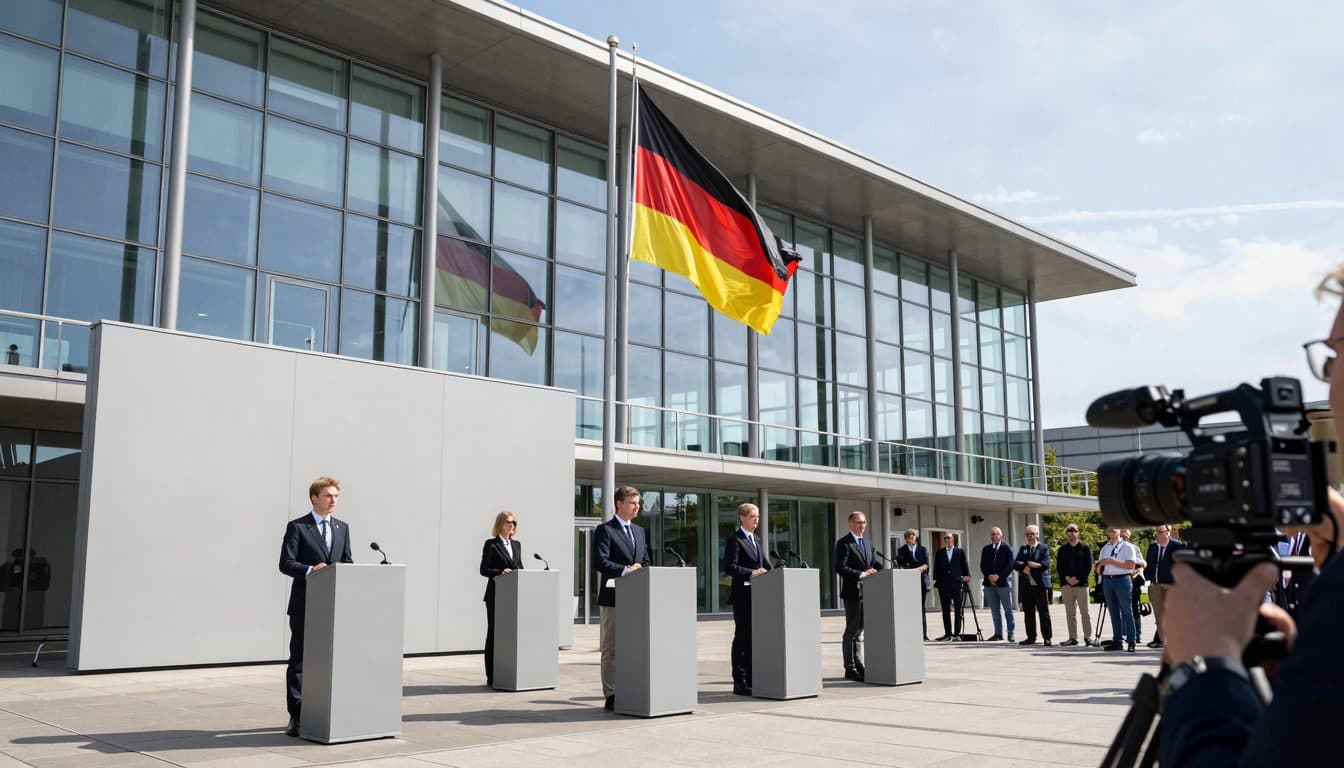
AI-generated image (z-image via Kie.ai)
Summary
Chancellor Friedrich Merz reshuffled his cabinet on July 24, 2026, but the opposition and CDU figures criticized the procedure, especially the dismissal of Transport Minister Patrick Schnieder. The new appointments of Carsten Linnemann at Health and Nina Warken at the Chancellery failed to silence voices describing the process as "planlos" and "chaotic."
German Chancellor Friedrich Merz carried out a cabinet reshuffle on July 24, 2026, in which Carsten Linnemann took over the Health portfolio and Nina Warken became the first woman to head the Federal Chancellery, while the opposition and voices within his own Union criticized the procedure, especially the dismissal of Transport Minister Patrick Schnieder.
A reshuffle aimed at relaunch
The intervention by the head of the Executive, Friedrich Merz, came after weeks of internal turbulence within the coalition and with the stated goal of giving the Government a new political boost. At an urgent press conference convened on Friday, Merz introduced the new members of his team and described the operation as an "ordentliche Umbesetzung," according to tagesschau24.
The central changes included the move of Carsten Linnemann, hitherto CDU secretary general, to the Health Ministry, replacing Nina Warken, who in turn was appointed head of the Federal Chancellery. Merz himself highlighted the latter appointment as historic: "Mit ihr wird erstmals in der Geschichte unseres Landes eine Frau als Leiterin in das Bundeskanzleramt einziehen," he stated.
Alongside these appointments came the departure of Transport Minister Patrick Schnieder, whose dismissal was arranged in an especially bumpy manner. Schnieder had held the post and had prior experience as a state secretary in the same ministry. His farewell to colleagues came via a message informing them: "Der Bundeskanzler hat mich gestern Nachmittag darüber informiert, dass er mich als Bundesverkehrsminister entlassen wird," according to an SMS obtained by dpa and published by the "Handelsblatt."
Schnieder's dismissal and the stumble over his successor
The most striking episode was the U-turn by the candidate Merz had initially chosen to replace Schnieder. According to available information, the would-be successor accepted on Thursday night, then pulled back, and declined the offer again the next day on technical grounds, delaying the appointment. "Jetzt geht alles in die zweite Verlängerung," the news coverage summed up about a process labeled "chaotic."
Criticism was swift. From the opposition, Green lawmaker Dahmen told the "Augsburger Allgemeine" that, with Linnemann's arrival at the Health Ministry, "entsteht der Eindruck, dass für dieses Ministerium weder gesundheitspolitische noch ärztliche Kompetenzen entscheidend sind." Die Linke's health policy spokesperson, Gürpinar, told the "Rheinische Post" that Linnemann is "ein Radikaler in der Sozialpolitik," which "lässt das Schlimmste befürchten."
Criticism inside and outside the Union
Within the Union itself, critical voices were equally forceful. Former federal minister Peter Altmaier said on the X social network that he felt "gerührt und wütend" about the treatment of Schnieder. Former CDU lawmaker Wolfgang Bosbach told the "Handelsblatt" that the way it was handled left him "sehr nachdenklich." The federal vice president of the Christlich-Demokratische Arbeitnehmerschaft (CDA), Christian Bäumler, described the situation as "Willkür" and stated: "Eine Bundesregierung darf nicht wie ein Königreich geführt werden."
The dismissed minister's close circle also reacted harshly. The chairman of the CDU municipal group in Arzfeld, Gerhard Kauth, told the "Tagesspiegel": "In ganz Rheinland-Pfalz gibt es Unverständnis, das versteht keiner." From Union circles, Schnieder's treatment was described as "menschlich nicht in Ordnung," and one commentator likened the situation to "ein Torwart, der nicht Linksaußen spielen sollte," according to the coverage.
The football comparison was no coincidence. Lawmaker Fritz Güntzler, 60, the CDU parliamentary group's financial policy spokesperson and captain of FC Bundestag, the lawmakers' football team, was precisely the candidate initially proposed for Transport whose appointment ultimately fell through. The metaphor of "musical chairs" inside the cabinet was used by Martin Florack to describe a process in which personnel moves seemed to respond more to improvisation than to a defined strategy.
The football metaphor and the profile of the frustrated candidate
Political analyst Oliver Lembcke, interviewed by tagesschau24, nonetheless considered that Merz could have "die Stunde genutzt," meaning the opportune moment to rescue the coalition from its current low. Political scientist Benjamin Höhne, 48, a lecturer in Berlin, Potsdam, Halle-Wittenberg, and Magdeburg, also provided context on the Executive's delicate parliamentary situation.
On the policy front, the reshuffle takes place against a backdrop marked by the need to move forward in the autumn with tax and pension reforms, and by the already completed passage of a health reform in the Bundestag and Bundesrat. Linnemann, freshly arrived at the Health portfolio, will have to familiarize himself with an area where pending reforms in the care sector loom, while the CDU at the federal level "nähert sich langsam, aber sicher der 20 Prozent" in voting intentions, according to tagesschau24.
Another significant change was the appointment of the hitherto secretary general of the CDU/CSU parliamentary group, Jens Spahn, whose resignation came amid a scandal linked to surrogacy in the United States, according to prior reports. His successor at the head of the faction, Thorsten Frei, was agreed between Merz, CSU leader Markus Söder, and the parliamentary leadership, and is projected as a figure who, according to expert Korte, "nie so offensive Machtfragen gestellt hat wie Spahn."
Policy and parliamentary context
The SPD, the coalition partner, reacted with a communiqué of institutional courtesy. Its secretary general, Tim Klüssendorf, stated: "Wir stehen als SPD verlässlich in der Koalition zur Verfügung und erwarten eine vertrauensvolle Zusammenarbeit mit den neuen Kolleginnen und Kollegen, denen wir einen guten Start in ihren neuen Verantwortungsbereichen wünschen." By contrast, from within the Union it was described as a spinning "sehr wilder Personalkarussell," in words captured by the coverage.
At the Digital Ministry, handling the reduction of bureaucracy was left to a 33-year-old politician considered one of the CDU's young talents, as the coverage highlighted. The new official in charge of Bund-Länder coordination, Philipp Amthor, was presented as someone "der weiß, wovon er redet" and "gut vernetzt mit den Chefs der Staatskanzleien der 16 Bundesländer."
Voices from the Social Democratic majority in government and from the Green allies joined the calls for order. Greens co-chair Brantner considered that Spahn's resignation was "längst überfällig" and saw in it an opportunity for Merz. The coming days will be marked by the expectation of further ministerial changes: "Es wird weitere Wechsel im Bundeskabinett geben," Merz warned, pledging that the adjustments, "nicht zuletzt vor der Sommerpause, brauchen noch einige Tage und vielleicht auch mehr Zeit," as he stated.
Next steps and pending challenges
Schnieder himself closed his communication to lawmakers with a terse "Danke, gute Arbeit," while the ministerial presentation lasted barely twelve minutes, in a gesture interpreted as a symptom of the moment's discomfort. The coverage described a chancellor "komplett vorgeführt" and a procedure combining media urgency with a lack of internal consolidation.
Looking ahead to the coming days, Merz announced that on Monday he will inform the party headquarters about the consequences of the reshuffle for the CDU's territorial organization. Meanwhile, the tug-of-war between the need to relaunch the coalition and the pressure over credibility will continue to set the political agenda in Berlin, with the underlying challenges of tax, pension, and health reform as the immediate horizon.
Questions & Answers
What main changes did Friedrich Merz introduce in his cabinet on July 24, 2026?
Merz appointed Carsten Linnemann, until then CDU secretary general, as the new Health Minister replacing Nina Warken, who became the first woman to head the Federal Chancellery, while Transport Minister Patrick Schnieder was dismissed.
Why was the reshuffle procedure criticized?
The opposition and voices within the Union itself described the process as "planlos" and "chaotic," especially over the way Schnieder's departure was handled, the withdrawal of the candidate initially proposed to replace him, and the lack of health expertise attributed to Linnemann.
What political and policy challenges does the Merz government now face?
The Executive must move forward in the autumn with tax and pension reforms, finalize the already approved health reform, and demonstrate managerial capacity after a reshuffle marked by internal pressure and a loss of public credibility.
Merz cabinet reshuffle: criticism over the Schnieder affair | allfacts360