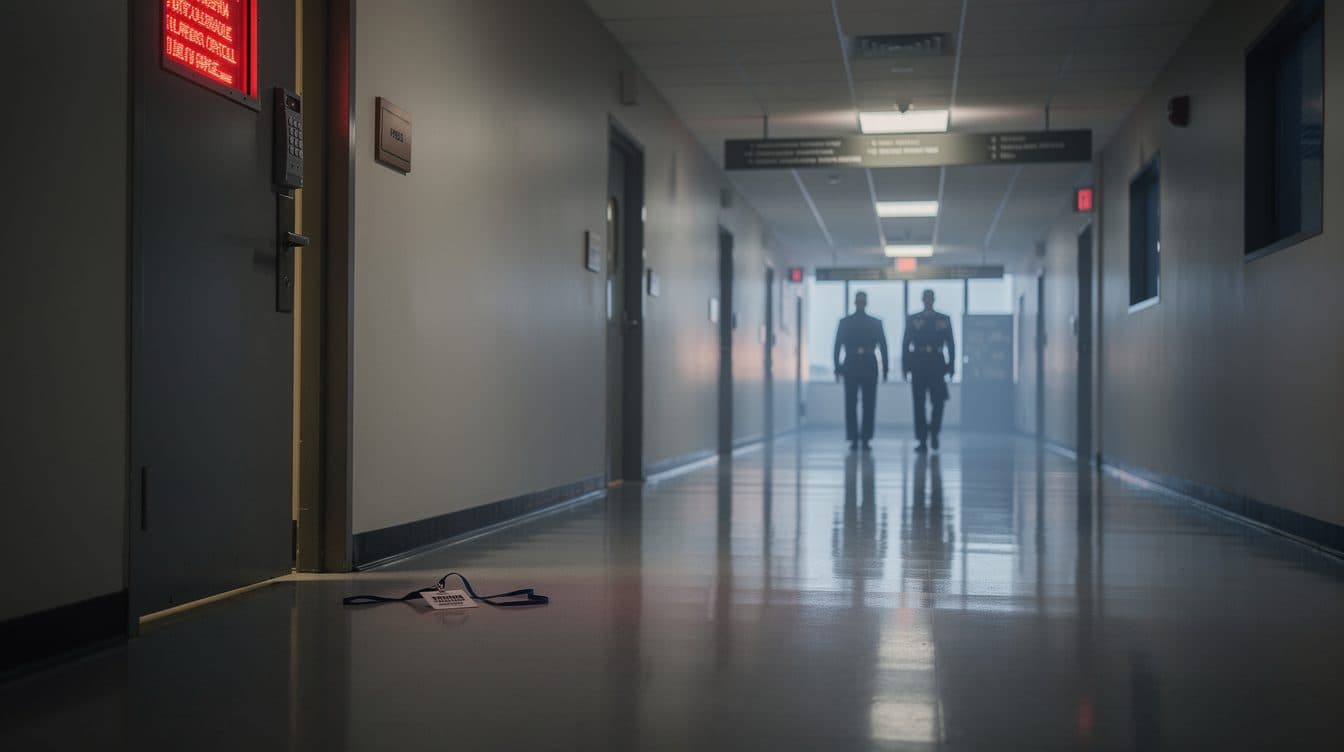
Pentagon closes press office to journalists: classified as a restricted information area
Washington, June 2, 2026
AI-generated image (flux-2/pro-text-to-image via Kie.ai)
Summary
The U.S. Department of Defense has declared its press office a classified information area, banning journalists from access starting June 2, 2026. The move, announced by spokesperson Joel Valdez, follows a series of restrictions already challenged in court by The New York Times.
Washington, June 2, 2026
The Pentagon announced on June 2, 2026, the immediate closure of its press office to journalists, declaring the area due to the presence of speechwriters who regularly handle classified material.
U.S. Department of Defense spokesperson Joel Valdez announced that as of Tuesday, June 2, 2026, media representatives will no longer be able to access the premises of the Pentagon press office. The decision, described as immediately effective, was initially reported by Deutschlandfunk and subsequently confirmed by other international news outlets.
According to Valdez's explanation, the office has been officially declared a "Bereich mit geheimen Informationen" – an area with classified information. The stated reason is that among the employees working there are official speechwriters, who handle "routinemäßig mit Verschlusssachen," meaning regularly classified material.
The spokesperson stated verbatim: "Infolgedessen ist es Journalisten künftig nicht mehr gestattet, die Büroräume zu betreten." In other words, journalists will no longer be permitted to enter the Pentagon press office premises in the future. The measure represents a further tightening of rules already introduced by the Department of Defense towards the press in recent months.
The official reason: speechwriters in contact with secrets
In addition to the physical closure of the workspace previously reserved for media representatives, the Pentagon has imposed an additional restriction: journalists can now move within the building only if accompanied by an "Aufsichtsperson," a supervisory official. This rule effectively makes it impossible for reporters to interact freely with internal sources or carry out their coverage work independently.
The decision comes about three months after a federal court ruling that had partially deemed the Pentagon's strategy unconstitutional. In March, a federal judge had partially granted the lawsuit filed by The New York Times, ruling that some of the imposed restrictions violated the First Amendment of the U.S. Constitution, which guarantees freedom of the press.
The New York Times had sued the Department of Defense after new directives were issued last fall, prohibiting accredited journalists from publishing information not previously approved by the Pentagon. The same guidelines also prohibited contacting unauthorized sources within the Defense apparatus.
The New York Times lawsuit and the March ruling
The new rules were contained in a roughly 21-page document, which almost all major American newspapers had refused to sign. The failure to sign had effectively opened the legal battle that culminated in the March ruling, which, however, did not manage to halt the tightening of measures adopted in recent weeks.
The closure of the press office is part of a broader hardening of relations between the administration and the media. Since Donald Trump returned to the White House, the U.S. government has progressively tightened the rules governing journalists' access to federal institutions and their coverage of executive activities.
A significant chapter of this strategy concerns the composition of the White House press pool, the select group of journalists who follow the president daily. Recently, the composition of the pool was changed, and leading news agencies such as Associated Press, Reuters, and Bloomberg lost their permanent spots.
Restructuring of the White House press pool
In their place, social media influencers were admitted, a choice that drew strong criticism from journalists' professional associations. The decision was interpreted as a preference for more direct communication channels less subject to traditional editorial verification.
Trump himself has repeatedly labeled inconvenient investigative reports and journalistic accounts as "Fake News," even taking targeted actions against individual news outlets. This rhetoric, according to various observers, has contributed to creating a climate where systematic restrictions on media access face less political opposition.
The June 2026 episode marks a significant escalation: for the first time, an entire press office of a federal department is declared a classified area, effectively barring journalists from one of the government's main communication hubs. Press freedom advocacy organizations have announced their intention to explore new legal initiatives.
A landscape of growing media restrictions
The March federal ruling had declared the Pentagon's approach only partially unconstitutional, leaving several interpretative questions open. The current move, declaring an entire area as security-sensitive, could be designed to circumvent the points of the ruling that the Department was forced to revise.
From a practical standpoint, news outlets that maintain accredited correspondents at the Pentagon now find themselves unable to independently access the space where the daily routine of briefings and informal contacts with officials took place. The only remaining channel is the request for accompaniment, subject to prior approval and unpredictable timelines.
Several commentators have pointed out that the decision risks compromising the very ability of investigative journalism to operate within one of the most relevant departments of the American administration, both for foreign policy issues and for defense budget matters, which amount to hundreds of billions of dollars annually.
Practical consequences for journalism at the Pentagon
The Pentagon press office, since its establishment, had represented one of the most frequented points of contact between federal institutions and the media, also due to the global role played by the U.S. armed forces. Its transformation into a limited-access area raises questions that go beyond the individual dispute and concern the relationship between the executive power and citizens' right to be informed.
Currently, the Department of Defense has not announced any revision of the measure nor indicated a timeline for a possible restoration of previous conditions. Journalists' professional organizations, for their part, are studying whether and how to challenge the new decision, also in light of the existing judicial precedent.
The episode is part of a long-term trend that, since the 2024 election cycle, has seen a progressive reduction of the spaces traditionally guaranteed to the press. The declaration of secrecy of the press office represents, from this perspective, the most radical step taken by the administration towards accredited media so far.
Questions & Answers
Why did the Pentagon close its press office to journalists?
Spokesperson Joel Valdez explained that the office was declared a classified information area because speechwriters who regularly handle classified material ("routinemäßig mit Verschlusssachen") work there.
What role did The New York Times play in the matter?
The New York Times filed a lawsuit against the Department of Defense following restrictions introduced in the fall of 2025; a federal judge declared the Pentagon's approach partially unconstitutional in a March 2026 ruling.
How does the decision connect to the policies of the Trump administration?
Since Donald Trump returned to the White House, the government has tightened media rules, changing the composition of the presidential press pool in favor of influencers and labeling unwelcome investigations as "Fake News," in a context of increasing limitations on journalists' access to institutions.
Pentagon closes press to journalists, June 2026 | allfacts360