Reform of German Support Classes: Ministry Aims to Reduce Annual Class Loss for a Quarter of Students
Vienna, July 22, 2026
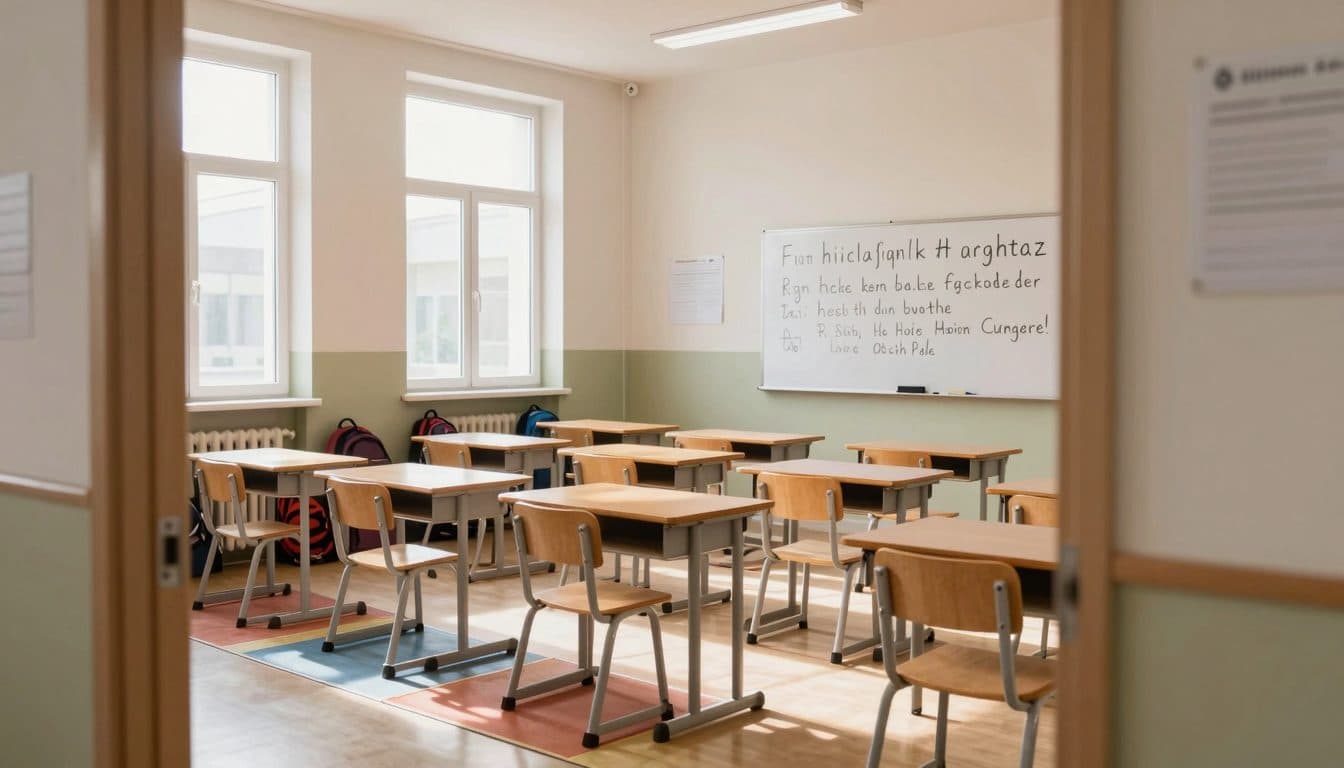
AI-generated image (z-image via Kie.ai)
Summary
The Ministry of Education plans to expand the more flexible advancement rules for students in German support classes, applicable from fall 2026. In the future, children with an "insufficient" MIKA-D result should also be able to advance with a positive performance prognosis, in order to reduce lost school years.
Vienna, July 22, 2026
Austria's Ministry of Education plans, effective with the 2026/27 school year, more flexible advancement rules for children in German support classes, so that fewer students in "extraordinary" status lose a school year in the future.
The baseline situation has been the same for years: In Austria, since the 2018/19 school year, school beginners and lateral entrants from abroad who do not score well enough on the controversial MIKA-D placement test must attend separate German support classes and groups. In the model introduced by the black-blue coalition, "extraordinary" students receive a maximum of 20 hours per week of German instruction in separate classes or groups for up to two years. Joint instruction with the regular class only takes place in subjects such as crafts, music, or physical education.
The consequence of this construction is a high number of so-called educational losses. According to the latest OECD report "Education at a Glance," the proportion of over-age students – those who are at least two years older than intended for their grade level – in middle schools and lower secondary academic schools (AHS-Unterstufen) rose from 6.5 to 9.1 percent between 2015 and 2023. This is primarily attributed to the system of grade repetition, which is unusual in other countries, the separate German support, and the preschool classes.
Baseline Situation: Separate Model Since 2018
APA also has a concrete statistic: Of the 22,800 students who received extraordinary status for the first time in the 2022/23 school year, 22 percent had to repeat a grade once and three percent twice. Currently, more than 48,000 children are enrolled in German support classes. This means that almost a quarter of all students in extraordinary status lose at least one year in their school career – a figure that Education Minister Wiederkehr considers "much too high."
Ukrainian students were particularly affected recently. The old regulation had led to hundreds of Ukrainian students having to repeat a grade despite positive grades in all subjects, rather than being able to transfer directly to a middle school, lower secondary academic school, or further education school. The ministry also points to transitions after the fourth grade of primary or middle school, where the formal requirements "in individual cases" led to additional career losses.
Data Situation: Statistics and OECD Comparison
The package of measures, which will take effect step by step from fall 2026, is intended to remove these hurdles. For example, the current obligation to set up separate German support classes or groups from eight extraordinary students at a location will be dropped. Instead, from fall onward, half of the schools should use school-autonomous models in which German is supported within the regular class. In the case of significant progress, an additional test can also be conducted in the future so that a child can transfer to the German support group or the regular class with good results.
At the same time, the advancement rules are being relaxed: From the 2026/27 school year onward, students with positive assessments in all subjects and a positive performance prognosis from the class or school conference can advance even if, according to MIKA-D, they only have an "insufficient" command of German. Previously, advancement despite an insufficient test result was only possible under strict conditions; greater flexibility had only existed temporarily during the coronavirus pandemic. This also applies to the transition option from primary school to middle school.
Reform from Fall 2026: More Flexible Advancement Rules
Since the 2023/24 school year, students have been able to switch to ordinary status earlier if they achieve the "sufficient" MIKA-D result at the end of the school year rather than at the half-year mark. In addition, the mandatory MIKA-D test is to be conducted only at the end of the summer semester in the future, in order to reduce the administrative burden. In the subjects they take, students should also be able to receive grades. Students with an "unsatisfactory" result must continue to repeat the year.
The MIKA-D test itself has been revised in terms of content: Additional questions have been added for the 3rd and 4th grade of primary school and for middle school to make classification more precise. This is intended to increase the accuracy of the test and reduce the number of incorrect assignments.
Further Components: Summer School and Opportunity Bonus
In addition to the reform of the support classes, further components are being announced. From 2025, a mandatory summer school for children with German support needs will be introduced. For school locations with particularly large numbers of educationally disadvantaged migrant children, additional staff is to be provided via a so-called "Chancenbonus" (opportunity bonus). According to Wiederkehr, the goal is for children and adolescents to lose their extraordinary status earlier and participate fully in school life with good German language skills.
The Ministry of Education justifies the package with the goal of reducing career losses as much as possible. At the same time, reference is made to international comparative data, which attribute the high proportion of over-age students in Austria to the interplay of grade repetition, separate German support, and preschool classes. With the gradual restructuring from fall 2026, the system is to focus more strongly on integration into regular instruction.
Critics have been demanding for years that the model of separated German support classes be fundamentally reconsidered. They point to the isolation from regular instruction and the long-term effect on educational trajectories. The now planned more flexible advancement rules and school-autonomous models are regarded as a step in this direction, but do not completely replace the existing structure. It remains unclear for the time being how the school-autonomous models will be concretely designed in practice and what resources will be made available to schools for this purpose.
Reactions and Open Questions
Overall, the reform changes several levers simultaneously: the testing frequency of MIKA-D, the threshold for switching to ordinary status, the possibility of flexible advancements despite formally insufficient German skills, as well as the school organizational framework conditions. For the more than 48,000 affected children, this means, in the best case, fewer lost school years and an earlier connection to regular instruction.
The next steps lie in the implementation at schools. From fall 2026 onward, the first school-autonomous models are to start, while the new advancement rules will simultaneously apply. The mandatory summer school has already been running since 2025. Education Minister Wiederkehr has emphasized to APA that the reforms are intended to help students lose their extraordinary status earlier and participate fully in school life with good German language skills.
Outlook: Impact Expected No Earlier Than the Next School Years
In the long term, the impact of the reform will be measured by the development of the proportion of over-age students. If the proportion – as documented in the OECD report since 2015 – continues to rise, the debate about German support classes and the system of grade repetition is likely to flare up again. With the package, the Ministry of Education sees itself on a path that is to noticeably reduce the structural loss rates.
The APA report also makes clear: Students with an "unsatisfactory" result must continue to repeat the year – advancement is not possible in this case even under the new rule. The reform thus deliberately moves in the area between "insufficient" and "sufficient," not in the case of completely unsatisfactory performance.
Questions & Answers
Which change applies from the 2026/27 school year for advancement from the German support class?
Students with positive assessments in all subjects can advance with a positive performance prognosis from the class or school conference even if their MIKA-D result is only "insufficient." Students with an "unsatisfactory" result must continue to repeat the year.
Why did the old regulation particularly affect Ukrainian students?
According to APA, the old regulation led to hundreds of Ukrainian students being unable to transfer directly to a middle school, lower secondary academic school, or further education school despite positive grades in all subjects, and having to repeat the grade.
What changes in the school organizational setup of the support classes?
From fall onward, the obligation to set up separate German support classes or groups from eight extraordinary students at a location is dropped; half of the schools are to use school-autonomous models for German support within the regular class instead.
German Support Classes Reform 2026: Less Annual Loss for | allfacts360