Reichenau Festival opens 100th-anniversary season with a Roaring Twenties 'Fledermaus'
Reichenau an der Rax, 02 July 2026
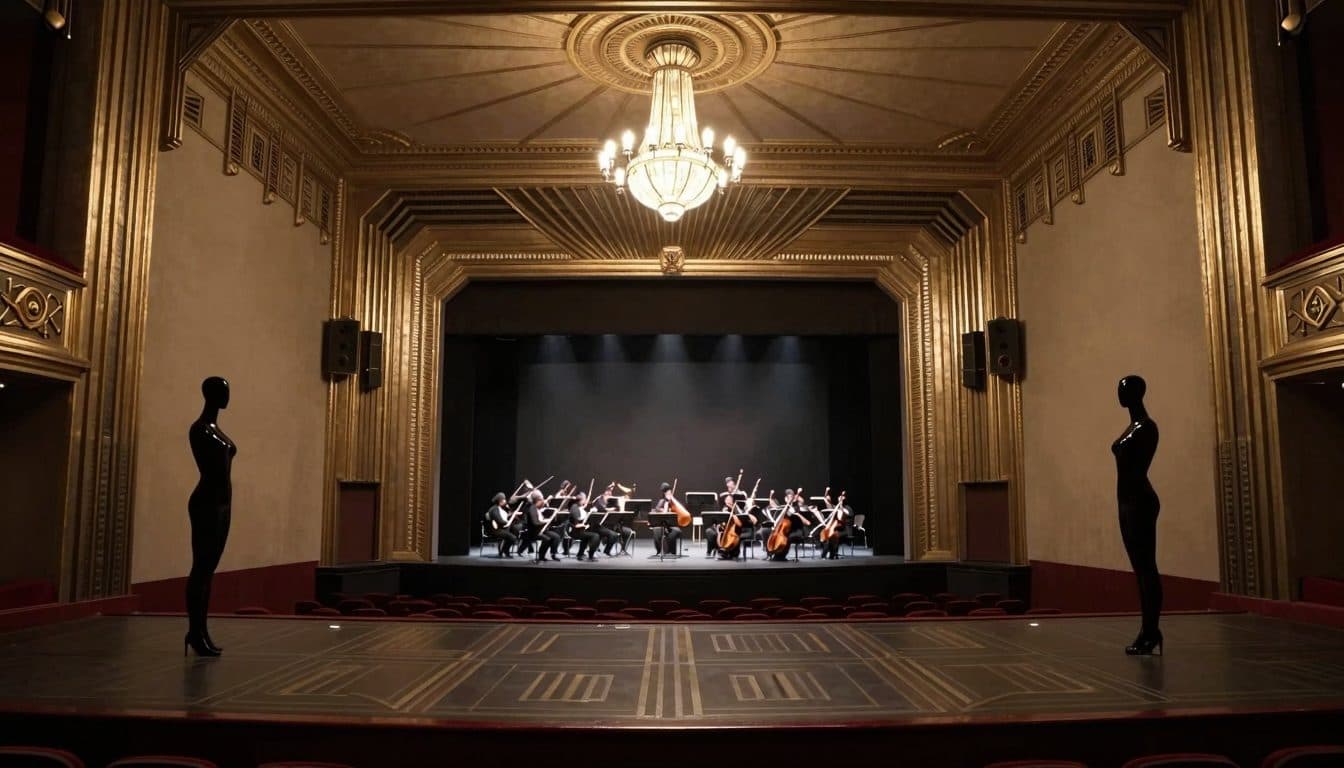
AI-generated image (z-image via Kie.ai)
Summary
The Reichenau Festival has opened its 100th-anniversary season with a new production of Johann Strauss's "Die Fledermaus," relocated by directors Lukas Schrenk and Nils Strunk to Vienna in 1926. The adaptation blends operetta, musical revue and slapstick, and received warm applause at its Wednesday premiere.
Reichenau an der Rax, 02 July 2026
The Reichenau Festival opened its 100th-anniversary season on Wednesday evening with a new production of Johann Strauss's "Die Fledermaus" that relocates the operetta to Vienna in 1926, the year a former wood-pulp mill in Reichenau an der Rax first opened its doors as a theatre and concert hall.
The premiere, attended on 2 July 2026, marks a century since the building's conversion into a performance venue. Festival director Maria Happel took the risk of staging "Die Fledermaus" again for the anniversary, after a Strauss tribute the previous season that she described, in the language of the festival's press materials, as having "tax-freed" the composer and crowned him "King of Swing."
Happel entrusted the production to the duo of Lukas Schrenk and Nils Strunk, who had already adapted Mozart's "Die Zauberflöte" and Bizet's "Carmen" for younger audiences with considerable success. For their third Reichenau collaboration, the pair transplanted Strauss's score from its original 1874 setting to the Vienna of hyperinflation, American jazz and dance halls, where the Wiener Werkstätte aesthetic had just been declared the last word in modernity.
A century of theatre in a former mill
The staging is built around the geometric visual vocabulary of late-1920s design, with sets by Maximilian Lindner that place the action in a world of Art Deco mannequins and angular patterns. The 1926 frame allows the directors to connect the "Gründer-Krach" (the stockmarket crash of 1873 that shaped the original operetta) to the inflation of the early 1920s, drawing a parallel between the two economic crises. As one reviewer noted, "Die Traumnovelle," Arthur Schnitzler's 1926 study of a masked ball charged with erotic tension, was published the same year and offers an obvious point of reference.
The structure of the evening deliberately parodies the conventions of the genre. The first act plays as a Nestroy-style farce with songs; the second, with a Prince of Darkness played by Moritz Mausser in a Johnny-Depp-style look, evokes Schnitzler's dream novella; the third piles on slapstick in the manner of a Charlie Chaplin silent. Sebastian Wendelin, lanky and topping his costume with an outsized peaked cap, doubles as the drunken prison guard Frosch and, in the same breath, parodies Chaplin's "Great Dictator" and, with carefully choreographed stumbles, the perennial New Year's Eve sketch "Dinner for One."
Musically, the evening remains anchored in Strauss's original melodies, arranged in what reviewers called "very accomplished" new orchestrations. The score is repeatedly invoked only to be "torn apart" within a few bars, as one critic put it. The exception comes early on, when jazz-flavoured passages are allowed to blend into Strauss's writing — a path, the same critic suggested, that might have been worth following further. Otherwise, as another reviewer wrote, "the secured firework of gags fizzles out into a polite 'merci.'"
The 1926 frame: from the Gründer-Krach to hyperinflation
Performances drew particular praise. Raphael von Bargen, billed as the German "Eisenstein" inside a deliberately Viennese ensemble, won over audiences as the lovestruck Gabriel von Eisenstein, contributing punchy saxophone solos along the way. Julia Edtmeier enchanted in the dual role of Rosalinde's shrill maid and an Art Deco mannequin. Mausser's Prince of Darkness was singled out for a pompous entrance aria styled as a musical theatre number — "as if it were 'The Phantom of the Operetta.'"
The production's satirical bite is sharpened by interpolated lyrics. Lines such as "Die Zeit, sie rennt, das Geld verbrennt / Es wankt der ganze Kontinent" — "Time runs, money burns / The whole continent totters" — capture, in the words of one review, "the much-quoted dance on the volcano" that defined the mood of the interwar years. As a further nudge to the audience, the directors dropped the tired stage-business of Eisenstein's supposed Hungarian countess: she simply steals his wedding ring from his finger.
The libretto's gender politics, progressive for the 1870s, are read against the backdrop of the Neue Sachlichkeit (New Objectivity) of the late 1920s, prompting the festival's own commentators to ask what became of the emancipatory impulses that had animated the original work. "One reflects, weary, on what changes those emancipatory concerns actually underwent between 1874 and 1926," a programme essay observes.
Performances and musical arrangement
The finale builds to a full-scale brawl, after which the entire cast — somewhat battered — lines up at the footlights, and Falke (Peter Lesiak) tentatively offers a reconciliatory "Brüderlein und Schwesterlein." The evening ran close to three hours, and the "Eifersuchtstango" encore was, by one account, "almost too much of a good thing."
The review in the festival's own materials called the premiere "a veritable coup," noting the warm applause that greeted the company. "Glücklich ist, wer vergisst" — "Happy is he who forgets" — runs the famous line from the operetta's second act, but, as one critic wrote, "an original 'Fledermaus' like this one will be remembered for a long time to come."
Not every commentator was won over. One review argued that the production turns "Die Rache einer Fledermaus" — the original working title, "The Revenge of a Bat" — into a kind of torture of the piece itself. "The plot of the 'Fledermaus' is just a drunk story," that writer complained, "that doesn't gain substance when depth is faked with Sigmund Freud quotes." The same review concluded that Strauss's work is "the masterwork of its genre" and that the adaptation does not serve it.
Critics divided on Strauss treatment
The festival has framed the production as a deliberate counterpoint to its Strauss-heavy jubilee year, in which the composer's legacy was celebrated with what one commentator called "fluffy sound carpets." Here, by contrast, Strauss's melodies are quoted, deconstructed and reassembled, with the operetta's familiar numbers recast as a revue-style sequence at "Palais Orlofsky." The format mirrors the 1920s craze for American-style variety entertainment imported into Viennese nightlife.
Set against the building's centenary, the choice of year — 1926, when the Reichenau theatre itself opened — lends the staging a self-reflexive layer. The Reichenau Festival's communications frame it as an attempt "to rewrite the history of high-class light music," a phrase that signals the company's ambition to mark its anniversary not with museum-piece reverence but with an aggressively contemporary take.
The production is the third Reichenau partnership for Schrenk and Strunk, who previously tackled Mozart and Bizet. The festival, founded in the converted wood-pulp mill that opened in 1926, has used such adaptations to court younger audiences and to test whether the classical canon can survive collision with the visual idioms of the late 1920s. The "Fledermaus" premiere suggests that, in Reichenau at least, the experiment continues to find both supporters and sceptics.
Questions & Answers
What is the Reichenau Festival's new production?
The festival opened its 100th-anniversary season with a new staging of Johann Strauss's "Die Fledermaus," relocated by directors Lukas Schrenk and Nils Strunk to Vienna in 1926.
Why did the directors set the operetta in 1926?
They chose 1926 because that is the year the Reichenau theatre itself opened, and because the interwar period offers parallels with the 1873 "Gründer-Krach" that originally framed Strauss's work.
Who sings the principal roles in the production?
Raphael von Bargen sings Eisenstein, Julia Edtmeier plays the maid and an Art Deco mannequin, Moritz Mausser plays a Johnny-Depp-styled Prince of Darkness, and Sebastian Wendelin doubles as Frosch and as a Chaplin-style figure.