Rising Fuel Prices: Coalition Negotiates the Future of the Price Brake
Vienna, July 22, 2026
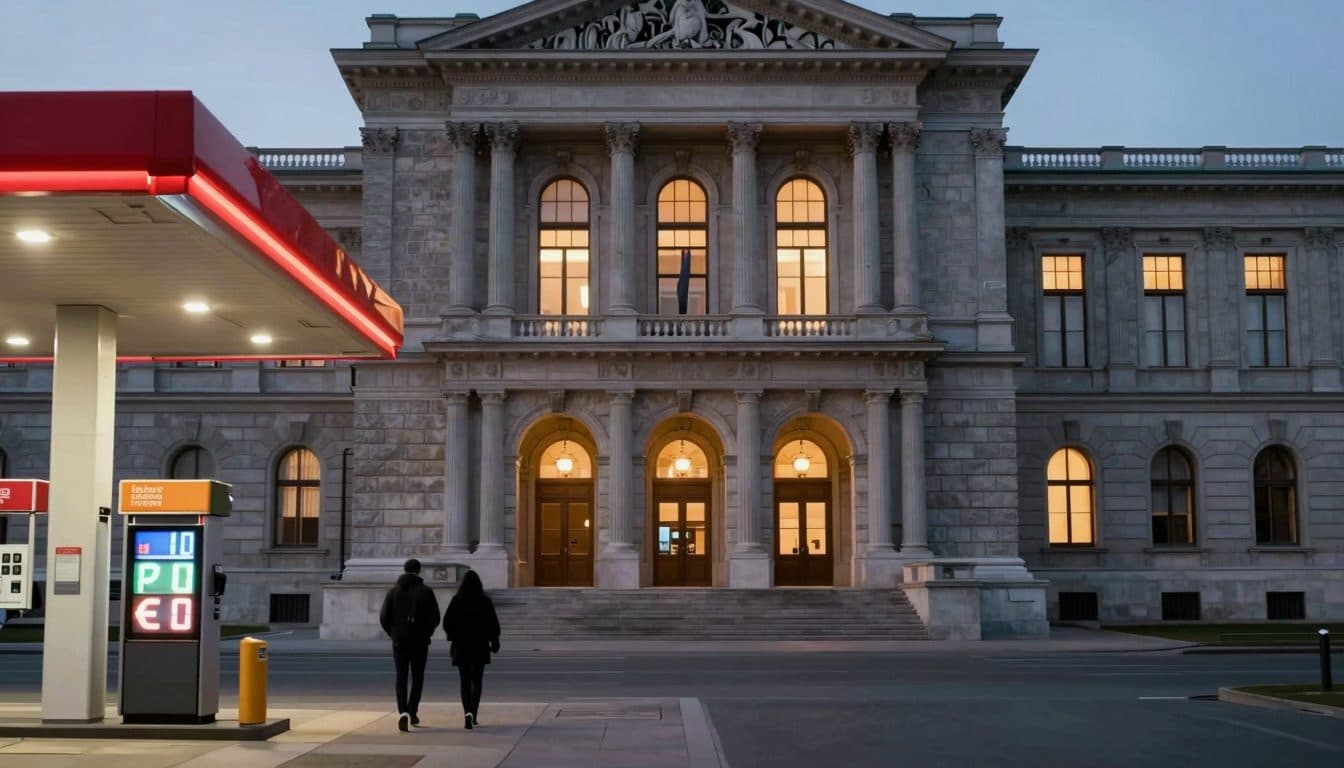
AI-generated image (z-image via Kie.ai)
Summary
Due to rising fuel prices caused by the escalation in the Strait of Hormuz, the ÖVP-SPÖ-NEOS coalition is negotiating the future of the price brake. So far, none of the three governing parties has publicly committed to an expansion.
Vienna, July 22, 2026
The Austrian federal government is negotiating adjustments to the price brake in effect since April in light of rising fuel prices again, with ÖVP and NEOS being more skeptical of a renewed margin intervention than the SPÖ.
Prices Back Near March Peak
Prices at domestic fuel pumps have recently risen significantly again. On Tuesday, diesel cost 1.989 euros per liter and gasoline 1.864 euros in the nationwide median, according to E-Control data. The gasoline price is thus only just below the peak of around 1.9 euros at the end of March, when prices had briefly exploded following the start of the Iran war in February. For comparison: in the week before the war began in February, gasoline had cost a median of 1.52 euros per liter and diesel 1.57 euros.
The trigger for the renewed price increase is an escalation in the Strait of Hormuz. The price of a barrel (159 liters) of the reference grade Brent from the North Sea rose by over 3 percent on the futures market to around 95 dollars. Brent oil is thus at its highest level since the beginning of June. In the second half of June and the beginning of July, the oil price had fallen step by step to 70 dollars due to hopes of a sustained ceasefire in the Middle East. Oil prices continued to rise on Wednesday morning due to ongoing US attacks on Iran, as reported by the news agency Reuters.
Trigger: Escalation in the Strait of Hormuz
The 10-cent fuel price brake introduced in April was originally intended to make diesel and gasoline ten cents per liter cheaper. Five cents were financed from a cap on the margins of the oil companies, and another five cents from a reduction in the mineral oil tax, which was funded through additional revenue from value-added tax. The margin cap on fuel prices, which caused considerable excitement in business circles, was already lifted by the government at the beginning of June. The margin cap was thus completely eliminated in June.
Compared to January, the net price level in April corresponded to an increase of 39 and 54 percent for gasoline and diesel, respectively. When the fuel price brake was first introduced in April, the net price for a liter of Super was 0.92 euros, and that for diesel was 1.215 euros. In mid-May, the net prices were just over 0.9 euros per liter for gasoline and 1.07 euros for a liter of diesel. Currently, the net station prices according to the Oil Bulletin of the European Commission are 0.86 euros per liter of gasoline and one euro per liter of diesel – and thus below fuel prices from two months ago.
How the Price Brake Works – and What Remains of It
At the end of July, the ÖVP/SPÖ/NEOS government must once again agree on how high the fuel price relief contribution should be. The mineral oil tax reduction is set as part of a monthly ordinance; the tax cut was simultaneously reduced. In July, it amounted to only 0.8 cents per liter. Most likely, this amount will be higher again in August than it was most recently in July. The Ministry of Finance is currently calculating how high the budget-neutral relief will be.
An expansion of the fuel price brake is now being debated politically again. Whether the price brake will be continued in its current form or whether it will be tightened again is currently being negotiated within the coalition. Initial negotiations are expected to take place, according to coalition circles to Ö1. However, no public commitment to this has come from any of the three governing parties so far.
Decisive for interventions in refinery margins is, according to the Price Act, that "unusually high prices have led to macroeconomic distortions." This can be assumed when net station prices according to the Oil Bulletin of the European Commission are more than 30 percent above those from two months ago. This legal basis, on the basis of which the ordinances on the margin cap were issued, expires at the end of the year. Economics Minister Wolfgang Hattmannsdorfer reacted cautiously to the inquiry. The situation is being monitored daily. The top priority is security of supply, according to a statement to Ö1 and SN.
Power Struggle Within the Coalition
The fronts in the debate are clearly drawn. ÖVP and NEOS are naturally more critical of a renewed margin intervention than the SPÖ. The Austrian Trade Union Federation (ÖGB) recently called for an "effective margin regulation" for diesel and heating oil. ÖGB economist Angela Pfister explained: "Es ist völlig unverständlich, dass die bisherige Margenregelung abgeschwächt wurde – vor allem, da der Konflikt im Nahen Osten noch lange nicht gelöst sein wird." This is also confirmed by E-Control.
The mineral oil tax reduction was steadily scaled back in the following months. In any case, the obligation for gas stations to pass on reduced wholesale prices at the pump remains in force. It also remains in place that gas stations must continue to pass on price reductions in international price quotations by the end of August. The median value is the price that lies exactly in the middle of all price reports submitted.
The domestic mineral oil industry is resisting new interventions. "Nein, den brauchen wir nicht," Geschäftsführerin Hedwig Doloszeski told SN. The fragmented domestic gas station market works very well, and Austria remained in the lower third of the European comparison for fuel prices in June. In the longer term, the fuel price brake could endanger independent small gas stations and thus competition, she warned.
Union and Business at Odds
Entlastungen werden also discussed in Germany as well. Berlin had introduced a so-called Tankrabatt in the spring, analogous to the Austrian fuel price brake, which worked purely through a tax reduction. While SPD General Secretary Tim Klüssendorf recently called for a fuel price cap, his coalition partner, Economics Minister Katherina Reiche (CDU), has already ruled out new relief measures due to the rise in fuel prices. She justified this with the words: "Wir haben mit der Spritpreisbremse ein sehr, sehr teures Instrument eingesetzt. Das hat uns viele Milliarden Euro gekostet. Diese sind momentan im Bundeshaushalt auch nicht zur Verfügung."
A Look at Germany
The debate about the fuel price brake has thus picked up speed again. With the end of the summer holidays and the expiry of the current ordinances at the end of August, the government is under pressure to present a solution. The question of whether the gradual reduction in relief will continue or whether rising prices in view of the geopolitical situation will trigger a new political feat remains open for the time being.
Nicolas Dworak and Jakob Pflügl reported on July 22, 2026 for the Salzburger Nachrichten and ORF. Developments on the commodity markets and the political reactions to them will shape the discussion in the coming weeks.
One thing is certain: for drivers in Austria, refueling remains expensive for the time being. If the coalition does not adopt new measures, prices on the international markets will feed directly through to the pumps. The course for a possible return of the full price brake will be set in the coming days.
Questions & Answers
What is the fuel price brake and how does it work?
The 10-cent fuel price brake introduced in April consists of a reduction in the mineral oil tax and a cap on the margins of the oil companies. The margin cap was already lifted at the beginning of June, and the mineral oil tax reduction has since been gradually reduced, amounting to only 0.8 cents per liter in July.
Why have fuel prices in Austria risen again?
The trigger is an escalation in the Strait of Hormuz: due to ongoing US attacks on Iran, the Brent oil price rose by over 3 percent on the futures market to around 95 dollars per barrel – the highest level since the beginning of June. On Tuesday, diesel cost 1.989 euros and gasoline 1.864 euros per liter in the nationwide median.
What positions do the parties take on the future of the price brake?
According to the Austrian Trade Union Federation (ÖGB), the SPÖ is open to an effective margin regulation, while ÖVP and NEOS are skeptical of renewed intervention. Economics Minister Wolfgang Hattmannsdorfer stated that the situation is being monitored daily and that the top priority is security of supply.
Fuel Price Brake: Coalition Negotiates Expansion Following | allfacts360