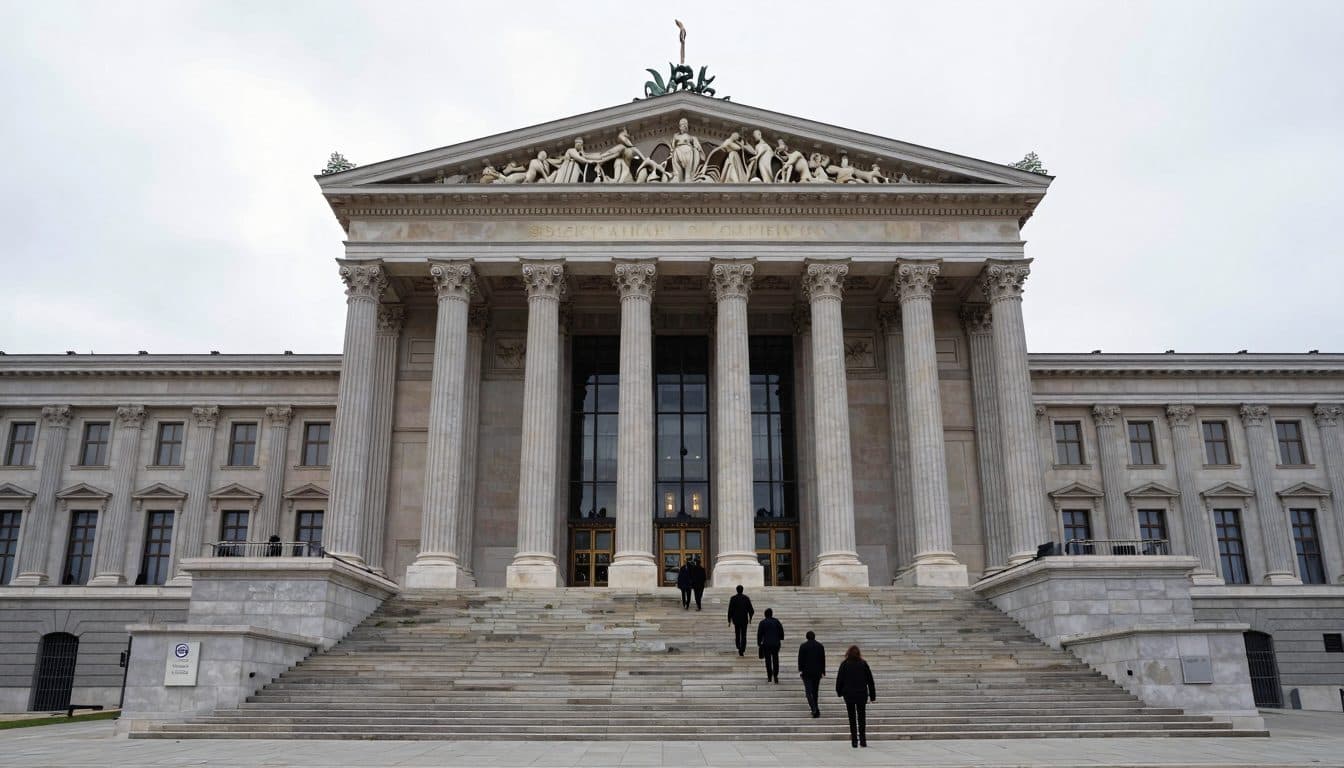
Rosenkranz shows openness to security checks for parliamentary staff
Vienna, July 12, 2026
AI-generated image (z-image via Kie.ai)
Summary
National Council President Walter Rosenkranz (FPÖ) has signaled his fundamental willingness to support security checks for parliamentary staff in the Presidential Conference. At the same time, he is facing criticism from the Greens over the personnel matter surrounding the new Parliamentary Director and the connections of FPÖ staff to the Identitarians.
Vienna, July 12, 2026
National Council President Walter Rosenkranz signaled on Sunday in the ORF program "Hohes Haus" that he was willing to support security checks for parliamentary staff in the Presidential Conference.
Trigger of the debate
The discussion about possible security checks for parliamentary staff had recently been reignited by the appointment of the new Parliamentary Director Roland Weinert as well as by the revealed connections of FPÖ staff to the right-wing extremist Identitarian movement. National Council President Walter Rosenkranz showed himself on Sunday in the ORF program "Hohes Haus" fundamentally open to corresponding measures, should these be decided by majority or unanimously in the Presidential Conference.
In an interview with the daily newspaper "Kurier," Rosenkranz said he was "für alles zu haben" (open to anything) that is decided by majority or unanimity in the Presidential Conference. Specifically, he pointed out that he had already raised the issue of security checks in one of the recent Presidential Conferences. At the time, however, all parties had said "No" to it, as Rosenkranz stated verbatim: "In einer der letzten Präsidialen habe ich dieses Thema angesprochen, alle Parteien hätten dazu aber 'Nein' gesagt."
Gödl's initiative and the incidents
The demand for security checks originally came from ÖVP parliamentary club chairman Ernst Gödl, who had reaffirmed it in the ORF program "Report." Gödl justified the initiative with a series of incidents in the FPÖ's orbit. Specifically, reference was made to violent actions in which men from the FPÖ environment were involved, including an assault on a taxi driver in Leoben.
Rosenkranz conceded in the "Kurier" interview that at the time of Weinert's appointment he had not known that the staff member involved in the Leoben incident had already left the FPÖ. In substance, he emphasized that in the case at hand it was not about demonstrations or a worldview, but about the "Vorwurf einer strafbaren Handlung" (allegation of a criminal act). Such things have "nichts zu suchen" (no place) in Parliament.
Weinert and the fraternities
At the same time, Rosenkranz defended the appointment of Weinert as the new Parliamentary Director. For the position, there had been a regular selection process with a total of eleven applications. Furthermore, he rejected the accusation that members of fraternities in Austria were subject to a professional ban: "Es gibt auch für Burschenschafter in Österreich kein Berufsverbot." This statement is closely linked to the debate about personnel overlaps between fraternities, the FPÖ, and the Identitarians.
Regarding the classification of the Identitarians as right-wing extremist by the Austrian domestic intelligence service, Rosenkranz took a nuanced position. He said he could "durchaus vorstellen, auch nach den Beispielen, wo Gewalt geübt wurde, dass zumindest Teile davon tatsächlich auch Gewalt als Mittel einsetzen und daher rechtsextrem" (well imagine, also based on the examples where violence was exercised, that at least parts of them actually use violence as a means and are therefore right-wing extremist). Members of the Identitarians were "nicht nur gewaltbereit sind, sondern gewalttätig" (not only willing to use violence, but violent).
Domestic intelligence and the Identitarians
The term "Remigration" is also at the center of the political dispute. Rosenkranz, who — unlike Second National Council President Peter Haubner (ÖVP) and Third National Council President Doris Bures (SPÖ) — did not issue a call to order to FPÖ MPs who used the term in the National Council, rejected the interpretation of it as a battle cry. "Für mich ist 'Remigration' ein Begriff, der aus der Wissenschaft kommt, der seit den 1960er-Jahren verwendet wird. Der Begriff komme aus dem Lateinischen," Rosenkranz explained. He refused "intellektuell" (on intellectual grounds) to call the term a battle cry.
Dispute over the term "Remigration"
At the same time, Rosenkranz made clear that the FPÖ does not understand remigration to mean mass deportations. Asked whether the term meant mass deportations, he replied: "Um Gottes willen, nein." A deportation "nach den geltenden Bestimmungen" (in accordance with the applicable provisions) was what "wir Freiheitlichen" (we Freedom Party members) understood by remigration and what was also in the election program. Nevertheless, he stressed that the revocation of citizenship and deportation of people was "keine freiheitliche Gesinnung" (not a Freedom Party mindset) and represented "keine Rechtsstaatlichkeit" (no rule of law).
The Greens meanwhile intensified their criticism of Rosenkranz. The Greens' spokesperson on right-wing extremism, Lukas Hammer, said in a statement that Rosenkranz was "für dieses Amt absolut ungeeignet" (absolutely unsuitable for this office) and had "das Vertrauen des Parlaments mittlerweile endgültig verspielt" (definitively lost the Parliament's trust). Hammer also accused Rosenkranz of retreating into a victim role instead of critically confronting the "extrem rechten Umtrieben" (far-right activities) of his own party.
Greens' criticism and demand for removal
Hammer further announced that the Greens urgently needed to discuss a mechanism for removing the National Council President: "Wir müssen dringend über eine Abwahlmöglichkeit sprechen." Rosenkranz reacted evasively and fundamentally openly: "Wenn es eine Mehrheit gibt, warum nicht?" He did not see himself as an autocrat: "Ich bin kein Diktator hier." Should the ÖVP table a corresponding motion, this could lead to an amendment of the rules of procedure, "und die wird dann durch mich vollzogen" (and it will then be implemented by me), Rosenkranz said.
Procedural questions surrounding the National Council also play a role in the debate. The ÖVP had recently made a concrete demand for security checks, pointing to the revealed connections of FPÖ parliamentary staff to the Identitarians. From the ÖVP's perspective, a new instrument is needed to prevent persons with such a background from working in parliamentary operations in the future. The FPÖ, for its part, stated that it had already parted ways with the staff member involved in the Leoben incident.
Open questions and outlook
The dispute fits into a longer-term debate about the role of domestic intelligence in assessing political movements. The Federal Office for the Protection of the Constitution and Counterterrorism classifies the Identitarian movement in Austria as right-wing extremist; the Interior Ministry shares this assessment. Rosenkranz referenced this without fully adopting the classification, but pointed to specific incidents of violence as justification for the assessment of at least parts of the movement.
It remains open whether the Presidential Conference will actually adopt a decision on security checks in the coming weeks. The positions of the five parliamentary groups represented in the Presidential Conference have not yet been coordinated; unanimous decisions in the Presidential Conference are considered the exception. It is also unclear how any potential removal mechanism for the office of the National Council President could be designed under constitutional law and which parliamentary majorities would be required for it.
Both the ÖVP and the Greens have made clear that they want to stick with the issue. Gödl pointed out that the recent incidents within the FPÖ underscored the need for security checks. The Greens, in turn, linked the personnel debate surrounding Rosenkranz to the demand for an institutional removal mechanism that could have effects beyond the current legislative period.
Regardless of the concrete outcome, the debate over parliamentary staff, the term "Remigration," and the handling of movements classified as right-wing extremist is likely to shape the domestic policy agenda in Vienna for the foreseeable future.
Questions & Answers
Who is Walter Rosenkranz?
Walter Rosenkranz is the National Council President and belongs to the FPÖ. He is currently facing criticism over the appointment of the new Parliamentary Director and over connections of FPÖ staff to the Identitarians.
Why is the ÖVP demanding security checks for parliamentary staff?
ÖVP club chairman Ernst Gödl justified the demand with a series of incidents in the FPÖ's orbit, including a violent assault on a taxi driver in Leoben, as well as with the revealed connections of FPÖ staff to the Identitarians.
What have the Greens demanded of Rosenkranz?
The Greens' spokesperson on right-wing extremism, Lukas Hammer, said Rosenkranz was unsuitable for his office and had lost the Parliament's trust. The Greens are demanding a mechanism to remove the National Council President.
Rosenkranz open to security checks in Parliament | allfacts360