Russia launches most massive wave of attacks since start of war – at least 13 dead in Kyiv
Kyiv, July 02, 2026
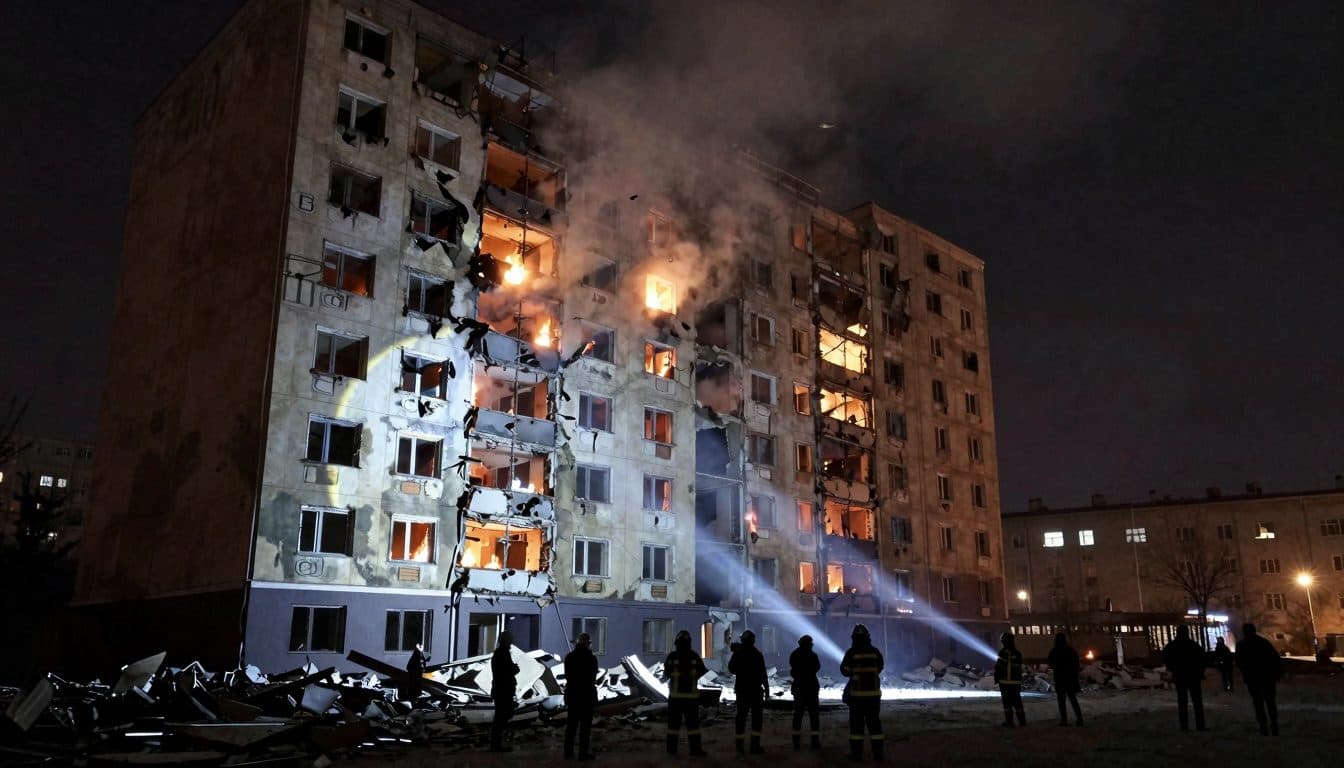
AI-generated image (z-image via Kie.ai)
Summary
Russia attacked Ukraine overnight into Thursday with nearly 500 drones as well as dozens of cruise missiles and rockets. President Volodymyr Zelensky spoke of one of the heaviest waves of attacks since the beginning of the war; at least 13 dead and 86 injured were reported from Kyiv.
Kyiv, July 02, 2026
Overnight into Thursday, Russia attacked Ukraine with nearly 500 drones as well as dozens of cruise missiles and rockets, killing at least 13 people and injuring 86 others in Kyiv.
What is new since July 2, 2026
Update of July 2, 2026: For the first time, the official casualty toll for the Ukrainian capital is now available. In addition, the US think tank CSIS published a new report on the total losses of the Russian and Ukrainian militaries since February 2022.
Overnight into Thursday, Russia attacked Ukraine with unprecedented force. According to the news portal "The Kyiv Independent," the Russian side deployed nearly 500 drones as well as dozens of cruise missiles and rockets. The attack came in several waves and struck several Ukrainian cities simultaneously. Kyiv's mayor Vitali Klitschko wrote on Telegram that "the whole city" was being attacked. Reporters from the portal reported "incredibly loud explosions" that could be clearly heard even in air-raid shelters deep underground.
Focus on Kyiv: 13 dead and 86 injured
The Ukrainian capital Kyiv was hit hardest. According to official figures, at least 13 people were killed there and 86 others were injured. The military governor of the Kyiv region, Tymur Tkatschenko, spoke of at least 56 casualties, including two children; military governor Oleh Kiper also reported 13 injured. Following the evening strikes, air raid alarms were triggered again in the early morning. Frightened Kyiv residents sought refuge in subway stations; many had set up tents there to spend the night underground, sheltered from aerial attacks.
Other Ukrainian cities were also targeted. Reports indicated air raid alarms and explosions in Zaporizhzhia and Pavlohrad in the southeast as well as in Sumy and Kharkiv in the northeast of the country. Multi-story buildings – including a hotel – were reported to have caught fire, and some residential buildings were completely destroyed, according to the news portal "The Kyiv Independent." The portal's report spoke of one of the heaviest waves of attacks since the beginning of the war.
Attacks also hit Zaporizhzhia, Pavlohrad, Sumy and Kharkiv
Ukrainian President Volodymyr Zelensky had already warned on Wednesday in Dublin of an imminent major attack. He spoke on the sidelines of a ceremony marking the handover of the EU Council presidency in Ireland and said: "Alle ein, zwei Wochen gibt es heftige Attacken mit Hunderten Drohnen und Dutzenden Raketen, und heute gibt es die unangenehme Information über die nächste Vorbereitung eines solchen massiven russischen Angriffs." Because of the warning, he had shortened his stay in the Irish capital Dublin, which he was visiting for the start of Ireland's six-month EU Council presidency.
After the attack, Zelensky spoke again and reported at least 13 dead and more than 90 injured. Due to the heightened danger, the energy company Western Oil Group announced that starting Thursday, all gas stations in Kyiv and all front-line provinces would be closed between 9 PM and 7 AM.
Zelensky's warning from Dublin
Parallel to the airstrikes, the Washington think tank CSIS (Center for Strategic and International Studies) published a new situation report on the total losses of the war. According to the report, since the start of the war in February 2022, around two million soldiers have been killed, wounded or reported missing – 1.4 million of them on the Russian side. "Die kombinierten russischen und ukrainischen Verluste haben zwei Millionen überschritten," the study states.
CSIS put the total number of Russian fallen at 400,000 to 450,000, while on the Ukrainian side it was 125,000 to 150,000. At the end of January, the toll had still stood at around 325,000 killed Russians and 100,000 to 140,000 Ukrainians. This means that the estimates for Russian losses have risen by 75,000 to 125,000 within just a few months, while Ukraine lost an additional 25,000 to 60,000 soldiers according to CSIS estimates.
Particularly striking, according to the think tank, is the shifting ratio of losses. While for most of the time it had stood at 2:1 or 3:1, in the first half of 2026 it is estimated to have risen to 8:1. Russia is currently losing eight times as many soldiers as Ukraine. "Mehr russische Verluste als Neurekrutierungen" – this is how the study summarizes the situation. Russia must therefore replace more soldiers than it can recruit anew.
CSIS study: Two million soldiers as victims
The CSIS report also paints a picture of the situation at the front. According to the report, the attackers were unable to expand the territory they control in Ukraine in the spring of 2026 for the first time in years and had to accept individual territorial gains by the Ukrainians. Slow advances and hardly any territorial gains characterized the picture.
These developments stand in contrast to the massive wave of airstrikes on civilian targets that Russia flew overnight into Thursday. According to the assessment of former NATO General Erhard Bühler, who spoke on the podcast "Was tun, Herr General?", Ukrainian attacks on the Russian oil industry and logistics are worsening the fuel crisis in Russia. Fuel is now running short in 78 Russian regions.
Russia also reported its own losses from Ukrainian drone attacks. In a Ukrainian drone strike on the central Russian region of Nizhny Novgorod, one person was killed according to local authorities.
The Ukrainian air force and air defense were in continuous operation throughout the night, but according to initial findings were unable to intercept all projectiles. The exact tally of intercepted and unstopped drones and rockets was not yet fully available in the morning.
Situation at the front and in Russia
International reactions to the wave of attacks were initially muted. The EU had previously announced aid packages for Ukraine; the Ukrainian government most recently asked the EU to release 6.6 billion euros. The Ukrainian parliament meanwhile decided by a large majority to establish a "Pantheon" as a memorial site in Kyiv, in which "herausragende Vertreter der ukrainischen Nation" are to be honored.
The report was broadcast on July 2, 2026 on the Deutschlandfunk program. Reporters in Kyiv reported that cleanup work in the affected neighborhoods had begun in the morning. Rescue workers continued to search through the rubble of the destroyed residential buildings for possible further victims.
Questions & Answers
How heavy was the Russian wave of attacks on Kyiv overnight into July 2, 2026?
According to the portal "The Kyiv Independent," Russia deployed nearly 500 drones as well as dozens of cruise missiles and rockets. The report spoke of one of the heaviest waves of attacks since the beginning of the war in February 2022.
How many casualties did the attack in Kyiv cause?
According to official figures, at least 13 people were killed in Kyiv and 86 others were injured. President Volodymyr Zelensky also spoke of more than 90 injured.
What does the new CSIS study say about losses in the Ukraine war?
The Washington think tank CSIS puts the combined losses on the Russian and Ukrainian sides since February 2022 at more than two million soldiers. Of these, 1.4 million are on the Russian side; the ratio of losses is said to have shifted in the first half of 2026 to about 8:1 in Ukraine's favor.
Ukraine: Heaviest Russian wave of attacks since 2022 – Kyiv | allfacts360