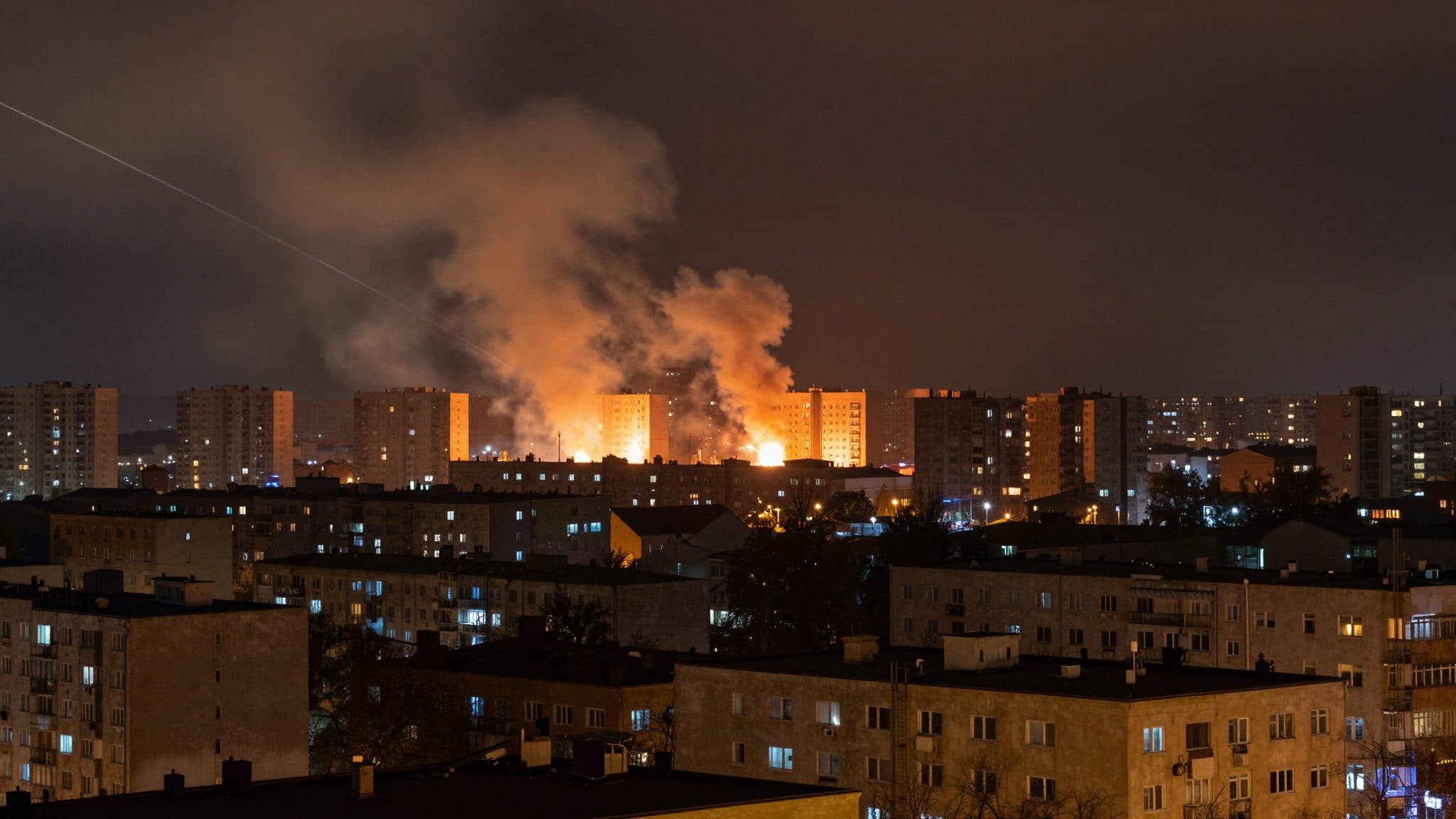
Russia launches one of the most intense attack waves since the start of the war on Ukrainian cities
Kyiv, July 2, 2026
AI-generated image (z-image via Kie.ai)
Summary
Overnight into Thursday, Russia attacked several Ukrainian cities with combat drones, missiles and cruise missiles. In Kyiv, at least eight people were killed and 34 others injured according to authorities; a hotel in the center burned down.
Kyiv, July 2, 2026
Russia struck several Ukrainian cities overnight into Thursday with one of the most intense attack waves since the start of the war, deploying combat drones, missiles and cruise missiles, killing at least eight people in Kyiv and injuring 34, according to authorities.
Attack wave over several major cities
In the night into Thursday, Ukraine once again became the target of a massive Russian aerial assault wave. As reported by the news portal "The Kyiv Independent," the attackers deployed dozens of missiles and cruise missiles. Reporters for the portal spoke of "incredibly loud explosions" that were clearly audible even in air raid shelters deep underground. The report spoke of one of the most intense attack waves since the start of the war.
The Ukrainian capital Kyiv was hit particularly hard. According to authorities, at least eight people were killed and 34 injured in the capital. Multi-story residential buildings were hit, and a hotel in the city center also burst into flames. According to Kyiv Mayor Vitali Klitschko, the roof of a hotel on the central Shevchenko Boulevard caught fire.
Frightened Kyiv residents sought refuge in subway stations. Many of them had reportedly set up tents there to spend the night underground protected from air strikes. According to the report, authorities had triggered air raid sirens again in the early morning following initial impacts the previous evening.
Zelenskyy's warning from Dublin
In addition to Kyiv, other Ukrainian cities were also affected. According to reports, there were air raid sirens and explosions in Zaporizhzhia and Pavlohrad in the southeast as well as in Sumy and Kharkiv in the northeast of the country. Once again, several cities in Ukraine have become the target of a heavy attack wave involving Russian combat drones, missiles and cruise missiles.
Already on Wednesday, Ukrainian President Volodymyr Zelenskyy had warned of an imminent large-scale attack on Ukraine. Speaking on the sidelines of a ceremony marking the change of the EU Council Presidency in Dublin, Zelenskyy said: "Alle ein bis zwei Wochen gebe es massive Attacken mit Hunderten Drohnen und Dutzenden Raketen." He also stated: "heute gibt es die unangenehme Information über die nächste Vorbereitung eines solchen massiven russischen Angriffs". Zelenskyy announced that he would return to Ukraine quickly after a press conference in Dublin. His compatriots should heed alarm signals and seek shelter.
Neighboring Poland had briefly scrambled fighter jets as a precautionary measure, but then recalled them and announced that no airspace violation had been detected.
Military situation according to CSIS
The initial reports of the attacks could not be independently verified. Independently of this, reports from the Center for Strategic and International Studies (CSIS), based in Washington, paint a picture of the overall situation of the conflict that places the severity of the latest escalation in a broader context.
According to CSIS, the total number of soldiers killed, injured or missing since the start of the war in February 2022 has risen to around two million, 1.4 million of them on the Russian side alone. CSIS put the total number of Russian fallen at 400,000 to 450,000, while on the Ukrainian side it was 125,000 to 150,000. At the end of January, the figures had still stood at around 325,000 Russians killed and 100,000 to 140,000 Ukrainians. It is considered certain that both Russia's leadership and Ukraine's play down their own losses and inflate those on the opposing side.
CSIS says its figures are based on information from the military, intelligence services and governments of various countries. According to this, the monthly number of Russian losses now exceeds the number of new recruits. The main reason for this is the intensified and highly effective use of Ukrainian combat drones.
Losses on both sides
While the ratio between Russian and Ukrainian losses had mostly been at 2:1 or 3:1, it is estimated to have risen to 8:1 in the first half of 2026, CSIS wrote further. From a historical perspective, Russia's combat record in the Ukraine war is rather miserable compared to that of other military great powers after World War II.
The situation has also changed along the more than thousand-kilometer-long front. The attackers were no longer able to expand the territory they control in Ukraine in the spring of 2026 for the first time in years and had to accept individual territorial gains by the Ukrainians. According to CSIS's assessment, Russian advances along the more than thousand-kilometer-long front have slowed down.
Front line and territorial gains
The Russian attack wave on Thursday comes at a time when Kyiv says it is increasingly confronted with drones and missiles of Russian manufacture. Just on Wednesday in Dublin, Zelenskyy had pointed to the rhythm of the attacks and called on his compatriots to heed alarm signals and seek shelter.
The humanitarian situation in Kyiv remains tense in view of the destruction of several residential buildings and a hotel in the city center. Rescue workers were deployed in the early morning hours, while residents continued to wait it out in subway stations. Klitschko had previously reported on the fire on Shevchenko Boulevard.
Reactions and outlook
The Ukrainian government has recently stepped up its calls for international support. The background is reports that EU support is needed and, at the same time, criticism has been leveled at companies in the EU that, according to Kyiv, continue to work for Russia. Zelenskyy himself did not comment in detail on the indictment in the case of the Nord Stream pipeline explosions.
The latest attacks are part of an escalating pattern that Kyiv has been observing for months. With regard to the wave now reported, Zelenskyy said he would return to Ukraine quickly after the press conference in Dublin. The situation in the affected cities of Zaporizhzhia, Pavlohrad, Sumy and Kharkiv remained unclear on the morning of July 2, according to reports.
International observers rate the attacks as a significant escalation. Even if individual reports could not be independently verified, the accounts of "The Kyiv Independent," the mayor's statements and the president's remarks paint a mutually consistent picture of a coordinated large-scale offensive against several major Ukrainian cities in a single night.
Questions & Answers
Which cities in Ukraine were affected by the attacks on July 2, 2026?
According to reports, explosions struck Kyiv, Zaporizhzhia, Pavlohrad, Sumy and Kharkiv, with the capital being particularly hard hit.
How many casualties are reported from Kyiv?
According to authorities, at least eight people were killed and 34 injured in Kyiv; in addition, the roof of a hotel on Shevchenko Boulevard caught fire.
What does the CSIS report say about the total number of losses since the start of the war?
CSIS puts the total number of soldiers killed, injured or missing since February 2022 at around two million, of which 1.4 million are on the Russian side, and sees the ratio of Russian to Ukrainian losses in the first half of 2026 at an estimated 8:1.
Russia attacks Ukraine with dozens of missiles: Kyiv under | allfacts360