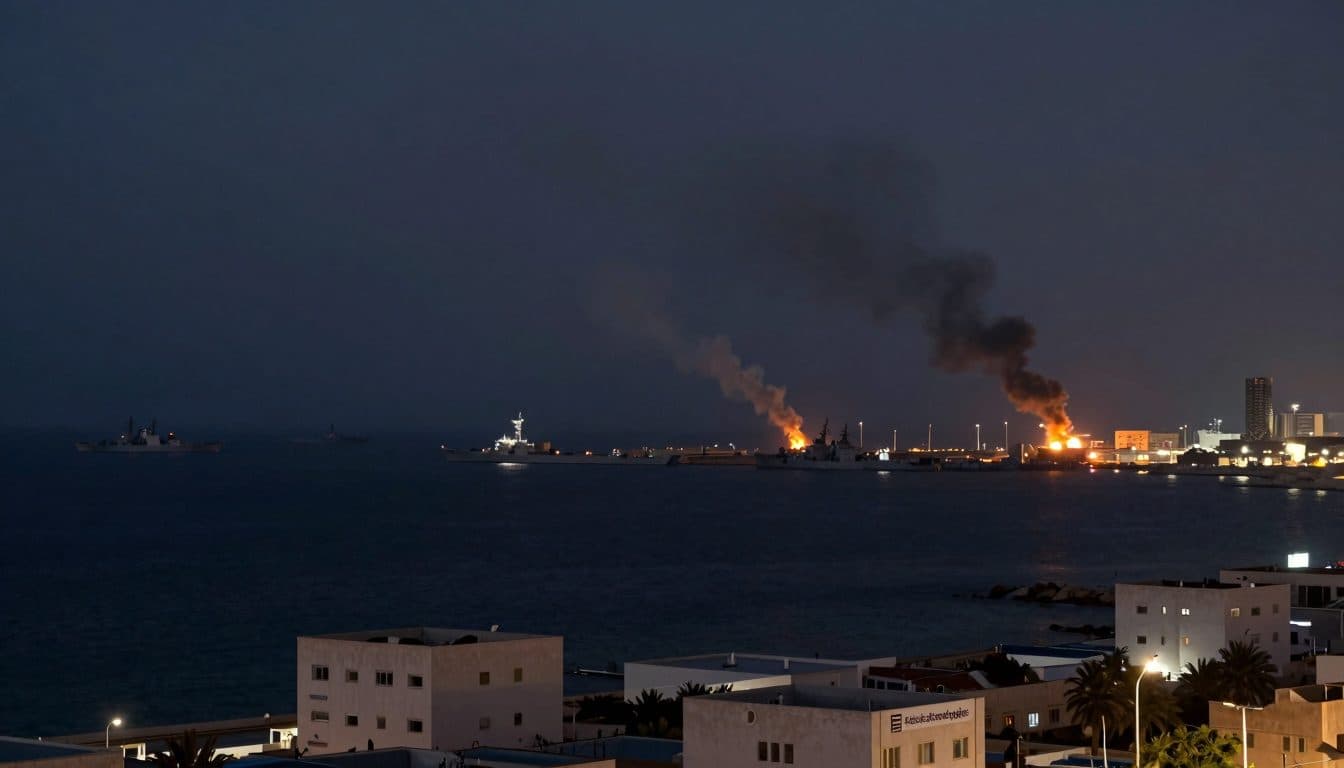
Saudi-led coalition flies airstrikes against Houthi positions in Yemen
Berlin, July 26, 2026
AI-generated image (z-image via Kie.ai)
Summary
The Saudi Arabia-led military coalition has bombed positions of the Houthi militia in the Yemeni province of Hodeidah in response to an attack on a Saudi tanker. The strike came after more than four years of relative calm and raises concerns about a new escalation in the Red Sea.
Berlin, July 26, 2026
The Saudi Arabia-led military coalition bombed positions of the Houthi militia in the Yemeni province of Hodeidah overnight into Friday, after a Saudi-flagged oil tanker was attacked in the Red Sea the previous day.
Background of the Escalation
The airstrikes targeted "legitimate military targets" of the Iran-allied Houthi militia, coalition spokesperson Turki al-Maliki said overnight on the platform X. The coalition had previously accused the militia of "maritime terrorism" on one of the world's most important shipping routes. Saudi media reported that "military positions of the Houthis" had been struck and targets threatening commercial shipping destroyed.
The trigger was an attack on the Saudi tanker "NCC Masa," whose hull was slightly damaged in the incident, the state-run Saudi news agency SPA reported, citing a source in the transport authority. Already overnight into Thursday, the Saudi tanker "Encelia" had been attacked, causing a fire on board. A "ban on shipping" would apply for Saudi Arabia with immediate effect, it was said. The Houthis, by contrast, said a "Yemeni rocket attack" had triggered fires in the city of Jizan in southern Saudi Arabia.
The attacks were the first major combat operations between the Saudis and the Houthis since a ceasefire took effect in 2022. While the agreement significantly reduced fighting, a lasting political solution has not yet been achieved. The conflict between Saudi Arabia and the Houthis has now persisted for more than ten years.
A Decade-Long Conflict
The Houthis had gradually overrun the impoverished country on the Arabian Peninsula in 2014, plunging it into a civil war. The Shia militia continues to receive weapons from Iran. A 2022 ceasefire significantly reduced fighting between the parties to the conflict, but a lasting political solution has not yet been reached.
The Houthis accused Saudi Arabia of a "dangerous escalation" and said the action would "not go unanswered." Attacks on civilian targets would "not go unpunished," the militia-controlled news agency Saba said. A television channel close to the Houthis described the airstrikes as "Saudi aggression."
Houthi Reaction
US President Donald Trump meanwhile announced "heavy military punishments against Iran and of course also against the Houthis themselves." "Should they do this again, the United States will hold Iran accountable, since the Houthis act as proxies for Iran," Trump wrote on his platform Truth Social. According to the "Wall Street Journal," Trump has grown increasingly skeptical in recent days that negotiations with Iran can truly lead to lasting peace.
US Threats and the Iran Crisis
The situation at the region's sea lanes is therefore tightening further. While the Strait of Hormuz lies to the east of the Arabian Peninsula — where the Iran war has repeatedly seen attacks on oil tankers and other commercial vessels — Bab al-Mandab ("Gate of Tears" or "Gate of Lamentation") lies to the west of the peninsula. An EU mission sees a greater risk for ships in the Red Sea. The United Nations also warned that isolated sailors in the Strait of Hormuz were in distress.
The militia had additionally announced a "blockade" of Saudi vessels on Monday — roughly a week after a new confrontation with Saudi Arabia. Following the latest incidents, concerns are growing about the Iran conflict spreading to other parts of the region. Since 2025, Islamabad has maintained a military alliance with Riyadh, further amplifying the scale of a possible escalation.
The US Army, according to its own statements, fired on the tanker "M/T Lavine" in the Gulf of Oman and rendered it unable to maneuver. The US military also reported that a tanker heading to an Iranian port had been attacked. After the thirteenth consecutive night of strikes, the United States has declared its latest wave of attacks against Iran concluded.
Military Activity in the Region
The tensions are fueled, among other things, by a rejected US ceasefire proposal that Iran did not accept. Iran had previously rebuffed US peace offers relayed through Iraq. The United States, together with Israel, began a war against Iran at the end of February 2026, in the course of which significant tensions among the allies came to light.
The Iranian leadership criticized unresolved disputes over the Strait of Hormuz in this context. The goal of the attacks was to trigger a "shockwave for the global economy." Trump warned Russia and China that supporting Iran would be "bad for them."
At the same time, the situation is also intensifying in other arenas. Tensions in the West Bank are escalating, the EU has imposed sanctions on Iranian judges, and the UN World Food Programme (WFP) has warned of drastic cuts to food aid in the Gaza Strip. Israeli Prime Minister Netanyahu is to meet Trump in Washington on Tuesday to discuss further action.
Diplomatic Situation and Outlook
The question of "How will US President Trump proceed?" stands at the center of international attention following these developments. Observers view the events as a possible prelude to a broader military confrontation that could extend well beyond the previous arenas of Yemen and the Red Sea.
A diplomatic solution to the decades-long simmering conflict between Saudi Arabia, Iran, and their respective allies is not in sight. The coalition announced that further strikes on Houthi positions would continue should the group once again threaten shipping in the Red Sea.
Concern about a chain reaction — affecting energy-exporting states on the Persian Gulf, shipping through the Red Sea, and ultimately the global economy — has sharpened markedly with the latest bombings.
Questions & Answers
Who ordered the airstrikes in Yemen?
The Saudi Arabia-led military coalition carried out the airstrikes on positions of the Houthi militia in the province of Hodeidah, as coalition spokesperson Turki al-Maliki stated.
Why did the coalition bomb Houthi positions?
In response to attacks on the Saudi tankers "NCC Masa" and "Encelia" in the Red Sea, for which Saudi Arabia holds the Houthi militia responsible and accuses them of "maritime terrorism."
What role does Iran play in the conflict?
The Houthi militia is, according to the United States and Saudi Arabia, supported by Iran and regarded as its proxy, which is why US President Trump announced retaliatory measures against Iran.
Saudi coalition strikes Houthis in Yemen | allfacts360