Severe storms sweep southwestern Germany, killing one in Karlsruhe
Karlsruhe, 17 July 2026
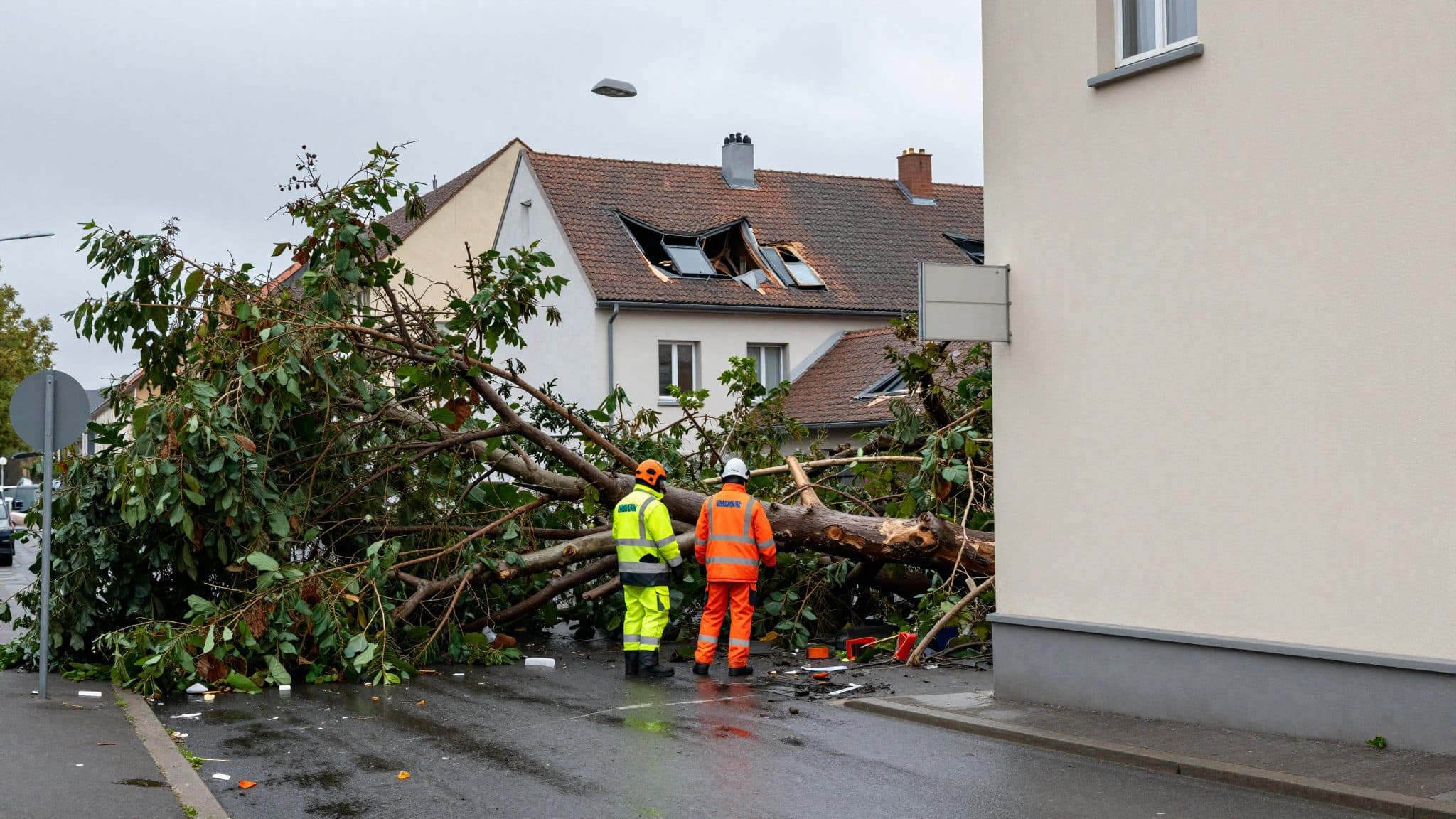
AI-generated image (z-image via Kie.ai)
Summary
Severe storms swept across large parts of Baden-Württemberg and Saarland on Thursday evening, killing one person in Karlsruhe when a falling tree struck them. Emergency services logged hundreds of weather-related operations, and the German Weather Service warned of further severe weather into Saturday.
Karlsruhe, 17 July 2026
One person was killed in Karlsruhe when a falling tree struck them during severe storms that swept across large parts of southwestern Germany on Thursday evening, prompting the city to declare an extraordinary operation situation as emergency services logged hundreds of weather-related calls.
The fatality occurred in Karlsruhe, which authorities identified as the focal point of the storm system. According to a police spokesperson at the Karlsruhe police headquarters, the period between 19:00 and 23:00 brought flooding, damaged traffic lights and cars, and cyclists and a child who were lightly injured by falling branches. The Karlsruhe fire department, working with the Technical Relief Service (THW), carried out more than 250 weather-related operations during the evening and night, the city's fire director said.
Because of the sustained exceptional situation, the city of Karlsruhe declared what German authorities call an "außergewöhnliche Einsatzlage," an extraordinary operation situation, to centrally coordinate the large number of deployments. The declaration allowed emergency managers to pool resources across fire, police, and relief services as calls continued to come in. Officials said the measure was necessary to keep pace with the volume of incidents concentrated in a short window.
The storms left a trail of damage across Baden-Württemberg. In the Rems-Murr-Kreis, falling trees struck a building and caused damage of around 100,000 euros, with about 50 operations reported to police. In the area covered by the Ludwigsburg police headquarters, a spokesperson said "einiges los wegen Unwettern," with roughly 70 operations, including incidents involving falling roof tiles and flooded basements. In Besigheim, in the Ludwigsburg district, a lightning strike hit a roof and triggered a fire; people were slightly injured.
Damage across Baden-Württemberg
On the A8 motorway in Swabia, between the Burgau and Günzburg exits toward Stuttgart, a series of six accidents caused by aquaplaning occurred on Thursday evening. One person was seriously injured and two others were slightly injured, according to a police spokesperson. The cluster of crashes underscored how quickly standing water on highways can turn dangerous when storms intensify.
Aquaplaning crashes on the A8
In Pforzheim, police counted around 30 severe-weather operations into the night. In Saarbrücken, heavy rain, wind gusts, and a lightning strike kept the fire department busy on Thursday evening, with more than 50 operation sites to work through. The eastern part of Saarbrücken, including the district of Güdingen, was particularly affected, according to officials.
The German Weather Service (DWD) said the storm system was not finished. In a forecast updated on Friday morning, the DWD warned that from the afternoon into Saturday night, thunderstorms with heavy rain, hail, and stormy or storm-force gusts could affect large parts of the country outside the northwest and west. The service said severe weather was not ruled out, with heavy rain of more than 25 liters per square meter possible in a short time, along with hail and storms.
DWD warns of further severe weather
For the eastern and central parts of the country, the DWD said extreme weather could occur locally. In the southwest and south, the service forecast large hail with a diameter of more than three centimeters and severe storm to hurricane-force gusts. The combination of hazards pointed to a continued risk of uprooted trees, flooded basements, and traffic disruption into the weekend.
Emergency services across the region were heavily mobilized. Police, fire, and relief workers dealt with uprooted trees, flooded basements, damaged vehicles, and traffic-light failures, often simultaneously. The Karlsruhe fire director's tally of more than 250 operations in a single evening illustrated the scale of the response required when a storm cell stalls over a densely populated area.
The fatality in Karlsruhe was the most serious consequence of the storm system, but additional people were injured elsewhere. In Besigheim, several people sustained light injuries in the lightning-triggered roof fire. On the A8, one person was seriously hurt and two others lightly hurt in the aquaplaning crashes. In Karlsruhe itself, cyclists and a child were lightly injured by falling branches.
The storm's footprint extended beyond Baden-Württemberg. Reports from Saarbrücken placed the Saarland firmly inside the affected zone, with the fire department handling more than 50 sites in the eastern part of the city. The combination of heavy rain, wind gusts, and lightning made conditions hazardous for both drivers and pedestrians, and authorities urged residents to avoid unnecessary travel during the worst of the weather.
Outlook for Friday and Saturday
Damage assessments were still being compiled on Friday morning. The 100,000-euro figure from the Rems-Murr-Kreis was one of the first concrete estimates to emerge, but officials in Karlsruhe, Ludwigsburg, Pforzheim, and Saarbrücken all indicated that the full cost would only become clear once operations wound down and property owners could survey their buildings and vehicles.
Looking ahead, the DWD's forecast suggested that southwestern Germany would remain in the firing line. With large hail and hurricane-force gusts possible in the southwest and south, and extreme weather not ruled out elsewhere, emergency planners warned that Friday afternoon and evening could bring a second wave of incidents. Residents were advised to secure loose objects, clear drainage where possible, and follow updates from local authorities.
The Karlsruhe declaration of an extraordinary operation situation was expected to remain in place until the immediate backlog of calls had been cleared. Coordination centers were tracking remaining hotspots, particularly flooded basements and damaged roofs, while road maintenance crews worked to restore traffic lights and clear debris from major routes.
For now, the priority for emergency services was completing outstanding operations and preparing for the next round of storms. Officials stressed that even storms that pass quickly can leave behind hazards such as weakened trees, waterlogged roads, and damaged power lines, and they asked the public to report dangerous situations rather than attempt to clear them independently.
Questions & Answers
Who was killed in the Karlsruhe storm?
One person was killed in Karlsruhe when a falling tree struck them during the severe storms on Thursday evening, according to police and fire officials.
Why did Karlsruhe declare an extraordinary operation situation?
The city declared an "außergewöhnliche Einsatzlage" to centrally coordinate the large number of weather-related operations, which the fire department said exceeded 250 during the evening and night.
What did the German Weather Service forecast for the coming days?
The DWD forecast further thunderstorms from Friday afternoon into Saturday night, with heavy rain of more than 25 liters per square meter, large hail over three centimeters in diameter, and severe storm to hurricane-force gusts possible in the southwest and south.
Karlsruhe storm: one killed, hundreds of operations | allfacts360