Severe storms sweep across Lower Saxony: hail shatters car windows, fire departments in continuous operation
Hanover, 14 July 2026
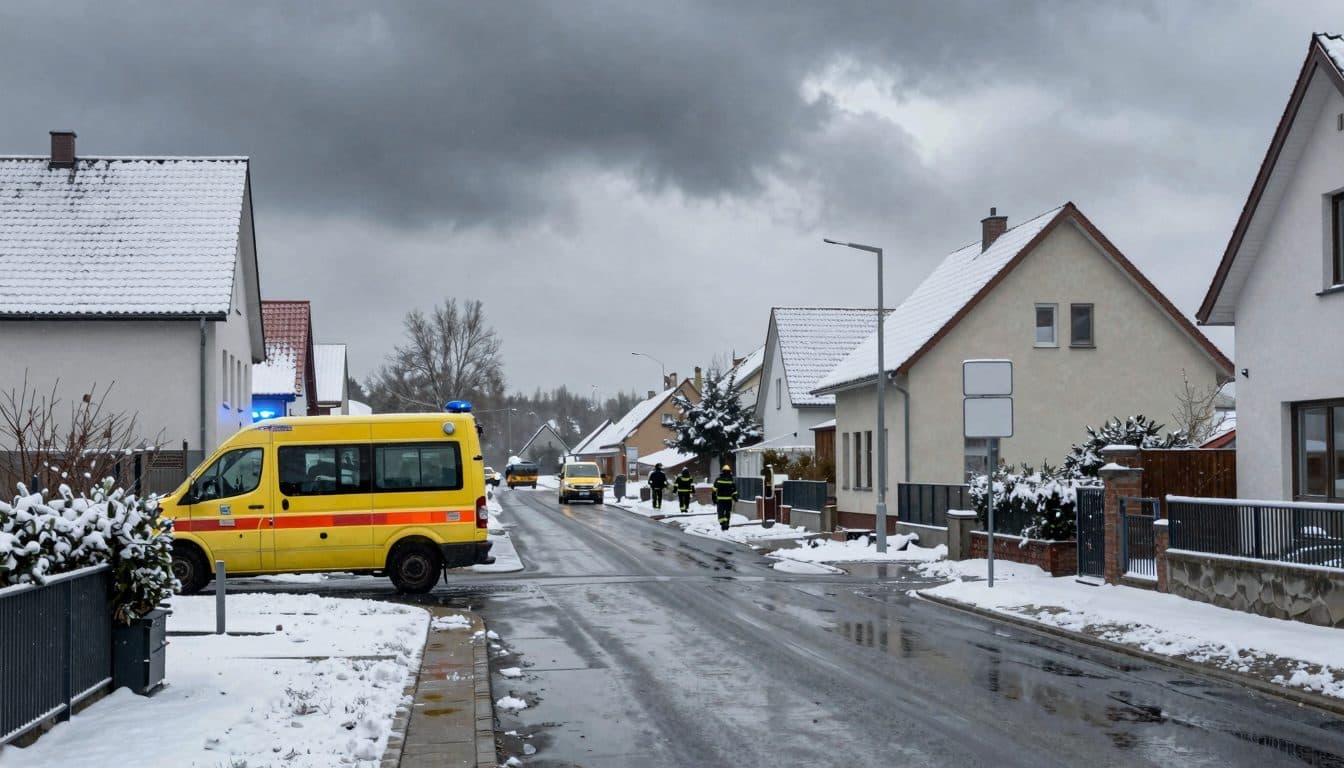
AI-generated image (z-image via Kie.ai)
Summary
Severe thunderstorms with tennis ball–sized hail and heavy rain hit large parts of Lower Saxony and neighboring regions on Monday evening and during the night to Tuesday. Fire departments and police counted thousands of deployments, an airport temporarily suspended operations, and the German Weather Service is warning of further severe weather.
Hanover, 14 July 2026
Severe thunderstorms with tennis ball–sized hail, storm gusts, and heavy rain struck parts of Lower Saxony, Mecklenburg-Western Pomerania, and North Rhine-Westphalia on Monday evening and during the night to Tuesday, causing widespread damage.
According to the German Weather Service (DWD), a thunderstorm front with heavy rain, hail, and storm gusts already moved across western Mecklenburg-Western Pomerania and parts of Lower Saxony on Monday afternoon. The severe weather produced a closed white layer of hail on streets within just a few minutes, flooded basements, and damaged buildings and vehicles in several rural districts.
Heidenau particularly affected
The town of Heidenau in the collective municipality of Tostedt in the district of Harburg was hit particularly hard. Golf ball–sized hailstones shattered car windows and left dents in paintwork, and dozens of roofs were damaged. A resident described: „Ich wohne jetzt 18 Jahre in Heidenau, ich habe so was noch nie erlebt, so ein Chaos." A witness added: „Es hat alles kaputt gemacht." The resident also reported that her roommate's car was „Schrott". Videos showed water running through roofs into apartments; one resident said: „Es ist nichts mehr heile, es regnet durchs Dach, in die Wohnungen rein."
In Sarstedt, hailstones measuring three to four centimeters were reported by the local fire department, damaging roofs and canopies. In Sarstedt, a woman became trapped in her basement by water and was rescued by fire department crews; she was subsequently taken to hospital.
Fires and lightning strikes
A lightning strike set a barn on fire in Bruchhausen-Vilsen in the district of Diepholz. In the Lower Saxon town of Rassau in the district of Uelzen, a barn also caught fire in the morning, though it initially remained unclear whether a lightning strike was likewise the cause. Earlier in the morning, a lightning strike near Bad Bevensen had hit a signal box, causing delays and partial cancellations on the Uelzen–Hamburg line; the Uelzen–Braunschweig connection was also affected.
In the Celle area, water stood several centimeters deep at multiple basement entrances and on a street, and up to 30 centimeters deep in an underground parking garage after heavy rain. In the Heidekreis region, several basements flooded, according to a fire department spokesperson. In total, fire departments in Lower Saxony responded to around 600 deployments according to initial estimates, while in the Hanover area alone there were around 1.000 weather-related deployments according to police. The Hanover fire department was on continuous duty with around 300 emergency personnel, according to its own information, and was still working on ongoing operations in the morning.
Fire departments and police in continuous operation
Police in Lower Saxony recorded around 250 weather-related emergency calls between 9 p.m. and 1 a.m. In Hanover, police received around 50 reports by 7 a.m. regarding license plates lost in the floodwaters. In total, emergency calls across the various control centers added up to around 2.300, with phone lines temporarily overloaded. Police also reported an unusually high number of false alarms at buildings, likely triggered by the severe weather.
In North Rhine-Westphalia as well, particularly in the Ostwestfalen-Lippe region, there were numerous deployments due to heavy rain, flooded basements, and dislodged manhole covers, according to the DWD. In Bielefeld, a lightning strike caused a roof truss fire, according to the city's fire department. The Gütersloh district fire department reported 115 deployments in Verl and the surrounding area since Monday evening. In the Lower Saxon district of Ludwigslust-Parchim, around 168 weather-related emergency calls came in within one hour, according to the control center; streets there were also under water and numerous basements flooded.
Damage in Mecklenburg-Western Pomerania and East Westphalia
In the district of Ludwigslust-Parchim in Mecklenburg-Western Pomerania, tennis ball–sized hailstones piled up on streets, forcing fire department crews to use wheel loaders to clear away the white masses. Emergency services pumped out basements and removed fallen trees. In Wittenburg in Mecklenburg-Western Pomerania, the fire department likewise used wheel loaders to remove the masses of hail. According to the Westmecklenburg control center, the scenes resembled a wintry snowfall; no one was injured there as of the latest information.
The severe weather also left its mark on rail and air traffic. Hannover-Langenhagen Airport had to suspend handling operations for around one hour on Monday evening for safety reasons, as a spokesperson explained. In Lower Saxony and in neighboring West Mecklenburg, trees also came down in many regions, including in the Göttingen, Braunschweig, and Northeim areas, where a tree fell onto a municipal building.
Impact on transportation and media
Due to storm damage at a printing plant in the region, several regional newspapers could not be printed or were printed late. Police warned road users not to touch objects lying around or damaged vehicles. NDR also pointed to five new regional WhatsApp channels that bundle current regional information for, among other areas, Lüneburg/Heide/Uelzen, Hannover/Celle/Hildesheim, and Braunschweig.
The DWD had already issued warnings on Monday evening for heavy rain, thunderstorms, hail, and isolated flooding in parts of Lower Saxony. For Tuesday, the weather service again announced powerful thunderstorms with heavy rain, storm gusts, and hail, with isolated extreme heavy rain, hail, and severe storm gusts possible. Saxony, Saxony-Anhalt, and Thuringia would be particularly affected, but locally heavy rain must also be expected in Lower Saxony, the DWD continued. The DWD also warned of „starker Wärmebelastung" in western and southwestern Germany.
ARD weather expert Martin Gudd, in view of the extreme heat phase that preceded the severe weather, urgently advised drinking more: „Die Menschen müssen viel mehr trinken als normal. Das wird gern von älteren Personen vergessen." Gudd also warned against simply closing rooms and hanging up damp towels: „Wenn man die Räume zumacht, erkauft man sich Feuchtigkeit. Das ist vor allem für ältere Menschen potenziell tödlich." He recommended seeking shade, avoiding direct sunlight, and ventilating interior spaces rather than sealing them off.
Heat warnings and behavioral advice
On Tuesday, according to the DWD forecast, daytime highs ranged between 27 and 30 degrees inland, and around 22 degrees on the coast; in southern Lower Saxony, thunderstorms were possible in the afternoon and evening. During the night to Wednesday, temperatures dropped to between 13 and 16 degrees, bringing noticeable cooling compared to the preceding tropical nights with temperatures reaching up to 40 degrees. Wednesday should be mostly sunny and dry according to the DWD, with temperatures of up to 32 degrees, though showers and thunderstorms were possible again in the afternoon. The EU climate service Copernicus had already recorded the hottest June in Western Europe since records began.
According to meteorologists' assessment, the severe weather is related to the extreme heat wave that preceded the event. The DWD noted that the thunderstorms may move only slowly, so that locally severe weather remains possible during the coming night as well. The weather is also expected to remain turbulent in the days that follow. Authorities asked the public to follow DWD warnings closely, to place emergency calls only in genuine emergencies, and not to enter flooded basements or damaged roofs on their own.
Despite the many instances of damage and deployments, no injuries were reported to the Westmecklenburg control center as of morning. No figures were initially available regarding the amount of property damage. Based on the experience of comparable events, insurers expected a significantly rising number of damage reports in the coming days, particularly involving damaged roofs, vehicles, and solar systems.
Questions & Answers
Which towns in Lower Saxony were hit hardest by the severe weather?
The town of Heidenau in the collective municipality of Tostedt (district of Harburg) was particularly hard hit, with golf ball–sized hail, shattered car windows, and damaged roofs. Sarstedt, Celle, Hanover, and the Heidekreis region also suffered in some cases considerable damage from heavy rain and hail.
How many deployments did fire departments and police have to handle?
In the Hanover region alone, the fire department responded to around 1.000 deployments according to police, and roughly 600 across Lower Saxony as a whole. Police recorded around 250 weather-related emergency calls between 9 p.m. and 1 a.m., with around 168 additional calls within one hour in the Ludwigslust-Parchim district.
What does the German Weather Service advise for the coming days?
The DWD warned of further powerful thunderstorms with heavy rain, storm gusts, and hail, with isolated extreme heavy rain, hail, and severe storm gusts possible. Saxony, Saxony-Anhalt, and Thuringia would be particularly affected, but heavy rain must also be expected locally in Lower Saxony; the DWD also warned of strong heat stress in western and southwestern Germany.
Severe weather in Lower Saxony: hail, flooding, emergency | allfacts360