SK Hynix Nasdaq Listing: Second-largest stock placement | allfacts360
SK Hynix brings ADRs to the Nasdaq, triggering the second-largest stock sale in history
Seoul, July 9, 2026
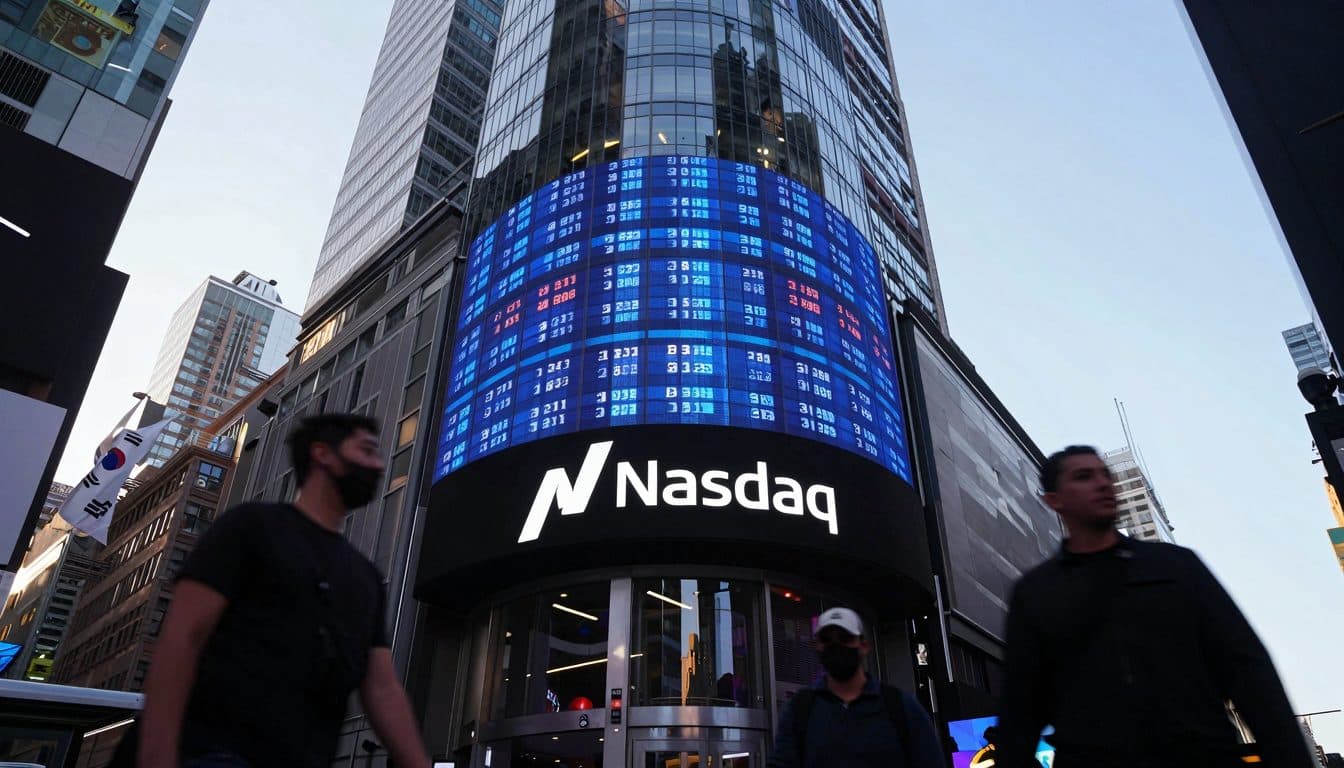
AI-generated image (z-image via Kie.ai)
Summary
South Korea's memory chipmaker SK Hynix will bring 177.9 million ADRs to the Nasdaq on Friday, raising around 28 billion US dollars. This would make it the second-largest stock placement in history, after SpaceX's IPO in June 2026; according to Bloomberg, the order book is oversubscribed more than sevenfold.
Seoul, July 9, 2026
The South Korean memory chipmaker SK Hynix will bring 177.9 million ADRs to the technology exchange Nasdaq on Friday, raising around 28 billion US dollars at the current count, which would make it the second-largest stock placement in history, behind SpaceX's IPO in June 2026.
Already on Thursday, the SK Hynix share in Seoul was unimpressed by the overall environment and rose by 4.87 percent to 2,177,000 won. On Friday, the shares are then set to begin trading in the US under the ticker SKHY, as SK Hynix states in its SEC registration document. Ten ADRs correspond to one common share, which means a single share is likely to be around 150 US dollars.
Demand is enormous. According to Bloomberg, the order book was oversubscribed more than sevenfold, with total subscription requests of around 171.5 billion dollars. As anchor investors, the British asset manager Baillie Gifford (invested in SK Hynix since 2000), the US hedge fund Coatue Management, and Situational Awareness Partners – the AI fund of former OpenAI researcher Leopold Aschenbrenner – have signaled interest in up to 7 billion dollars. If the issue price is set close to the closing price in Seoul, SK Hynix will receive around 24.5 billion dollars.
Record demand and prominent anchor investors
The gross proceeds are currently planned at around 28 billion dollars. This would make it the second-largest stock placement in history, behind SpaceX's IPO in June. Only SpaceX has ever raised more capital in a single transaction with its IPO in June 2026 (around 75 billion dollars, including greenshoe up to 85.7 billion dollars). Among US listings of foreign companies, SK Hynix would rank just behind Alibaba's 25-billion-dollar IPO of 2014. However, strictly speaking, this is not a classic IPO but a secondary listing with a capital increase – SK Hynix has been listed on the Korea Exchange for decades.
From the original issue volume to the adjusted size
The volume of around 29.65 billion US dollars originally filed with the US securities regulator SEC on June 30, 2026, was already reduced to around 28.21 billion US dollars on July 6, 2026, after SK Hynix's common share had previously declined at its home exchange in Seoul. Originally, up to 29 billion dollars had been under discussion before the share corrected sharply of late. SK Hynix's share is trading around 30 percent below its record high from the end of June. US competitor Micron has also corrected sharply. SK Hynix is issuing 17.79 million new shares – around 2.5 percent of the share capital.
Goldman Sachs, Citigroup, Bank of America, and JPMorgan are acting as lead managers. SK Group Chairman Chey Tae-won will ring the opening bell at the Nasdaq personally. UBS even recommends an arbitrage trade to clients: buy ADRs, short sell the shares listed in Korea. The Nasdaq listing also brings the possible inclusion in the Nasdaq-100 at the index review in December, which would trigger passive inflows from ETFs such as the Invesco QQQ.
HBM dominance: The strategic foundation
The background to the rally is SK Hynix's dominant position in high-performance memory for artificial intelligence. SK Hynix is one of three major memory chip manufacturers worldwide alongside Samsung and Micron – and the market leader in the decisive segment: High Bandwidth Memory (HBM). Nvidia is by far the largest customer: SK Hynix supplies HBM3E and HBM4 memory for the AI accelerators of the GPU market leader. According to IDC data cited in the company's own SEC registration document, SK Hynix held a 56.4 percent share of global HBM revenue in the first quarter of 2026, putting it well ahead of competitors such as Micron Technology. According to a Goldman Sachs estimate, SK Hynix continues to supply around two-thirds of the latest generation, the HBM4 chips, for Nvidia's new AI platform Vera Rubin.
In 2025, the company had a 61 percent world market share in DRAM products according to analyses by market researcher Trendforce. Analysts see the company on a high: According to analyst forecasts, SK Hynix's profit margin could rise to more than 70 percent in the second quarter. Operating profit is likely to at least septuple year-on-year according to a Yahoo Finance survey – to 61 trillion won, equivalent to around 35.5 billion euros or 33 billion francs. The share is traded at a forward P/E of around 6.
Since the start of the year, the price had risen 340 percent by the end of June – before then falling by 30.5 percent. Employees can look forward to a profit-sharing payment of more than 300,000 euros or over 270,000 francs per head. SK Hynix, the number two by market capitalization on the stock exchange in Seoul, exemplifies the rise of the South Korean chip industry.
Use of proceeds: Billions for new factories
According to the company, the entire issue proceeds are to flow into new manufacturing facilities. Around 20.5 billion dollars are earmarked for the first fab in the new Yongin semiconductor cluster, around 12.5 billion dollars for the P&T7 advanced packaging plant in Cheongju, and around 7.9 billion dollars for EUV lithography machines from the Dutch equipment manufacturer ASML. The latter also come from the US subsidiary Solidigm, which SK Hynix acquired from Intel in 2021.
These investments are part of a much larger national program unveiled at the end of June: a combined 2.4 trillion euros are to be invested by Samsung, the SK Group, and other companies in new chip factories, robots, and AI data centers. The shorthand 3-3-5 stands for Lee's promise to make South Korea one of the three leading AI powers in the world, to once again achieve solid economic growth of three percent, and to move the country into the top five largest economies in the world. The International Monetary Fund currently ranks the nation of 51 million in fifteenth place.
From Hyundai offshoot to key AI supplier
The company's roots go back a long way. The chipmaker SK Hynix was founded in 1983 as Hyundai Electronics Industries. When the memory chip market collapsed in 2001 and the company plunged deep into the red, the division was spun off under the name Hynix Semiconductor. An acquisition by the SK Group in 2012 brought the final turnaround. On the other hand, management relied on engineers as company leaders, who had been developing the then-still-insignificant HBM chips since 2009 – a strategy that is now paying off spectacularly.
Not all market observers see the rally as risk-free. There is also a structural risk: according to CNBC, SK Hynix and Samsung Electronics together account for more than 40 percent of the market capitalization in the benchmark KOSPI index. A single negative demand wave for AI chips could therefore hit the South Korean stock market disproportionately. The cyclical nature of the memory chip market also remains a risk, as the 2001 crash showed.
Risks and valuation questions
The issuance of new shares also dilutes existing shareholders by around 2.5 percent, which represents a significant value transfer at the current valuation level. Nevertheless, with the surprisingly great success of the listing, SK Hynix is consolidating its position as a global key supplier to the AI industry – and bringing its home country South Korea closer to the goal of joining the ranks of the five largest economies.
Bottom line: The Nasdaq debut marks a milestone that recalibrates the AI value chain. While Nvidia chips would be worthless without HBM memory, SK Hynix controls the bottleneck at which the billion-dollar investments in AI data centers are decided. The stock market premiere is therefore far more than a financial event – it is an industrial policy signal.
Analysts see the company on a sustained high as long as the AI boom continues. Should SK Hynix actually be included in the Nasdaq-100, the buying pressure from index funds would be an additional price driver. The coming quarterly results will show whether the operating result justifies the extraordinary valuation on the stock markets.
Questions & Answers
Who is SK Hynix and why is the company currently so in demand?
SK Hynix is a South Korean memory chipmaker founded in 1983, which, alongside Samsung and Micron, is one of the three major DRAM and NAND manufacturers worldwide. In the High Bandwidth Memory (HBM) segment, the company is the market leader with a 56.4 percent world market share in the first quarter of 2026 according to IDC data, and the main supplier for AI chipmaker Nvidia.
How does the Nasdaq listing differ from a classic IPO?
This is a secondary listing with a capital increase, as SK Hynix has already been listed on the Korea Exchange for decades. The company is bringing 177.9 million ADRs (American Depositary Receipts) to the Nasdaq under the ticker SKHY, raising around 28 billion US dollars through the issuance of 17.79 million new shares, which corresponds to around 2