South Korea Announces Billion-Dollar Chip and AI Investment Program
Seoul, June 29, 2026
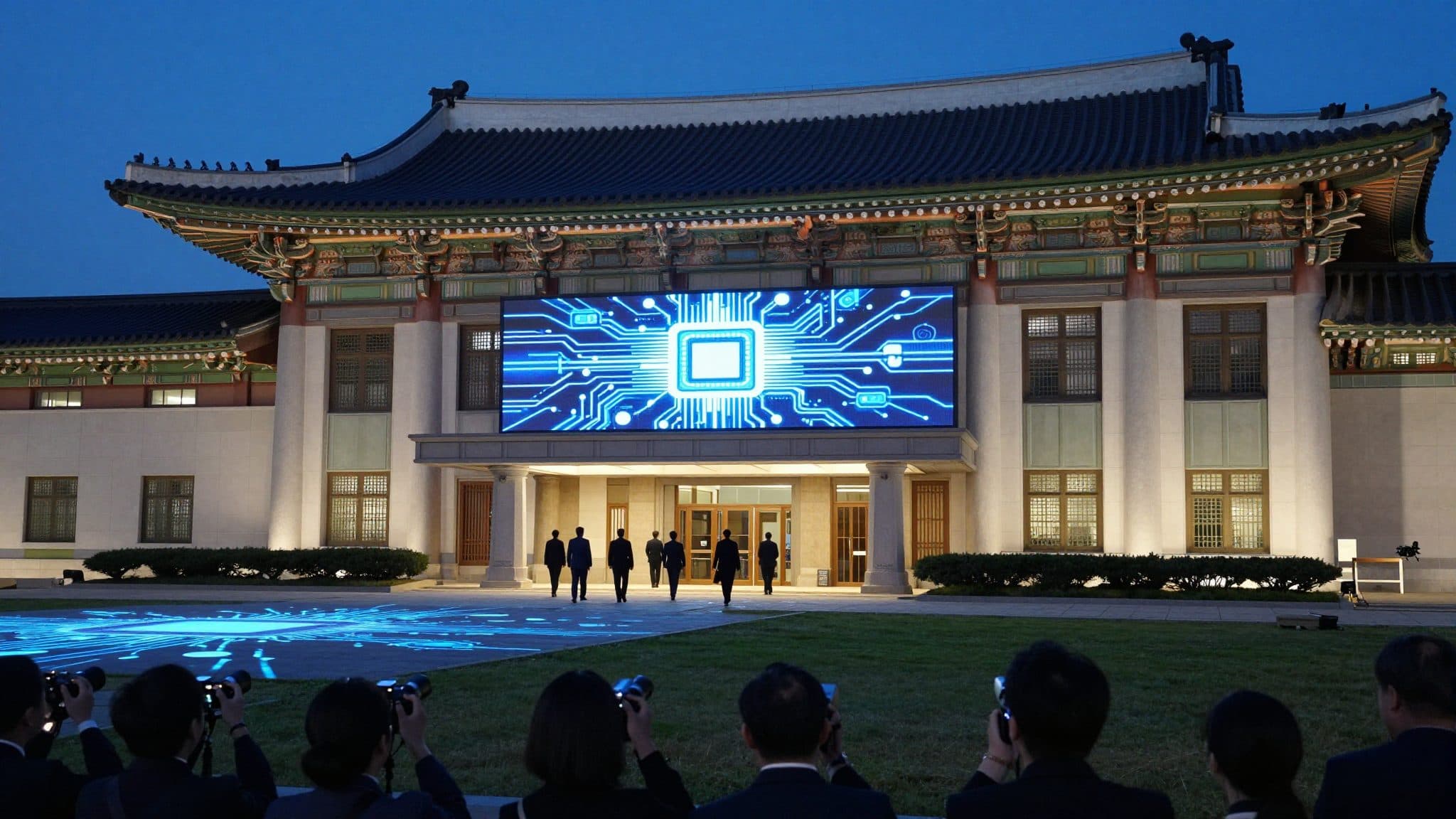
AI-generated image (z-image via Kie.ai)
Summary
South Korean President Lee Jae-myung has announced a billion-dollar investment program aimed at massively expanding the country's semiconductor and AI industry. Samsung and SK Hynix plan joint investments of up to approximately 1.3 trillion US dollars over the coming decade.
Seoul, June 29, 2026
South Korean President Lee Jae-myung announced on June 29, 2026, in a televised address in Seoul a large-scale investment program aimed at significantly strengthening the country's position in semiconductor manufacturing and artificial intelligence.
Three Pillars for the Leap Forward
According to the president, the program is intended to set the course for a "new chapter in the history of Korea." At its center are three areas that Lee Jae-myung described as the "triple axis for our great leap forward": semiconductors, physical AI, and AI data centers. Lee declared: "We must secure the core elements of artificial intelligence faster than any other country."
The heads of Samsung Electronics and SK Hynix were present at the presentation in the presidential office. According to reports by CNBC and other media, both corporations are to jointly build a semiconductor ecosystem worth around 800 trillion South Korean won, equivalent to approximately 454.4 billion euros. This is tied to the construction of new, large chip clusters in the southwest of the country, a region that has so far been less economically developed than the greater Seoul area.
According to a report by the Korea Economic Daily, the two corporations' plans over the coming decade add up to as much as 2,000 trillion won, equivalent to roughly 1.3 trillion US dollars. Of this, according to reports, around 1,000 trillion won – approximately 646 billion US dollars – is attributable to Samsung, with a similarly large sum going to SK Hynix. According to the Korea JoongAng Daily, a single facility alone costs at least 60 trillion won, around 40 billion US dollars. The focus of the investments is shifting from chip back-end production to the particularly capital-intensive wafer production.
Clusters in the Southwest: Gwangju and South Jeolla as Centers
The city of Gwangju and the province of South Jeolla have announced that they will themselves invest between 5 trillion won (approximately 2.8 billion euros) and 20 trillion won (approximately 11.4 billion euros). According to media reports, total investments could even exceed a quadrillion won in the coming years, equivalent to roughly 569 billion euros. The funds are to be used for semiconductor factories, AI data centers, advanced packaging technologies, batteries, and displays.
The background to the program is the government's effort to break up the strong economic concentration in the greater Seoul area and to more strongly integrate the regions outside the capital. At the same time, Seoul wants to use the program to secure domestic supply chains and achieve technological sovereignty. The chip industry is of crucial importance for South Korea's export-dependent economy, as the two manufacturers are among the world's largest producers of memory chips.
Samsung and SK Hynix: The Driving Corporations
Even before the presidential address, Samsung had announced long-term investments of one quadrillion won, equivalent to around 568.7 billion euros, for the 2030s. SK Hynix, for its part, had also announced an expansion of its production capacities. According to consistent reports, SK Hynix is now the most valuable corporation in South Korea, having displaced Samsung from the top spot. The company is regarded as the most important supplier of high-bandwidth memory chips, or HBM chips, which are indispensable for Nvidia and other AI specialists.
The growing demand for high-performance memory chips is driving the business of both corporations. Cloud providers and AI companies are currently massively expanding their infrastructure, from which Samsung and SK Hynix benefit. With the announced billion-dollar investments, the government wants to ensure that South Korean companies can maintain and expand their leading position in the age of artificial intelligence. Samsung also expects its investments to help reduce the technological gap behind rival SK Hynix.
Accelerated Approvals and Bureaucracy Reduction
South Korea's Minister of Trade, Industry, and Energy, Jung-Kwan Kim, announced: "We will rapidly expand our production capacities by drastically shortening the timeframe from approval to completion." This is intended to ensure that bureaucracy reduction underpins the ambitious project. The initiative is also intensifying the global race for dominance in the semiconductor industry, in which the European Union is also attempting to reduce its dependence on foreign suppliers through subsidy programs.
On the stock market, however, the announcements caused uncertainty. On the day of the presentation, Samsung's share on the Korea Exchange temporarily lost 3.87 percent to 326,000 won, while SK Hynix's share dropped 1.35 percent to 2,637,000 won. Observers pointed out that the financing of the enormous sums and the question of what ultimately remains for shareholders are at the center of the discussion. Presidential advisor Kim Yong-beom described the expected figures in advance as "very unusual"; the government itself classified the sums as unusually high.
Uncertainty on the Stock Market
In addition, according to observers, it remains unclear whether the announced trillion-sum will actually become a binding commitment or merely a declaration of intent. The estimates circulating range from 900 trillion won for the southwest cluster alone to 2,000 trillion won for all of the corporations' plans. According to a report by the news agency Yonhap, Samsung also has a planned share buyback of around 90 trillion won, although this has not yet been confirmed by the board.
Critics have expressed doubts as to whether the rather rural southwest region can provide the necessary infrastructure for a project of this magnitude. The question of whether enough qualified specialists can be attracted there also remains unresolved. Some observers also see the plan as an attempt by the president to boost his popularity outside the greater Seoul area.
Criticism: Infrastructure, Specialists, Political Motives
The importance of the chip industry for South Korea can hardly be overstated. The country is one of the most important production locations for memory chips worldwide, and the semiconductor industry contributes a significant share to exports. With the announced program, Seoul wants to secure its position in a key technology of the 21st century and hold its own against competitors in Asia, North America, and Europe.
The project is part of a series of similar industrial policy initiatives worldwide. While the European Union is using subsidies to drive the expansion of domestic chip manufacturing, the United States is relying on the CHIPS Act and similar programs. With its current announcement, South Korea is pursuing the goal of being at the forefront of this competition while also reducing its dependence on individual markets.
South Korea in the Global Chip Race
Overall, the announcement shows that Seoul is willing to mobilize enormous sums in the global tech race. Whether the investments can be implemented as planned will become clear in the coming years. Already now, however, the program is likely to further intensify the dynamics in the global semiconductor market.
Questions & Answers
What did President Lee Jae-myung announce on June 29, 2026?
Lee Jae-myung announced in a televised address in Seoul a large-scale investment program for the semiconductor and AI industry, which includes, among other things, the construction of new chip clusters in the southwest of the country.
How much do Samsung and SK Hynix want to invest?
According to reports by the Korea Economic Daily, the two corporations' plans over the coming decade add up to as much as 2,000 trillion won, equivalent to roughly 1.3 trillion US dollars, of which about half is attributable to Samsung.
What role does SK Hynix play in the global chip market?
According to consistent reports, SK Hynix is the most important supplier of high-bandwidth memory chips for Nvidia and is now the most valuable company in South Korea, ahead of Samsung.
South Korea: Billion-Dollar Program for Chips and AI | allfacts360