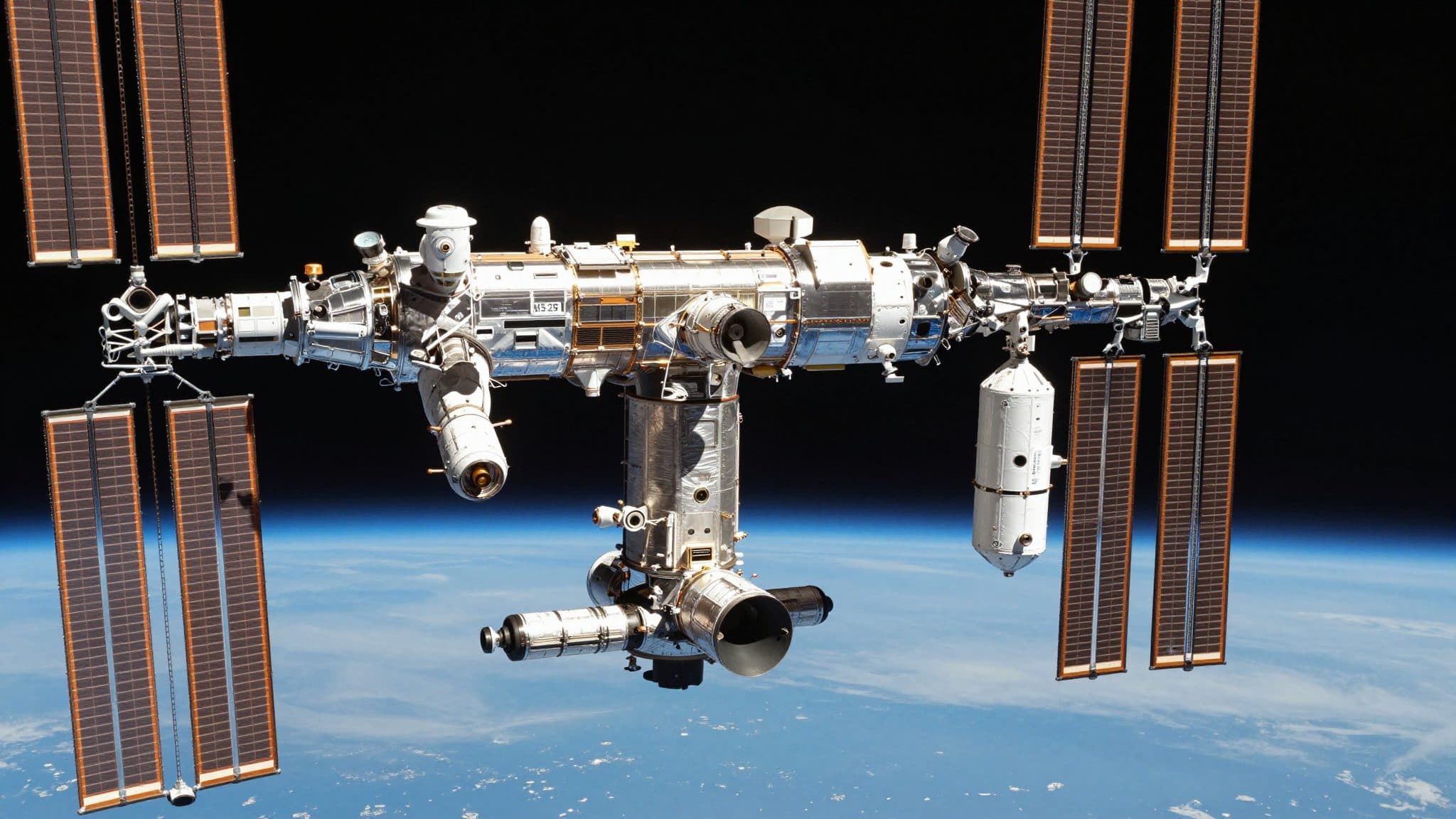
Soyuz MS-29 with Russian-American crew docks at the ISS
Baikonur, 15 July 2026
AI-generated image (z-image via Kie.ai)
Summary
The Russian spacecraft Soyuz MS-29 docked at the International Space Station ISS on Tuesday evening with two Russian cosmonauts and one US astronaut. After docking at the "Prichal" module, ten spacefarers are now living and conducting research on the outpost in Earth orbit.
Baikonur, 15 July 2026
The Russian spacecraft Soyuz MS-29 docked at the International Space Station ISS on Tuesday at 20:52 Moscow time (19:52 CEST) with two Russian cosmonauts and one US astronaut, thereby increasing the number of crew members in orbit to ten.
Docking at the "Prichal" module
The docking maneuver at the Russian ISS module "Prichal" was announced by the Russian state space agency Roscosmos via the messaging service Telegram. According to the Russian state space agency Roscosmos, the flight from the Baikonur cosmodrome in Central Asian Kazakhstan to docking lasted around three hours.
Dmitry Bakanov had watched the launch of the rocket together with Jared Isaacman on the ground. According to the Russian news agency TASS, Bakanov and Isaacman agreed during their talks to extend ISS cooperation until 2030.
Talks on the future of the ISS
With the mission, US American Anil Menon began his first spaceflight. For the two Russians, Pyotr Dubrov and Anna Kikina, it is already their second assignment in space. According to the available reports, Menon has family roots in Ukraine.
The trio officially belongs to the 75th long-term mission on the ISS. The new team is to live and conduct research there for around eight months. This is also associated with close cooperation with the astronauts and cosmonauts already on board.
Already on the station before the docking, according to the available reports, were US astronauts Jessica Meir, Jack Hathaway, and Chris Williams as well as Frenchwoman Sophie Adenot. In addition, there were the three Russians Sergey Kud-Sverchkov, Sergey Mikayev, and Andrey Fedyaev from the previous 74th mission from February.
Who is flying up there?
With the arrival of the trio, the number of spacefarers on board the ISS rose to ten. It is a relatively large contingent for a station that has long been divided among the participating spacefaring nations and has come under increasing tension in recent years.
The ISS is jointly operated by NASA, Roscosmos, the European Space Agency ESA, and the space agencies of Canada and Japan. Since 1998, it has been humanity's most long-lasting space laboratory to date. Long-term missions have been flying to the ISS regularly since 2000.
Rare meeting in Baikonur
According to the available information, Isaacman's visit to Baikonur was the first stay by a head of the US space agency at a joint launch with Russia at this location in eight years. Before the launch, Isaacman met with Bakanov to discuss future cooperation.
During this encounter, Isaacman thanked Roscosmos, according to sources close to the talks, and told the crew that "the teamwork carried out in the past months reflects the professionalism and commitment of everyone involved".
The date also has a political dimension: Since Russia's annexation of the Ukrainian Crimean peninsula in 2014 and the invasion of Ukraine in 2022, cooperation between Russia and the other participating states has been made more difficult. Nevertheless, both sides are maintaining their partnership in Earth orbit.
A look at Russia's own station
According to Bakanov's words, the cooperation between Roscosmos and NASA is to continue according to the current state at least until 2030. The NASA website also already lists plans for missions through the year 2032. Bakanov also announced the continuation of the so-called cross-flights to the ISS until the end of the station's operation.
In the long term, Russia plans, according to previous statements by Bakanov, to build its own national space station. According to this, construction work could begin in 2028, with operations possibly starting in the mid-2030s. This would create Russia's own alternative to the ISS.
Cooperation between Russia and the USA has become rare in the current geopolitical crisis times. To the extent that Western sanctions hit the Russian energy sector and the import of important technologies, Russia's dependence on China is growing. According to the available information, Roscosmos is cooperating with China on a planned lunar mission.
Symbolism and limits of cooperation
Plans for broader US-Russian cooperation in space, including a possible Russian participation in NASA's Artemis lunar program, have, according to the available reports, failed. The Soyuz MS-29 and its crew, meanwhile, are one of the visible signs that the partnership in Earth orbit continues.
The fact that Anil Menon, whose mother has Ukrainian roots, is launching into orbit with cosmonauts from Russia gives the mission a special symbolic significance beyond the professional level. The three crew members will carry out experiments together under conditions of weightlessness in the coming months.
On the ground, the launch in Kazakhstan was observed by representatives of the participating space agencies. The Baikonur cosmodrome is one of the oldest and largest launch facilities in the world and has been used for decades also for crewed Soyuz missions. From the launch from the Baikonur cosmodrome in Central Asian Kazakhstan to the docking, only around three hours passed.
The Soyuz MS-29 is another building block in the long line of Russian spacecraft that have been taking astronauts and cosmonauts to the ISS for decades. Even though the political general weather conditions between Moscow and Washington have changed markedly, the technical chain between Baikonur, the control center near Moscow, and the orbit evidently continues to function.
For Menon, Dubrov, and Kikina, a stay of around eight months on the space station now begins. During this time, they will carry out maintenance work, conduct scientific experiments, and possibly also receive visits from further supply and crew ships.
With the successful mission, Russia is also sending a signal that it is fulfilling its role as an ISS partner despite all political tensions. Observers rate the joint appearance of Bakanov and Isaacman in Baikonur as a signal that the two spacefaring nations want to cautiously sound out the dialogue beyond the year 2030.
The fact that the ISS continues to be operated despite the geopolitical crises is also of importance for the international scientific community. Many experiments on board are only possible under the special conditions of weightlessness and cannot easily be transferred to other platforms.
At the same time, the mission illustrates the transformation of Russian space strategy: with the announced cross-flights to the ISS and the parallel pursuit of its own station, Roscosmos is building up its ability to act for the time after the end of international partnership. Until then, however, the Soyuz MS-29 remains a symbol of cooperation that continues despite all political adversities.
The docking took place on Tuesday evening, as Roscosmos announced via Telegram. With this announcement, another chapter ended in the nearly three-decade-long history of the ISS, whose future is admittedly limited, but whose scientific yield is set to grow once again in the coming months.
Questions & Answers
Who flew to the ISS with Soyuz MS-29?
On board the Russian spacecraft were the US American Anil Menon as well as the Russian cosmonauts Pyotr Dubrov and Anna Kikina. It is Menon's first and for Dubrov and Kikina their second spaceflight.
When and where did Soyuz MS-29 dock?
The spacecraft docked on Tuesday at 20:52 Moscow time (19:52 CEST) at the Russian ISS module "Prichal", as Roscosmos announced via Telegram. The launch took place beforehand from the Baikonur cosmodrome in Kazakhstan.
How long is the new crew to remain on the ISS?
The trio of the 75th mission is to live and conduct research on board the International Space Station for around eight months. This temporarily increases the number of spacefarers on the ISS to ten.
Soyuz MS-29 docks: ISS crew rises to ten | allfacts360