Strait of Hormuz blocked: Shipping companies seek | allfacts360
Strait of Hormuz blockade: Shipping companies desperately seek alternatives
Dubai, 30 June 2026
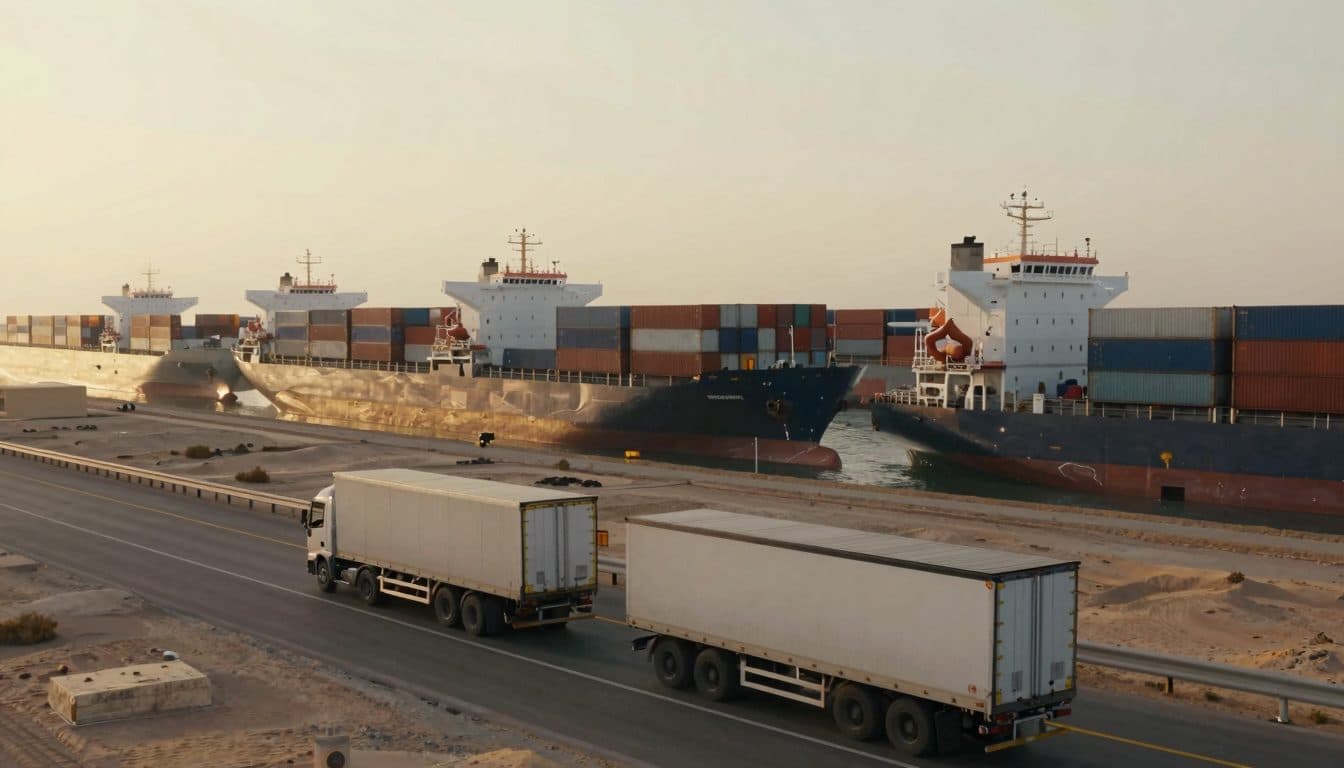
AI-generated image (z-image via Kie.ai)
Summary
Roughly four months after the start of the extensive blockade of the Strait of Hormuz caused by the Iran war, shipping companies and Gulf states are frantically searching for alternatives. Pipelines, trucks, and historic railway lines are meant to replace the blocked sea route – but experts expect it will take months before the ship backlog is cleared.
Dubai, 30 June 2026
For roughly four months, the Iran war has been blocking the Strait of Hormuz, forcing shipping companies and Gulf states to transport oil and goods via pipelines, trucks and, in some cases, revived railway lines to the Mediterranean.
The Strait of Hormuz as the world's trade chokepoint
The strait between Iran and Oman is the only sea route to the Persian Gulf and, as such, the most important access to the global market for several Arab Gulf states. After the renewed mutual attacks between the US and Iran last weekend, Iran has once again closed the Strait of Hormuz. "The extensive blockade has now been going on for around four months," the research states.
The narrow waterway is of enormous importance for global trade: about a quarter of the world's seaborne crude oil transport passes through the Strait of Hormuz, and more than 20 percent of raw material exports overall originate from this region. "The Dutch think tank HCSS speaks of the 'biggest and most complex energy shock in history'," the source reports.
Ship jam and billions in value
The consequences are now visible everywhere. According to estimates from Allianz Commercial, around 1,150 ships are stuck in the strait, with the cumulative value of cargo and ships put at 125 billion euros. Before the crisis, around 140 ships passed through the strait daily; currently, the numbers fluctuate, according to Justus Heinrich, who is responsible for shipping and transport at the insurer Allianz Commercial, between 20 and 50 departing ships per day. He says: "The situation is very dynamic, and not in a positive sense. Shipping cannot rely on absolutely anything. It can only react on a day-to-day basis."
The blockade is increasing pressure on alternative routes. "Part of it can be rerouted via existing pipelines in Saudi Arabia, the Emirates and Iraq – the rest is largely blocked," the analysis states. In May, the shipping company MSC announced new routes, partly served by trucks across the Saudi Arabian desert, in order to manage "the challenging situation in the Middle East." The Danish major shipping company Maersk has also been informing customers for weeks about new "land bridges" to make deliveries to and from Saudi Arabia, Bahrain and Qatar possible.
Pipelines as alternative routes
In Iraq, whose state revenues in normal times come to more than 90 percent from oil exports, unusual paths have long been in use. Hundreds of tank trucks depart daily on the route through Syria toward the Mediterranean. As Nawaf Al Sabah, chairman of Kuwait's state oil company, said most recently in Washington, Kuwait is examining exports via pipelines in the Emirates and Saudi Arabia. In fact, according to the website Tankertrackers.com, Kuwait exported no oil at all in April for the first time since 1991.
The United Arab Emirates, meanwhile, are building another West-East pipeline to the Gulf of Oman, with the goal of putting it into operation as early as next year. The current capacity of 1.8 million barrels per day is to be doubled to 3.6 million. In addition, Saudi Arabia is examining increasing its oil storage capacities worldwide.
Iraq is also trying to increase its export volumes: exports via a pipeline through Kurdish territory into Turkey to the Mediterranean currently amount to around 220,000 barrels (of 159 liters each) per day – the government wants to triple this volume if possible. Another pipeline leads from Iraq also via Turkey, but bypassing the Kurdish-controlled areas. Following a test phase, a further 300,000 barrels per day are to be pumped here for export.
Additionally, Turkey and Saudi Arabia are working together to revive a railway line running through Jordan and Syria, whose origins date back to the Ottoman Empire. Inspiration also comes from the historic Trans-Arabian Pipeline "Tapline," which from 1950 onward pumped oil from eastern Saudi Arabia via Jordan and Syria to the Mediterranean for European customers. "Operations were discontinued in 1990," the source notes – because larger tankers and the reopening of the Suez Canal made the sea route cheaper again.
Rail, trucks and historic routes
But overland pipelines are expensive, often politically difficult to implement across national borders, and plagued by delays. "Even after the framework agreement between the US and Iran, nobody knows when the war will end and the sea route might be navigable normally again," the source writes. A proposal from Dubai to artificially create a maritime connection called the "Road of Unity" through the Emirates from the Persian Gulf to the Gulf of Oman likewise remained a draft – the architecture firm's accompanying text dreams of "greater control, continuity and resilience in trade networks."
An end to the jam is not in sight, according to Heinrich's assessment: "We have to assume that it will take many weeks, if not months, until all the ships currently stuck there have then passed through the strait in good order. This is not an issue that can be resolved within a few days." In addition, ships would partly need maintenance and spare parts before they could set sail. The International Maritime Organization IMO has also suspended plans to evacuate the more than 10,000 stranded seafarers. Heinrich continues: "But de facto the bordering states of Oman and Iran could of course have other objectives."
Germany is simultaneously preparing for a possible mine-clearing operation in the strait and is sending ships to the Red Sea. The Bundestag could decide on a mandate as early as July. The fact that the Strait of Hormuz imports not only energy sources but also kerosene, gasoline, base oils, fertilizers for agriculture and helium for electronics and cooling shows the breadth of the dependency. "After all, more than 20 percent of raw material exports come from this region," the source notes – and global container traffic is currently being "rewritten" by the declining reliability of the sea routes in the region, as Kyle Henderson, who monitors global container traffic, tells the trade magazine "FDI Intelligence."
Overall, it is clear: the Gulf states are responding at full speed, but none of the replacement routes can substitute the capacity of the Strait of Hormuz in the short term. Whether the passage will one day be possible again without restrictions remains, according to Heinrich, "speculation for now."
Questions & Answers
Why is Iran blocking the Strait of Hormuz?
Iran is using the strait as a lever of pressure in its conflict with the US. After renewed mutual attacks last weekend, Iran has again largely closed the passage; an end to the war and a normalization remain unclear even after a framework agreement between the US and Iran.
Which alternatives to the sea route are currently being used or planned?
Alternatives in use include truck transports from Iraq through Syria to the Mediterranean as well as pipeline exports via Turkey; planned or under construction are an additional West-East pipeline from the Emirates, another Iraqi pipeline bypassing Kurdish territory, and the revival of a rail route between Turkey and Saudi Arabia.
How long will it take, according to experts, to clear the ship jam in the strait?
Justus Heinrich of Allianz Commercial expects it to take many weeks, if not months, until all the roughly 1,150 stuck ships have passed through the strait again – also because some ships require maintenance and spare parts beforehand.